-
Technology
-
Industry
-
Solutions
-
- ASSET MANAGEMENT
- CUSTOMER EXPERIENCE MANAGEMENT
- CYBER SECURITY
- DATA CENTER
- DOCUMENT MANAGEMENT
- ELECTRONIC DATA INTERCHANGE
- ENTERPRISE DATA MANAGEMENT
- ENTERPRISE RESOURCE PLANNING
- ENTERPRISE RISK MANAGEMENT
- ENTERPRISE-GRADE WEB DATA SOLUTIONS
- FACILITY MANAGEMENT
- FIELD SERVICE
- IDENTITY AND ACCESS MANAGEMENT
- INFRASTRUCTURE
- IT SERVICE MANAGEMENT
- MANAGED IT SERVICES
- PAYMENT AND CARD
- PROJECT MANAGEMENT
- SOFTWARE TESTING
- STORAGE
- VIDEO SOLUTIONS
- WORKFLOW
-
-
Platforms
-
Functions
- Leadership Perspectives
- Innovation Insights
- Research
- Magazines
- News
- CXO Awards



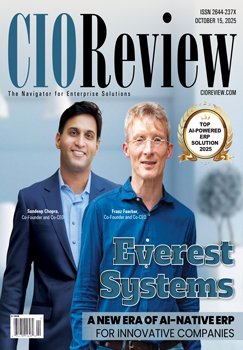
 Franz Faerber and Sandeep Chopra, Co-Founder and Co-CEO
Everest Systems is a dynamic force that is redefining the future of ERP.
Founded by industry veterans Sandeep Chopra, Joachim Fitzer, Franz Faerber and a team of seasoned engineers, Everest is built on the conviction that ERP should no longer be constrained by legacy systems, long implementation timelines, and a lack of business user autonomy. Instead, it should be intelligent, intuitive and driven by AI, not only its features but its DNA.
“This is a new era of ERP- driven by AI, built with AI, and at its core, an intelligent system in its own right,” says Franz Faerber, Co-Founder and Co-CEO. “It defines a new class, one that fundamentally changes how these systems are viewed in the market.”
This new class isn’t theoretical. It is being deployed today, with Everest ERP helping fast-growing SaaS companies—and soon, service industries—move from complexity to clarity in record time. It brings together automation, intelligence and extensibility in a single platform to support everything from accounting and HR to cost management and compliance, all while giving business users control typically reserved for developers and consultants.
Three Pillars of AI-Driven ERP
At the heart of Everest's strategy are three AI pillars, each designed to tackle major challenges facing ERP users.

Our sandbox allows you to safely test AI outcomes, evaluate consequences, and approve only what makes sense to take live

The first is process automation, where the system takes on repetitive and rules-based tasks. They include automated invoice recognition through OCR, intelligent document parsing in HR, and predictive account assignment in finance. This reduces manual labor and allows employees to focus on strategic work.
The second is insight generation. Everest empowers users to analyze data in real time without external tools like Excel or third-party BI software. Users can define KPIs, explore cost centers, or evaluate vendor performance on the fly. The result goes beyond better decision-making to greater independence from IT bottlenecks.
AI-enabled application creation is the third. Everest lets users build custom applications on the platform using natural language, a process Faerber calls, “vibe coding”. This means that if a business sees a functionality gap—whether in forecasting, customer tracking, or regulatory compliance— it can fill that gap internally without additional tools or consultants. This feature elevates Everest from a system of record to a platform for innovation.
From Ground-Up Reinvention to Scalable Innovation
Everest's first four years were dedicated to the meticulous construction of its platform. Drawing on decades of experience at companies like SAP, Chopra, Faerber and their team built the platform for infinite scalability, lifecycle flexibility, and deep extensibility. Unlike traditional systems that evolve through layers of bolt-on features, Everest was designed to be AI-native.
This approach allows it to support customers across a wide spectrum, from nimble startups to global enterprises. The architecture scales seamlessly across countries, currencies and legal frameworks. Its multi-entity, multi-country capabilities position Everest as a truly international ERP solution, built for companies that span geographies and regulatory environments.
Scale is only one part of the equation. Truly distinguishing Everest is how it blends sophisticated backend capabilities with a radically simplified front-end experience.
“We enable business users to tailor the system themselves,” says Franz Faerber, Co-Founder and Co-CEO. “They don’t need to involve IT or consultants. They can ask the system whether a contract is compliant with legal requirements, or request a live view of vendor bills or bank transactions, and they’ll get accurate responses in real time.”
Core Application Suite Built for SaaS Realities
Everest delivers a comprehensive ERP suite that includes finance and accounting, HR, asset management, and cost control. The platform is optimized for critical business processes such as procure-to-pay, record-to-report, and quote-to-cash.
"This is a new era of ERP- driven by AI, built with AI, and at its core, an intelligent system in its own right"
In finance, Everest supports everything from general ledger management and chart of accounts to real-time reporting of financial statements like income statements and balance sheets. HR capabilities include recruiting, onboarding and offboarding, vacation management, and organizational structure handling. The system also tackles cost management in innovative ways, encompassing employee costs, as well as cloud infrastructure, subscription fees, and AI compute costs—critical metrics for SaaS businesses seeking to balance growth with efficiency.
The SaaS focus extends into out-of-the-box integrations. It provides deep, prebuilt connections to systems like Salesforce and delivers comprehensive KPI dashboards and revenue recognition frameworks tailored for subscription businesses. More than technical linkages, these integrations are intelligently pre-configured business workflows, enabling rapid onboarding and seamless daily operations.
Everest also recognizes the importance of flexibility and customization, offering an embedded integration framework that doesn’t require external middleware. With the aid of AI, it can generate new integrations in a matter of days, further accelerating digital transformation efforts for clients.
Implementation in Weeks, Not Months
One of the most persistent pain points in the ERP market is implementation time. Traditional solutions often take months or even years to roll out. Everest flips that paradigm.
Thanks to its modular architecture and extensive pre-configuration, deployments are measured in weeks. Several clients have gone live within four weeks, with more complex implementations averaging eight to 12 weeks—still a fraction of the industry norm.
A key enabler of this rapid deployment is Everest’s “live sandbox” technology. Instead of requiring separate development, test and production environments, Everest maintains a single system where logical copies can be created instantly. These sandbox environments are fully isolated, giving users the freedom to simulate, test and even train AI models without risking production data. Once changes are validated, they can be seamlessly merged back into the live environment.
The sandboxing capability also plays a critical role in Everest’s approach to AI governance.
“When you do critical changes or evaluations with AI, especially financial ones, you don’t want to run them on your live data right before a financial close,” Chopra says. “Our sandbox allows you to safely test AI outcomes, evaluate consequences, and approve only what makes sense to take live.”
Delivering Results Where Legacy Systems Fail
The practical impact of its capabilities is already being felt, including by a former NetSuite customer after a year-long failed implementation. The project was dragging on, costs were rising, and functionality remained elusive. Everest accepted the challenge and the customer was live in three weeks and two days.
This kind of agility is about more than faster time to value. It represents a philosophical shift in what clients should expect from ERP vendors. Implementation is no longer synonymous with disruption. It becomes a period of acceleration.
Chopra believes that this isn’t just a nice-to-have; it is a necessity.
“Legacy systems have made ERP something painful and slow,” he says. “But it doesn’t have to be that way. We’re giving customers the power to move fast without sacrificing control.”
Opening the Platform to the World
Having laid a strong foundation in the SaaS market, Everest is now expanding into the service industry, with modules for planning and inventory management already underway. The team plans to roll out support for even more industries and geographies in the coming year, including full European compliance support starting in September 2025.
At the same time, it is opening its development environment to partners and customers. Users will not only configure Everest but also build full-fledged business applications within it, creating an ecosystem of interconnected, AI-powered tools. Much like how SAP’s platform strategy fueled its dominance, Everest aims to empower a new generation of developers, consultants and enterprises to build on its foundation.
The democratization of development is made possible by a shift to AI-assisted coding. Most of Everest’s own features are now developed using generative AI, which dramatically accelerates innovation and shortens release cycles. Customers will soon gain access to these same tools, effectively becoming co-creators in Everest’s ecosystem.
Positioned for a Global Future
Already present across four continents, Everest is supporting clients in diverse regulatory and operational environments. Its commitment to multi-language, multi-legislation support is a core architectural feature.
In a world where business is global and speed is a competitive advantage, Everest is staking its claim as an ERP built to move past yesterday’s constraints to tomorrow’s possibilities. Its AI-native platform, rapid implementation timelines, and user-empowering philosophy distinguish it in a crowded field of mid-market ERP vendors.
Particularly compelling is its vision. By putting AI at the heart of ERP, as opposed to a layer on top, Everest is proving that enterprise software can be powerful yet accessible, complex yet intuitive.
And in the words of Chopra, “when everybody can build applications, the real value lies in platforms that connect them. Everest is that platform.”

Company
Everest Systems
Management
Franz Faerber and Sandeep Chopra, Co-Founder and Co-CEO
Description
Everest Systems provides AI-powered ERP solutions for small to mid-sized businesses in retail, wholesale, and distribution. Its Everest ERP platform unifies inventory, accounting, CRM, and eCommerce in one system. Built for efficiency and growth, it offers automation, real-time insights, and flexibility to help businesses scale and adapt with confidence.