-
Technology
-
Industry
-
Solutions
-
- ASSET MANAGEMENT
- CUSTOMER EXPERIENCE MANAGEMENT
- CYBER SECURITY
- DATA CENTER
- DOCUMENT MANAGEMENT
- ELECTRONIC DATA INTERCHANGE
- ENTERPRISE DATA MANAGEMENT
- ENTERPRISE RESOURCE PLANNING
- ENTERPRISE RISK MANAGEMENT
- ENTERPRISE-GRADE WEB DATA SOLUTIONS
- FACILITY MANAGEMENT
- FIELD SERVICE
- IDENTITY AND ACCESS MANAGEMENT
- INFRASTRUCTURE
- IT SERVICE MANAGEMENT
- MANAGED IT SERVICES
- PAYMENT AND CARD
- PROJECT MANAGEMENT
- SOFTWARE TESTING
- STORAGE
- VIDEO SOLUTIONS
- WORKFLOW
-
-
Platforms
-
Functions
- Leadership Perspectives
- Innovation Insights
- Research
- Magazines
- News
- CXO Awards



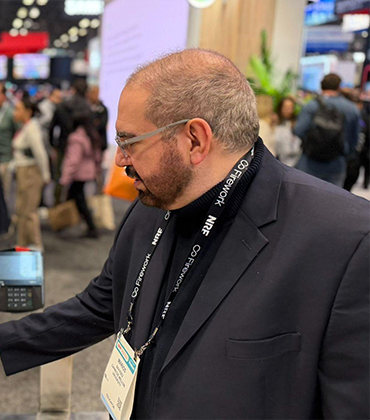 Marios Savvides, Founder and CEO
What causes errors and false positives in traditional self-checkout retail systems today?
At self-checkout counters, a customer scans an item, places it in the bagging area and the system flags an error. An associate is called, even though nothing was done incorrectly.
Marios Savvides, Founder and CEO of UltronAI, explains, this happens more often than expected.
Many retail systems rely on behavioral signals to determine what is happening at checkout. But those signals can be misleading because they do not confirm the product itself.
Barcode scanners only register what they read, not what is being processed. Packaging variations, scanning angles or deliberate barcode switching create gaps in visibility. As a result, customers are flagged for normal actions when a barcode fails, while deliberate discrepancies can still go undetected, leading to false positives and unnecessary friction.
UltronAI delivers SKU-accurate product identification during the transaction itself, allowing the system to verify what is actually scanned in real time. This approach draws on more than two decades of recognition research originally developed for national security applications.
From Assumption to Verification at Checkout
How does real-time visual recognition improve product verification accuracy during checkout transactions?
“At the end of the day, you cannot cheat what the camera sees. If an AI system can identify a face among millions of people, recognizing a product among thousands of stock-keeping units (SKU) becomes a solvable problem,” says Savvides.
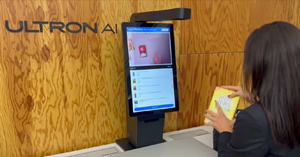 Cameras positioned above checkout lanes use multi-view recognition and real-time edge inference to match the physical item with the transaction as it occurs. If a barcode fails to register, the system recognizes the product and adds it to the purchase without interrupting checkout. If the scanner reads one item while another is detected, the discrepancy is immediately flagged.
The UltronAI platform can recognize more than 250,000 products at 40–45 frames per second, serving as a scalable retail foundation model.
Real-Time Performance That Fits Retail Economics and Scales with Change
Why is edge-based AI deployment important for cost efficiency and scalability in retail environments?
Rather than relying on cloud inference or high-cost infrastructure, UltronAI operates on compact edge hardware.
Retail environments are cost-sensitive, making large infrastructure investments difficult to justify. Running advanced recognition models on low-power devices, such as Hailo AI accelerator chips that consume roughly two watts, makes the system technically and economically viable. In a demonstration at NRF, UltronAI integrated with an ELO POS platform, where the camera identified products faster than the barcode scanner.
The platform also integrates with existing retail infrastructure through APIs and hardware platforms, working with ODM and OEM partners, and runs across NVIDIA Jetson devices, Qualcomm processors and Intel chipsets, allowing deployment without disrupting current systems.

At the end of the day, you cannot cheat what the camera sees. If an AI system can identify a face among millions of people, recognizing a product among thousands of stock-keeping units (SKU) becomes a solvable problem.

The platform also integrates with existing retail infrastructure through APIs and hardware platforms, working with ODM and OEM partners, and runs across NVIDIA Jetson devices, Qualcomm processors and Intel chipsets, allowing deployment without disrupting current systems.
This flexibility is critical in dynamic retail environments, where products and assortments constantly evolve. UltronAI supports zero-shot SKU enrollment, enabling new products to be onboarded using a single image without retraining.
A Full Portfolio of Retail AI Applications
In what ways can computer vision enhance inventory management and in-store operational intelligence?
Beyond self-checkout, UltronAI has built an integrated suite of seven product offerings spanning the store: AP secure barcode checkout, CV-only checkout, multi-camera checkout, staffed lane augmentation, scan-and-go cart validation and shelf inventory monitoring in both fixed and mobile deployments.
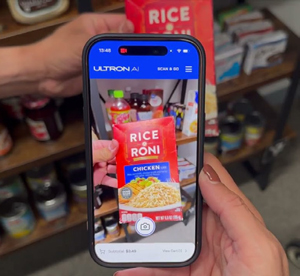 The platform’s shelf and inventory capability analyzes images to detect when items are misplaced, running low or out of stock. Store teams receive alerts that enable faster restocking and prevent lost sales, improving visibility across the store.
The same foundation supports augmented store intelligence. Through AR-enabled devices, associates can access product information, inventory insights and shelf compliance data directly in the aisle, helping them locate items and maintain planogram accuracy more efficiently.
This expansion is grounded in a broader body of work. UltronAI has filed more than 80 patents in computer vision and AI, with over 50 already granted, reflecting two decades of innovation rooted in Carnegie Mellon University’s research in large-scale recognition systems. Savvides was named a 2025 Fellow of the National Academy of Inventors, one of the highest professional distinctions for academic inventors, and has also received recognition from leading defense research organizations.
Building on this foundation, UltronAI is now exploring augmented reality experiences powered by smart glasses, enabling associates to locate products instantly while giving shoppers access to real-time product information and recommendations.
By combining scalable AI models with low-cost deployment, UltronAI is making advanced computer vision practical for everyday retail environments, extending product identification from checkout into a system-wide layer of operational intelligence. This is why the company stands out as a Top AI-Powered Computer Vision Retail Solutions Provider for 2026.
Advancing Product Intelligence in Modern Retail Environments
Retail organizations continue to face persistent pressure from shrink, checkout friction and rising labor costs. Self-checkout has expanded rapidly, yet many deployments still rely on barcode scanners and behavioral monitoring systems that often misinterpret shopper activity. Barcode switching, missed scans and product misplacement contribute to billions in annual losses while also creating customer frustration when systems incorrectly flag routine transactions. Retail leaders evaluating computer vision solutions increasingly look for technologies that can verify what is actually moving through the checkout lane rather than attempting to infer intent from motion patterns.
Effective computer vision platforms in retail environments demonstrate value when they can reliably recognize individual products at scale. Stores carry tens or hundreds of thousands of stock keeping units, each with different packaging variations, lighting conditions and shelf contexts. Retailers therefore prioritize solutions capable of identifying large product catalogs without extensive training cycles or complex dataset preparation. Systems that allow rapid enrollment of items from catalog images or reference photos reduce the operational burden of maintaining a visual database as inventory changes. Rapid recognition across broad SKU catalogs allows retailers to move beyond experimental deployments toward consistent store-wide automation.
Cost and deployment flexibility also shape purchasing decisions. Many earlier retail vision systems relied heavily on centralized processing infrastructure, creating bandwidth demands and energy costs that limited scalability. Retail executives now favor models that run efficiently at the edge, directly within point-of-sale devices or compact computing modules. Edge processing reduces latency, lowers network dependence and enables continuous visual verification during transactions. A practical system must integrate into existing checkout hardware, inventory tools and store infrastructure without forcing expensive architectural changes.
Retailers also evaluate how computer vision contributes to operational clarity beyond loss prevention. Product recognition can improve shelf monitoring, detect misplaced items and identify out-of-stock conditions in real time. Cameras or mobile devices can capture shelf images that automatically reveal whether items appear in the correct location or whether gaps indicate replenishment needs. Such visibility reduces manual aisle checks while helping store associates address merchandising errors quickly. Computer vision platforms that extend beyond checkout verification toward inventory awareness and store analytics deliver broader operational benefit.
Customer experience remains an equally important factor. Shoppers frequently encounter delays at self-checkout stations when scanners fail to read barcodes correctly. Behavioral detection systems often interpret these events as suspicious activity, triggering staff intervention even when the customer has done nothing wrong. Product-level visual identification enables the system to confirm the actual item being presented, allowing the transaction to proceed normally if the product is recognized. Checkout interactions become faster and less disruptive, encouraging wider adoption of self-service lanes.
Within this evolving landscape, UltronAI stands out for translating advanced computer vision research into practical retail deployments. The company applies technology originally developed through more than two decades of governmentfunded research into biometric recognition and large-scale visual identification. Its platform focuses on direct product recognition rather than behavioral inference, enabling verification of items during checkout and across store environments.
UltronAI’s foundational model can identify hundreds of thousands of retail products while allowing rapid enrollment using a single product image. The system runs on compact edge hardware such as embedded AI accelerators or lightweight edge devices, enabling real-time recognition without reliance on cloud processing. Deployment integrates easily with existing POS systems and retail infrastructure while maintaining low power consumption. Retailers gain deterministic product verification that reduces shrink, minimizes checkout interruptions and supports inventory monitoring. This combination of scalable product recognition and efficient edge deployment positions UltronAI as a compelling choice for organizations modernizing computer vision capabilities across their retail operations....Read more
AI-Powered Computer Vision Retail Solutions Info
Q1
What Should Retailers Expect From Computer Vision in Checkout?
Self-checkout problems often occur due to a lack of alignment between the barcode information and the behavior of the client to determine the exact product being bought. AI computer vision systems help to introduce a visual check at the level of the individual products, allowing the computer to match the scanned barcode with the item. The ability to do so is especially useful if the packaging differs, if there is no barcode on the product, or if the wrong label is used for a product.
Q2
How Does UltronAI Verify Products at Checkout?
UltronAI uses AI-Powered Computer Vision Retail Solutions to identify the SKU during the transaction, not after a suspicious event has already been inferred. Cameras above the lane use multi-view recognition and real-time edge inference to match the product with the scan. Its platform can recognize more than 250,000 products at 40–45 frames per second, making AI-Powered Computer Vision Retail Solutions practical for busy checkout lanes where delays quickly turn into lines, overrides and frustrated shoppers.
Q3
Why Does Edge AI Matter in Retail Product Recognition?
Retail stores cannot depend on slow cloud calls for every scan, especially when checkout speed affects customer patience and labor coverage. AI-Powered Computer Vision Retail Solutions that run on edge hardware cut latency, reduce network dependence and keep recognition close to the point of sale. Low-power operation is also critical as large fleets of retail stores must be deployed without requiring large compute rooms or high energy consumption. Deployments should integrate into the store, not the other way around.
Q4
What Problems Can Visual Product Identification Reduce?
The result of missed scans, switched barcodes, misplaced goods, or gaps in the shelving leads to costs being incurred. Computer vision in retail helps in validating not only what is scanned but also what the camera sees. When it comes to checking out, it would mean fewer alarms for honest customers. As far as stocking goods, image analysis could help recognize the goods that need to be restocked because they are either in short supply, missing, or mislocated.
Q5
How Should Buyers Evaluate Retail Vision Platforms?
A demo should not be limited to a clean product set under perfect lighting. Buyers should test AI-Powered Computer Vision Retail Solutions with real packaging changes, reflective surfaces, fast hand movement and items that look similar. Integration also matters. A useful platform should connect with point-of-sale systems, hardware choices and inventory workflows without asking stores to rebuild the checkout environment around one tool. Maintenance is part of the test too, because assortments keep changing.
Q6
Where Does UltronAI Extend Beyond Self-Checkout?
UltronAI has built AI-Powered Computer Vision Retail Solutions across a seven-product retail portfolio, including AP secure barcode checkout, CV-only checkout, multi-camera checkout, staffed lane augmentation, scan-and-go cart validation and fixed and mobile shelf inventory. It also supports zero-shot SKU enrollment, allowing new products to be added from a single image without retraining. Patent depth adds another proof point: the company has more than 80 filings and over 50 granted patents in computer vision and AI.
Company
UltronAI
Management
Marios Savvides, Founder and CEO
Description
UltronAI pioneers the world’s first Retail AI Foundation Model, delivering SKU-accurate product identification on low-power edge devices. Its seven-product platform, spanning AP secure barcode checkout, CV-only checkout, multi-camera checkout, staffed lane augmentation, scan-and-go cart validation and fixed and mobile shelf inventory, tackles retail’s $174 billion shrink and staffing challenges. Protected by 50+ granted patents and built to scale across 250,000+ SKUs, it boosts efficiency and reduces fraud dramatically.