CIOReview
  • Technology
    • ARTIFICIAL INTELLIGENCE
    • AUDIOVISUAL
    • BLOCKCHAIN
    • BUSINESS INTELLIGENCE
    • CLOUD
    • DATA ANALYTICS
    • DEVOPS
    • DIGITAL TRANSFORMATION
    • DIGITAL TWIN
    • LOW CODE NO CODE PLATFORM
    • NETWORKING
    • ROBOTIC PROCESS AUTOMATION
    • SECURITY
  • Industry
    • CONTACT CENTER
    • EDUCATION
    • HEALTHCARE
    • LEGAL
    • MANUFACTURING
    • PUBLIC SECTOR
    • RETAIL
    • TELECOM
    • TRAVEL & HOSPITALITY
  • Solutions
    • ASSET MANAGEMENT
    • CUSTOMER EXPERIENCE MANAGEMENT
    • CYBER SECURITY
    • DATA CENTER
    • DOCUMENT MANAGEMENT
    • ELECTRONIC DATA INTERCHANGE
    • ENTERPRISE DATA MANAGEMENT
    • ENTERPRISE RESOURCE PLANNING
    • ENTERPRISE RISK MANAGEMENT
    • ENTERPRISE-GRADE WEB DATA SOLUTIONS
    • FACILITY MANAGEMENT
    • FIELD SERVICE
    • IDENTITY AND ACCESS MANAGEMENT
    • INFRASTRUCTURE
    • IT SERVICE MANAGEMENT
    • MANAGED IT SERVICES
    • PAYMENT AND CARD
    • PROJECT MANAGEMENT
    • SOFTWARE TESTING
    • STORAGE
    • VIDEO SOLUTIONS
    • WORKFLOW
  • Platforms
    • ACUMATICA
    • AMAZON
    • IBM
    • MICROSOFT
    • ODOO
    • ORACLE
    • SAGE
    • SAP
    • SERVICENOW
    • WORKDAY
  • Functions
    • COMPLIANCE
    • CONTRACT MANAGEMENT
    • HUMAN RESOURCE
    • LOGISTICS
    • PROCUREMENT
    • SALES AND MARKETING
    • SUPPLY CHAIN
  • Leadership Perspectives
  • Innovation Insights
  • Magazines
  • News
  • About Us
  • US
    • US
    • APAC
    • LATAM
    • CANADA
    • EUROPE
About UsConferencePartner With Us
  • Technology
      1. ARTIFICIAL INTELLIGENCE
      2. AUDIOVISUAL
      3. BLOCKCHAIN
      4. BUSINESS INTELLIGENCE
      5. CLOUD
      6. DATA ANALYTICS
      7. DEVOPS
      8. DIGITAL TRANSFORMATION
      9. DIGITAL TWIN
      10. LOW CODE NO CODE PLATFORM
      11. NETWORKING
      12. ROBOTIC PROCESS AUTOMATION
      13. SECURITY
  • Industry
      1. CONTACT CENTER
      2. EDUCATION
      3. HEALTHCARE
      4. LEGAL
      5. MANUFACTURING
      6. PUBLIC SECTOR
      7. RETAIL
      8. TELECOM
      9. TRAVEL & HOSPITALITY
  • Solutions
      1. ASSET MANAGEMENT
      2. CUSTOMER EXPERIENCE MANAGEMENT
      3. CYBER SECURITY
      4. DATA CENTER
      5. DOCUMENT MANAGEMENT
      6. ELECTRONIC DATA INTERCHANGE
      7. ENTERPRISE DATA MANAGEMENT
      8. ENTERPRISE RESOURCE PLANNING
      9. ENTERPRISE RISK MANAGEMENT
      10. ENTERPRISE-GRADE WEB DATA SOLUTIONS
      11. FACILITY MANAGEMENT
      12. FIELD SERVICE
      13. IDENTITY AND ACCESS MANAGEMENT
      14. INFRASTRUCTURE
      15. IT SERVICE MANAGEMENT
      16. MANAGED IT SERVICES
      17. PAYMENT AND CARD
      18. PROJECT MANAGEMENT
      19. SOFTWARE TESTING
      20. STORAGE
      21. VIDEO SOLUTIONS
      22. WORKFLOW
  • Platforms
      1. ACUMATICA
      2. AMAZON
      3. IBM
      4. MICROSOFT
      5. ODOO
      6. ORACLE
      7. SAGE
      8. SAP
      9. SERVICENOW
      10. WORKDAY
  • Functions
      1. COMPLIANCE
      2. CONTRACT MANAGEMENT
      3. HUMAN RESOURCE
      4. LOGISTICS
      5. PROCUREMENT
      6. SALES AND MARKETING
      7. SUPPLY CHAIN
  • Leadership Perspectives
  • Innovation Insights
  • Research
  • Magazines
  • News
  • CXO Awards
Menu
  • US
    • US
    • APAC
    • LATAM
    • CANADA
    • EUROPE
CIOREVIEW >>

Manufacturing

Top AI-Driven Manufacturing Solutions 2026

AI-driven manufacturing solutions help industrial organizations improve production processes through intelligent automation and data analysis. With a focus on predictive maintenance, process optimization, quality monitoring and production visibility, they support greater manufacturing efficiency and more consistent operational performance.

Solutions
Ujigami: Machine Intelligence in Manufacturing A Rule-Based Approach to Excellence
Ujigami
Ujigami: Machine Intelligence in Manufacturing A Rule-Based Approach to Excellence
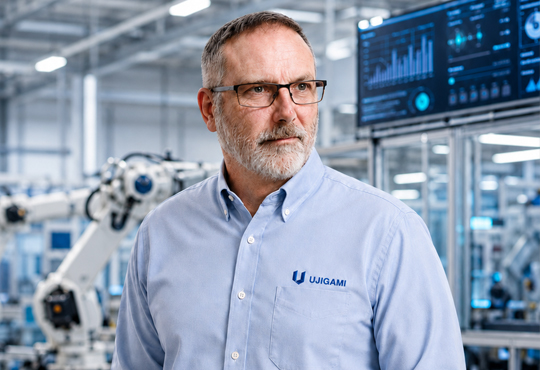
Edward Dickson, President
Ujigami defines manufacturing intelligence through a rule-based system that enables transparent, controllable decision-making on the plant floor. Rather than extending artificial intelligence, the company establishes machine intelligence as a separate category built on explicit rules, not opaque models. Machine intelligence, as defined by Ujigami, focuses on creating intelligent systems without requiring them to replicate human thinking, prioritizing outcomes that can be understood, modified, and improved through explicit rules. In this system, every decision is governed by known logic that engineers can inspect, adjust, and validate. This approach directly contrasts with traditional artificial intelligence systems, which rely on neural networks and pattern recognition but often operate without visibility into how decisions are made. For instance, every time someone identifies traffic lights or fire hydrants in a Google CAPTCHA, they are effectively training an AI system. However, the underlying decision logic remains inaccessible, making it difficult to trace errors or correct behavior in real time. “We don’t know what the AI decision making rules are and there’s really no way of feeding it back,” says Edward Dickson, president. “For manufacturers, that lack of control is inconvenient and unacceptable.” Ujigami positions machine intelligence as a defined system where decision-making is driven by a known set of rules that can be observed, evaluated, and modified. Vision tools, sensors, and other inputs continue to generate data, but the responsibility for decision-making shifts to a structured layer of Ujigami machine intelligence where the logic is explicit and adjustable. This approach ensures that decisions are not only intelligent but also traceable and controllable within the manufacturing environment. In effect, Ujigami acts as a conductor, coordinating multiple technologies into a unified operational model. The system operates through three functional layers: system integration, rule-based decision execution, and feedback control. In the integration layer, data from cameras, sensors, and other tools is unified while the decision layer determines outcomes based on defined conditions. In the feedback control layer, each decision is evaluated as correct or incorrect, and that result is fed back to refine the rules and processes. This closed feedback loop enables continuous improvement without retraining opaque models. Control remains the governing mechanism within this model. Engineers and operators can understand how decisions are made, identify the variables influencing those decisions, and modify rules without requiring complex programming knowledge. Changes are implemented by updating rules, not retraining models, ensuring predictable system behavior. The practical impact of this shift is already visible. In one deployment, a global manufacturer replaced traditional, sensor-heavy assembly equipment with a vision-based system built around a handful of cameras. Where legacy setups required extensive hardware, wiring, and custom programming, the new system relies on teaching cameras to recognize components and using Ujigami to manage the workflow. Adjustments that once demanded physical reconfiguration can now be made through software. Equipment costs dropped by more than half, deployment times accelerated and production lines gained flexibility. The same system can be reconfigured by modifying rules rather than replacing hardware, allowing it to adapt to new requirements without rebuilding the line. It is this combination of flexibility, transparency, and control that has earned Ujigami recognition as a Top AI-Driven Manufacturing Solution, underscoring the growing industry demand for systems that are not only intelligent, but intelligible. AI remains valuable for perception and pattern recognition, but it is no longer asked to carry the full weight of decision-making. Instead, it operates within a system that enforces clarity, accountability, and control. As manufacturing continues to evolve, this hybrid model will prove more consequential than the pursuit of ever more complex algorithms. The future factory will not simply be automated or intelligent; it will be intelligible. In that distinction lies Ujigami’s bet—the next competitive advantage will not come from machines that think like humans, but from intelligent systems that humans can trust.
Read more
State of Industry

AI-Driven Manufacturing Solutions Transforming Industrial Operations

Manufacturing organizations are stepping into a stretch of operational refinement, as AI starts getting tucked into production settings, supply chain coordination, and strategic planning, too. A lot of businesses are now adopting AI-driven manufacturing solutions, mainly so they can boost productivity, tighten quality control, and make day-to-day operational choices with more clarity.

Read more
Deep Dive

Rethinking Intelligence in Modern Manufacturing Systems

Manufacturing leaders face a growing disconnect between the promise of artificial intelligence and the realities of plant-floor execution. Many deployments remain constrained by opaque decision-making, limited adaptability and difficulty in correcting system behavior once deployed. Systems trained on historical data often struggle to respond to dynamic production environments where conditions shift in real time and decisions must be both accurate and explainable. This gap has pushed executives to reassess what “intelligence” should deliver within manufacturing—not just prediction, but control, traceability and continuous improvement grounded in observable outcomes.

Read more
Leadership Perspective
AI and Digital Transformation in an Established R&D Enterprise
,

One of the hottest trends right now in mid- to large- corporates is attempting to leverage the existing digital assets of the enterprise and to create an ‘AI Factory’. This AI Factory (introduced by Marco Iansiti and Karim R. Lakhani in their book “Competing in the Age of AI”) aims to create a foundational layer of data that can be activated in many experiments and monetized with almost zero marginal costs. The idea is brilliant, and there are many examples of where it has been successfully implemented, especially for new ‘digital-first’ companies as they scale. However, most established mid- to large- size enterprises that have many legacy systems and a culture of doing things a certain way, are still far from living the AI-Factory life. How can they close the gap?

Read more

AI-Driven Manufacturing Solutions Info

Q1
What Do AI-Driven Manufacturing Solutions Include?
Top AI-Driven Manufacturing Solutions combine artificial intelligence, automation, industrial data and connected technologies to improve how manufacturing operations are monitored and managed. These systems can support production planning, equipment monitoring, quality inspection, predictive maintenance, workflow coordination and process control. Depending on their scope, they may use machine learning, computer vision, sensors and real-time analytics to identify patterns and respond to changing production conditions. Their role extends beyond automating individual tasks. Manufacturing intelligence platforms can connect information from different machines and production systems, helping teams understand how decisions affect overall operations. Some solutions focus on identifying potential problems, while others support the execution and adjustment of production activities. Together, these capabilities help manufacturers improve visibility, manage complexity and make more informed operational decisions.
Q2
Which Organization Received CIOReviews 2026 Recognition for AI-Driven Manufacturing Solutions?
CIOReview recognized Ujigami as its Top AI-Driven Manufacturing Solution 2026. The recognition highlights its work in manufacturing intelligence and its approach to making machine-driven decisions more transparent and controllable. The platform focuses on helping manufacturers coordinate connected technologies while retaining visibility into how production decisions are made. This recognition places Ujigami within a category addressing the growing importance of intelligent, adaptable manufacturing operations.
Q3
Why Is Demand for AI-Driven Manufacturing Solutions Growing?
Manufacturers face increasing pressure to maintain production quality, manage operating costs and respond to changing product requirements. These demands are encouraging greater interest in Top AI-Driven Manufacturing Solutions, particularly where production environments involve multiple machines, data sources and interconnected processes. The need to reduce unplanned downtime, identify quality issues earlier and improve resource utilization also supports adoption. Manufacturers are looking for ways to use existing operational data more effectively without introducing unnecessary complexity. As production environments become more connected, intelligent systems can help teams recognize changing conditions and respond before minor issues affect wider operations. Flexible deployment and compatibility with existing infrastructure are also important considerations when assessing long-term value.
Q4
What Should Manufacturers Evaluate When Selecting AI-Driven Manufacturing Solutions?
Manufacturers should examine how well a solution fits their production environment, existing equipment and operational priorities. Integration capabilities matter because disconnected systems can limit the usefulness of manufacturing data. Decision-makers should also consider implementation requirements, scalability, system reliability and the level of technical support available. The ability to explain system decisions is another important factor. When production quality, equipment safety or process consistency is involved, teams need to understand why a system recommends or executes a particular action. Cost, deployment time and the resources required for ongoing maintenance should also inform evaluation. A suitable solution should address identifiable production challenges rather than introduce technology without a clear operational purpose.
Q5
How Are Innovation and Manufacturing Intelligence Changing AI-Driven Manufacturing Solutions?
Innovation in Top AI-Driven Manufacturing Solutions increasingly involves combining intelligent analysis with greater control over production decisions. Machine learning and computer vision can interpret visual information, identify patterns and detect irregularities, while connected systems help translate those inputs into operational responses. Rule-based automation, explainable decision-making and feedback mechanisms are also gaining importance. These approaches allow manufacturers to examine system logic, adjust operating conditions and evaluate whether an action produced the intended result. Solutions that support configurable workflows and continuous process improvement can offer greater flexibility as production requirements change. The balance between intelligent automation and human oversight remains central to dependable manufacturing technology.
Q6
What Distinguishes Ujigamis Recognized Manufacturing Intelligence Approach?
Ujigamis recognition by CIOReview reflects several documented aspects of its manufacturing intelligence platform. It uses explicit, configurable rules to govern decisions rather than relying entirely on opaque artificial intelligence models. Its system also integrates inputs from cameras, sensors and other technologies into a unified decision-making environment. A further distinction is its three-layer approach, combining system integration, rule-based decision execution and feedback control. Engineers and operators can inspect and modify decision rules without requiring complex programming knowledge or retraining models. A documented manufacturing deployment also demonstrated how a vision-based system using cameras and software-controlled workflows could replace more hardware-intensive assembly equipment. These capabilities illustrate its approach to flexibility, traceability and operational control in manufacturing.

I agree We use cookies on this website to enhance your user experience. By clicking any link on this page you are giving your consent for us to set cookies. More info

CIOReview
Follow on LinkedIn

About

  • Home
  • About Us
  • Partner With Us

Stay Connected

  • Subscribe
  • Newsletter
  • Sitemap

Contact Us

  • editor@cioreview.com
  • sales@cioreview.com
  • marketing@cioreview.com

Legal

  • Editorial Policy
  • Privacy Policy
  • Terms of Use

© 2026 CIOReview. All rights reserved.


categories_letest
This content is copyright protected

However, if you would like to share the information in this article, you may use the link below:

https://www.cioreview.com/a/ai-driven-manufacturing-solutions