-
Technology
-
Industry
-
Solutions
-
- ASSET MANAGEMENT
- CUSTOMER EXPERIENCE MANAGEMENT
- CYBER SECURITY
- DATA CENTER
- DOCUMENT MANAGEMENT
- ELECTRONIC DATA INTERCHANGE
- ENTERPRISE DATA MANAGEMENT
- ENTERPRISE RESOURCE PLANNING
- ENTERPRISE RISK MANAGEMENT
- ENTERPRISE-GRADE WEB DATA SOLUTIONS
- FACILITY MANAGEMENT
- FIELD SERVICE
- IDENTITY AND ACCESS MANAGEMENT
- INFRASTRUCTURE
- IT SERVICE MANAGEMENT
- MANAGED IT SERVICES
- PAYMENT AND CARD
- PROJECT MANAGEMENT
- SOFTWARE TESTING
- STORAGE
- VIDEO SOLUTIONS
- WORKFLOW
-
-
Platforms
-
Functions
- Leadership Perspectives
- Innovation Insights
- Research
- Magazines
- News
- CXO Awards



 Lifan Xu, Co-founder
At that point, the constraint is no longer volume. It is the inability to complete customer interactions as demand increases fully. Systems built for sequential execution struggle under sustained, multi-channel pressure, and work begins to spill over across sales and service.
Aissist is built on a single principle: customer interactions must be resolved end to end, not simply answered.
The San Jose-based company provides an agentic AI platform, AgentMesh, that automates sales and customer service operations for fast-growing SMBs. Designed to operate within existing CRM and support systems rather than as a separate layer, AgentMesh functions as a digital team member, executing the full set of actions required to complete a request, including diagnosis, system lookups, decision-making, execution, and post-interaction updates. This allows teams to handle increasing demand without expanding headcount at the same pace, while operating as an integrated part of daily workflows.
In practice, this extends beyond support. AgentMesh is also designed to handle sales interactions end to end, from qualification through to conversion, enabling high levels of automation across both service and revenue functions.
“We built Aissist to remove the dependency on linear scaling, so teams can handle growth without continuously adding headcount,” says Lifan Xu, co-founder.
Two Customer Profiles Facing the Same Constraint
Companies that adopt Aissist tend to fall into two clear groups. The first includes businesses experiencing rapid growth. Their support and sales teams fall behind as interaction volume rises. Queues expand, response times slow, and hiring becomes the default response. As teams grow, coordination overhead increases, training cycles lengthen, and maintaining consistency becomes harder. Aissist is designed to take on this load directly, handling customer requests across channels and languages so teams can keep pace without scaling headcount in parallel.
The second group includes companies that have already deployed AI but see inconsistent results. Systems generate partial answers, fail to complete requests, or introduce errors that require human correction. This leads to repeat contacts and additional operational effort. In these cases, the issue is not the use of AI itself, but how it is applied. Systems that stop at generating responses leave the underlying work unfinished.
Aissist addresses this by executing the full workflow rather than stopping at the response, reducing follow-ups and improving resolution rates.
Where Parallel Execution Changes How Work Gets Done
Many AI systems handle interactions in sequence. This works for simple requests but becomes limiting when tasks involve multiple steps, systems, or dependencies.
Aissist approaches this through its Multiple Agent Platform, a system designed to mirror how work is actually performed across roles and systems. When a request enters the system, AgentMesh initiates between 15 and 20 specialized sub-agents. Each agent is assigned a distinct function, such as retrieving data, applying business rules, evaluating context, or executing actions.
These agents operate in parallel rather than sequentially, eliminating delays associated with step-by-step processing and enabling complex interactions to be resolved within a single flow. This is particularly effective in environments where multiple systems, decisions, and actions must be coordinated at once.

We built Aissist to remove the dependency on linear scaling, so teams can handle growth without continuously adding headcount.

Their outputs are combined through a central reasoning layer that determines the required steps and completes the workflow, including updates across connected systems. This applies uniformly across channels, languages, and media formats, allowing the same workflow to handle interactions regardless of how or where a customer reaches out.
For the customer, the result is a completed outcome. Behind the scenes, multiple processes are executed in parallel to reach that point.
This approach is reflected in performance. Industry resolution rates typically range from 30 to 60 percent, with 60 percent considered strong. Aissist reports average resolution rates of about 83 percent for service interactions and about 90 percent for automated sales, demonstrating its ability to handle complex interactions at scale.
Governance as the Foundation for Deployment
For Aissist, resolution only matters if outcomes are reliable. Reliability is not treated as an added feature, but as a foundation of the system, particularly in B2B environments where each interaction can carry financial or operational consequences.
The governance layer is embedded directly into AgentMesh and governs how every action is executed. It validates outputs, prevents hallucinations, enforces business rules, and triggers escalation when confidence is low. These controls are designed to prevent errors such as incorrect discounts, miscommunicated policies, or commitments that cannot be fulfilled.
Without this layer, errors can create more work than they remove. A single incorrect interaction can lead to multiple follow-ups, additional support efforts, and customer dissatisfaction.
“When AI makes mistakes, it takes ten times the effort to correct them. That’s where most systems fall short,” says Xu, co-founder.
For this reason, governance is not a secondary capability. It is a core condition for deploying AI in production environments and a key factor in how the system is trusted within daily operations.
From 1.5-Hour Wait Times to Near-Zero Queues
Holafly, a global eSIM provider with roughly 500 million dollars in annual revenue, illustrates the impact at scale. The company was growing at 40 to 50 percent each year with a customer service team of around 500, yet still struggled to keep up. Average wait times reached 1.5 hours, and expansion plans projected the team growing toward 1,200.
The operational demands are high. Customer interactions include network diagnostics, device troubleshooting, refunds, plan changes, and billing issues. Demand also fluctuates with travel seasons, with peak periods driving sharp increases in volume.
After implementing Aissist, about 70 percent of service interactions and 90 percent of sales interactions are handled through AgentMesh. Queues that previously held hundreds of requests have dropped to near zero, while AI agents manage roughly 700 conversations simultaneously.
Headcount has stabilized between 300 and 400 representatives, allowing the company to support continued growth without scaling the team at the same rate. Customer satisfaction reflects this shift. At Holafly, human agent CSAT averages around 82 percent, while AI-handled interactions average about 90 percent, indicating that automation has maintained and, in many cases, improved the customer experience.
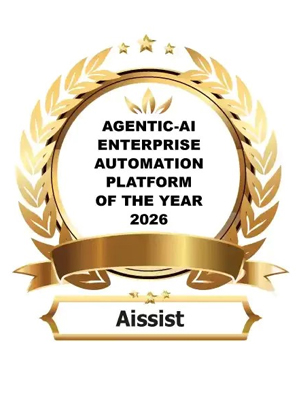
For an operation of this size and complexity, these results demonstrate a measurable improvement in customer operations’ performance under sustained growth. It is the culmination of outcomes across resolution rates, customer satisfaction, and scalability that has earned Aissist recognition as the Agentic-AI Enterprise Automation Platform of the Year.
Building the Operational Layer for Customer Operations
Aissist’s current capabilities represent an early stage in a broader product direction. The company is building toward what it describes as an agentic operational layer, where AI not only executes work but continuously improves how that work is performed.
This layer is designed to operate within the flow of daily operations. It automates workflows, builds operational intelligence by identifying patterns across interactions, and turns insight into action in real time. By being embedded directly within systems, it can detect emerging issues, highlight inefficiencies, and respond before they escalate.
It also provides visibility into customer sentiment, resolution patterns, and product-level feedback at scale, surfacing per-feature NPS scores, identifying sentiment shifts, and enabling businesses to understand and refine operations continuously before problems escalate. The goal is to improve performance across throughput, consistency, and scalability, while enabling businesses to absorb growth without increasing operational complexity. For companies facing sustained demand, this represents a shift in how customer operations are managed, moving from reactive support functions to systems that execute, learn, and improve continuously.
Advancing Enterprise Automation through Agentic Intelligence
Enterprises navigating rapid growth often discover that scale exposes structural limits rather than efficiencies. Customer-facing functions, particularly in sales and service, tend to absorb the strain first. Rising interaction volumes, unpredictable demand cycles and increasing expectations for immediacy create a compounding burden that traditional automation tools struggle to absorb. Many organizations respond by expanding headcount, yet this approach introduces its own constraints in hiring, training and coordination. Others experiment with AI-driven tools but encounter inconsistent outputs, fragmented workflows and declining customer satisfaction.
The emerging direction in enterprise automation reflects a shift from reactive systems toward autonomous execution. The distinction is not subtle. Systems that merely respond to queries offer incremental relief, but they do not address the full lifecycle of a business interaction. Decision-makers are increasingly evaluating platforms based on their ability to carry tasks through to completion, not just initiate or assist them. This requires a deeper integration of reasoning, action and system connectivity, where automation extends beyond communication into resolution.
Complexity tolerance has become a defining expectation. Enterprises rarely operate within simple, linear processes. Customer interactions involve multiple variables, dependencies and system touchpoints. Effective automation must demonstrate an ability to navigate these conditions without breaking into manual intervention at critical junctures. Platforms that distribute tasks across specialized components, while maintaining a coordinated outcome, tend to perform better in such environments. This structure enables simultaneous processing of multiple aspects of a request, rather than forcing a sequential and limited response model.
Reliability remains the most decisive factor shaping adoption. Inconsistent outputs, inaccurate commitments or unverified responses introduce downstream risk that outweighs efficiency gains. Enterprises require systems that validate outputs before execution, enforce governance standards and maintain alignment with business rules. Without this layer of control, automation becomes a liability rather than an asset. Performance metrics such as resolution rates or response speed hold little value if they are not paired with predictable and verifiable outcomes.
Another dimension influencing platform selection is the ability to embed automation within existing workflows rather than operate as a separate interface. Systems that function alongside human teams, augmenting rather than replacing their role, create a more flexible operating model. This integration allows organizations to distribute work dynamically between human and automated agents, maintaining oversight while reducing pressure on frontline teams. The result is not only efficiency, but a more balanced and sustainable approach to scaling operations.
Aissist positions itself within this evolving landscape through an architecture designed to execute rather than assist. Its platform deploys multiple specialized agents that operate concurrently, each addressing a distinct component of a task before consolidating outcomes into a final action. This approach enables it to handle complex customer interactions end to end, from diagnosis to resolution and system updates. It emphasizes governance as a core function, validating outputs to prevent errors and ensure consistency across interactions. In deployments, the platform has demonstrated significant automation across both service and sales functions while maintaining or improving customer satisfaction levels. For enterprises aiming to scale without proportionally expanding operational overhead, Aissist offers a structured approach, particularly for businesses managing high-volume customer engagement, multilingual interactions, and demand variability....Read more
Agentic AI Enterprise Automation Platforms Info
Q1
What Are Agentic AI Enterprise Automation Platforms?
Agentic AI Enterprise Automation Platforms are systems that do more than answer prompts or route simple requests. They interpret business context, plan multi-step work, take governed actions across software tools and escalate when judgment is needed. In service and sales operations, this can include resolving inquiries, updating records, summarizing interactions, tagging cases and surfacing operational patterns without forcing teams to rebuild their existing technology stack or turn every change into a custom development project. The best platforms also make their work measurable through resolution quality, handoff accuracy, cost control and process visibility.
Q2
How Does Aissist Support Enterprise Automation Beyond Chatbots?
Aissist applies Agentic AI Enterprise Automation Platforms through an operational layer built for service and sales work. Its AgentMesh technology coordinates specialized agents that can reason through issues, execute procedures and produce several outputs, such as responses, notes, summaries and system updates. The platform also connects with tools including Intercom, Zendesk, Freshdesk, Salesforce, Front, Gorgias and HubSpot, helping automation work inside existing workflows rather than outside them.
Q3
What Capabilities Should Organizations Look for in Agentic Automation?
Organizations should look for end-to-end workflow execution, system integration, human handoff, performance visibility and controls that keep automation aligned with business rules. Agentic AI Enterprise Automation Platforms should be able to handle ambiguity, apply verified knowledge, track outcomes and support continuous improvement. The goal is not isolated response generation, but dependable action that improves speed, consistency, operational visibility and customer experience while preserving oversight for exceptions, policy-sensitive situations and unusual requests.
Q4
Where Do Agentic AI Enterprise Automation Platforms Create the Most Value?
Agentic AI Enterprise Automation Platforms create value where work is repetitive but not simple. Examples include service resolution, sales follow-up, support diagnosis, customer record updates and escalation handling. These workflows often require context, policy awareness and several connected actions. By coordinating agents, data and human review points, the platform can reduce manual effort while giving leaders clearer signals about process gaps, customer friction, recurring case types and changing operational patterns.
Q5
How Does Aissist Use Insight and Optimization in Its Platform?
Aissist extends Agentic AI Enterprise Automation Platforms beyond task execution with Pulse and Evolve. Pulse reads tickets, agent activity and operations in real time to identify what is changing and why, including patterns across conversations, products and service processes. Evolve monitors those signals, recommends operational moves and helps close the loop between issue detection and improvement. Together, these layers make automation part of an ongoing performance system, not a one-time deployment.
Q6
Why Does Governance Matter in Enterprise Agentic AI?
Governance matters because autonomous workflow tools must be reliable, secure and understandable in production. Agentic AI Enterprise Automation Platforms need guardrails for verified knowledge, business policies, access limits and escalation. Strong governance helps prevent unsupported answers, keeps procedures consistent and ensures sensitive or unclear cases move to people. For enterprise teams, automation is useful only when it can scale across channels, tools and cases without weakening trust, compliance or accountability for leaders and frontline teams.
Company
Aissist
Management
Lifan Xu, Co-founder
Description
Assist is a San Jose-based agent AI platform purpose-built for enterprise sales and customer service automation. Serving fast-growing businesses, the platform resolves customer interactions end to end across all channels, languages, and media formats, delivering an average resolution rate of 83 percent and a customer satisfaction score of 4.8.