-
Technology
-
Industry
-
Solutions
-
- ASSET MANAGEMENT
- CUSTOMER EXPERIENCE MANAGEMENT
- CYBER SECURITY
- DATA CENTER
- DOCUMENT MANAGEMENT
- ELECTRONIC DATA INTERCHANGE
- ENTERPRISE DATA MANAGEMENT
- ENTERPRISE RESOURCE PLANNING
- ENTERPRISE RISK MANAGEMENT
- ENTERPRISE-GRADE WEB DATA SOLUTIONS
- FACILITY MANAGEMENT
- FIELD SERVICE
- IDENTITY AND ACCESS MANAGEMENT
- INFRASTRUCTURE
- IT SERVICE MANAGEMENT
- MANAGED IT SERVICES
- PAYMENT AND CARD
- PROJECT MANAGEMENT
- SOFTWARE TESTING
- STORAGE
- VIDEO SOLUTIONS
- WORKFLOW
-
-
Platforms
-
Functions
- Leadership Perspectives
- Innovation Insights
- Research
- Magazines
- News
- CXO Awards



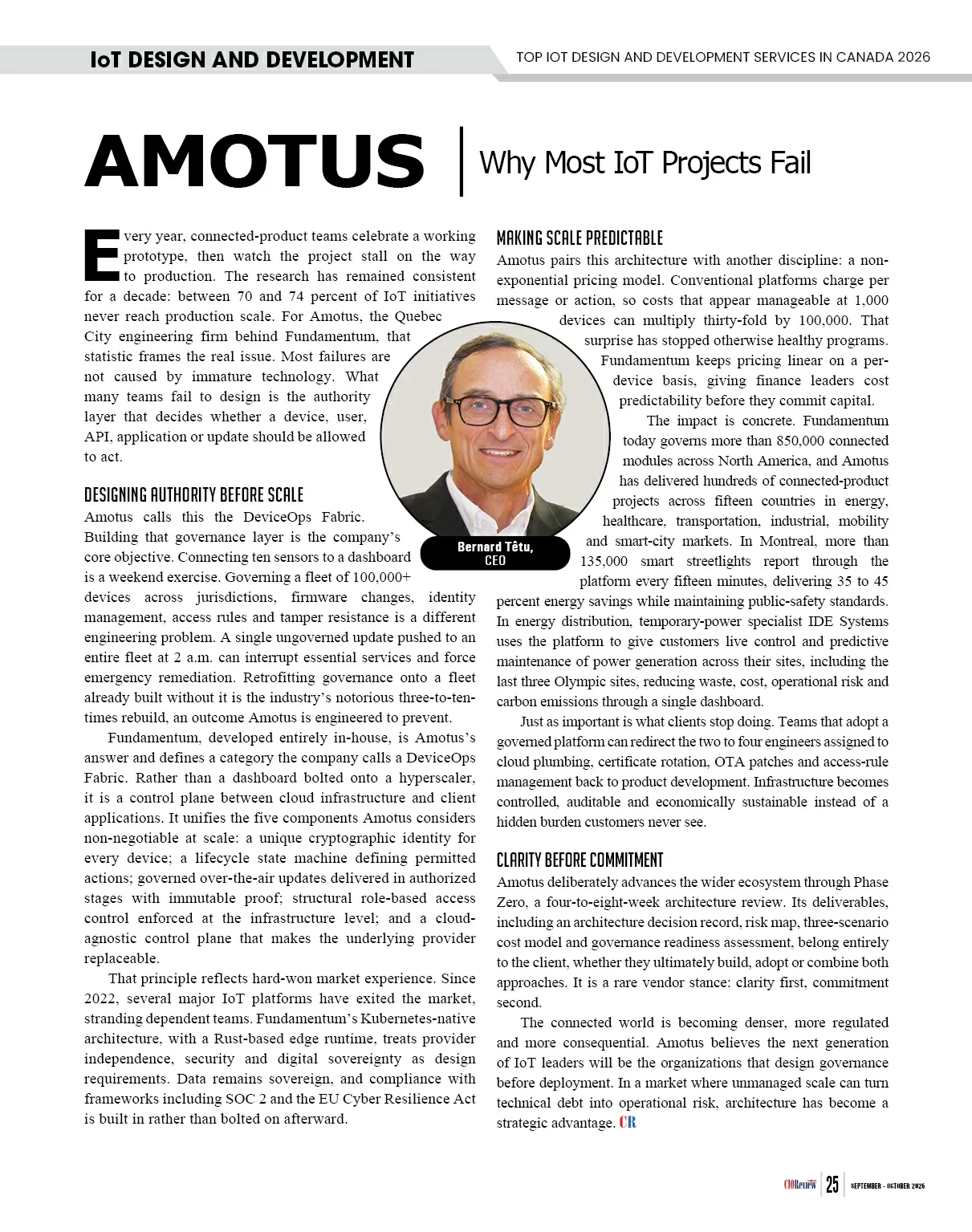
 Bernard Têtu, CEO of Amotus
Designing Authority Before Scale
Amotus calls this the DeviceOps Fabric. Building that governance layer is the company’s core objective. Connecting ten sensors to a dashboard is a weekend exercise. Governing a fleet of 100,000+ devices across jurisdictions, firmware changes, identity management, access rules and tamper resistance is a different engineering problem. A single ungoverned update pushed to an entire fleet at 2 a.m. can interrupt essential services and force emergency remediation. Retrofitting governance onto a fleet already built without it is the industry’s notorious three-to-ten-times rebuild, an outcome Amotus is engineered to prevent.
Fundamentum, developed entirely in-house, is Amotus’s answer and defines a category the company calls a DeviceOps Fabric. Rather than a dashboard bolted onto a hyperscaler, it is a control plane between cloud infrastructure and client applications. It unifies the five components Amotus considers non-negotiable at scale: a unique cryptographic identity for every device; a lifecycle state machine defining permitted actions; governed over-the-air updates delivered in authorized stages with immutable proof; structural role-based access control enforced at the infrastructure level; and a cloud-agnostic control plane that makes the underlying provider replaceable.
That principle reflects hard-won market experience. Since 2022, several major IoT platforms have exited the market, stranding dependent teams. Fundamentum’s Kubernetes-native architecture, with a Rust-based edge runtime, treats provider independence, security and digital sovereignty as design requirements. Data remains sovereign, and compliance with frameworks including SOC 2 and the EU Cyber Resilience Act is built in rather than bolted on afterward.
Making Scale Predictable
Amotus pairs this architecture with another discipline: a non-exponential pricing model. Conventional platforms charge per message or action, so costs that appear manageable at 1,000 devices can multiply thirty-fold by 100,000. That surprise has stopped otherwise healthy programs. Fundamentum keeps pricing linear on a per-device basis, giving finance leaders cost predictability before they commit capital.

IoT at scale is an architecture problem, not a technology problem. The failure lies in the layer teams never design.

The impact is concrete. Fundamentum today governs more than 850,000 connected modules across North America, and Amotus has delivered hundreds of connected-product projects across fifteen countries in energy, healthcare, transportation, industrial, mobility and smart-city markets. In Montreal, more than 135,000 smart streetlights report through the platform every fifteen minutes, delivering 35 to 45 percent energy savings while maintaining public-safety standards. In energy distribution, temporary-power specialist IDE Systems uses the platform to give customers live control and predictive maintenance of power generation across their sites, including the last three Olympic sites, reducing waste, cost, operational risk and carbon emissions through a single dashboard.
Just as important is what clients stop doing. Teams that adopt a governed platform can redirect the two to four engineers assigned to cloud plumbing, certificate rotation, OTA patches and access-rule management back to product development. Infrastructure becomes controlled, auditable and economically sustainable instead of a hidden burden customers never see.
Clarity Before Commitment
Amotus deliberately advances the wider ecosystem through Phase Zero, a four-to-eight-week architecture review. Its deliverables, including an architecture decision record, risk map, three-scenario cost model and governance readiness assessment, belong entirely to the client, whether they ultimately build, adopt or combine both approaches. It is a rare vendor stance: clarity first, commitment second.
The connected world is becoming denser, more regulated and more consequential. Amotus believes the next generation of IoT leaders will be the organizations that design governance before deployment. In a market where unmanaged scale can turn technical debt into operational risk, architecture has become a strategic advantage.
Designing IoT Products for Life after Launch
Connected-product programs tend to fail not when the prototype breaks but when the prototype works. A device sends data, a dashboard responds, and the first pilot looks convincing. The harder question comes later, when the fleet reaches thousands of units and needs identity control, firmware governance, access rules, uptime planning, and economics that do not collapse with growth.
The issue is not whether a development partner can build the product. Almost anyone can build the first one. The question is whether they understand what it takes to run it.
Hardware and firmware still matter. But a well-made device can still produce an unmanageable fleet if the connections between embedded systems, cloud services, wireless protocols, and security practices are treated as separate work packages rather than one engineering problem. A weak handoff anywhere in that chain is cheap to ignore early and expensive to fix later.
“Amotus works across the full architecture, from schematic and PCB development through firmware, embedded operating systems, cloud, and wireless connectivity. Its embedded teams handle Linux and RTOS environments, device drivers, secure boot, and OTA mechanisms. ”
At scale, governance becomes the dividing issue. Every device needs a unique identity, a defined lifecycle state, and rules for what it can do at each stage. An update that is harmless in a test group can spread damage quickly without staged rollouts and clear authorization. Role-specific access, traceable commands, and an auditable update history need to be designed before launch. Rebuilding a live connected architecture after customers are already using it costs far more than building it right the first time.
Platform dependency is a quieter risk. Many connected-product plans are built around a single cloud provider or IoT platform, which creates a migration problem if that platform changes or disappears. For regulated environments and public-sector deployments, this is not a vendor-preference question. Data residency, compliance requirements, and digital sovereignty make cloud-agnostic architecture a procurement condition, not a design option.
Pricing models are easy to underestimate at pilot volumes. Per-message and per-action structures can look reasonable with a hundred devices and become very hard to forecast with a hundred thousand. Finance teams need a cost structure they can model across rollout scenarios before they commit to one. Predictability determines whether the product can grow without redesign.
Amotus works across the full architecture, from schematic and PCB development through firmware, embedded operating systems, cloud, and wireless connectivity. Its embedded teams handle Linux and RTOS environments, device drivers, secure boot, and OTA mechanisms. Fundamentum, its IoT Platform as a Service, covers provisioning, monitoring, remote control, and fleet updates. Amotus calls its governance layer a DeviceOps Fabric, built around device identity, lifecycle controls, role-specific access, and software updates that are authorized and traceable. Services run on customizable microservices, and pricing scales with the fleet rather than per message or action. The board, firmware, cloud environment, and governance model are part of the same engineering decision from the start....Read more
IoT Design and Development Services in Canada Info
Q1
What Are IoT Design and Development Services in Canada?
IoT Design and Development Services in Canada cover the engineering work needed to build connected products and operate them reliably after launch. This can include hardware design, firmware, embedded operating systems, wireless connectivity, cloud infrastructure, security and device management. Effective IoT Design and Development Services in Canada also account for identity, access control, software updates and long-term operating costs rather than treating the prototype as the finished product.
Q2
How Does Amotus Approach IoT Design and Development Services in Canada?
Amotus approaches IoT Design and Development Services in Canada as an architecture problem that extends beyond the device itself. Its work spans schematic and PCB development, firmware, embedded operating systems, cloud and wireless connectivity. Its Fundamentum platform adds a DeviceOps Fabric that governs device identity, lifecycle states, access permissions and over-the-air updates. The architecture is Kubernetes-native with a Rust-based edge runtime, supporting cloud-provider independence.
Q3
What Problems Can IoT Development Services Help Organizations Solve?
IoT Design and Development Services in Canada can help organizations address problems that become harder as connected fleets grow. These include uncontrolled software updates, weak device identity, fragmented access rules, platform dependence and unpredictable infrastructure costs. A well-designed architecture creates clearer controls around what devices can do, who can access them and how updates reach them. This can reduce the need for costly rebuilding once a product moves from pilot deployment to large-scale operation.
Q4
What Should Organizations Consider When Selecting an IoT Development Partner?
The right IoT Design and Development Services in Canada should cover the complete product lifecycle, not just initial development. Organizations should examine how a provider handles embedded systems, connectivity, cloud architecture, security, device identity, firmware updates and fleet governance. Pricing should also remain predictable as deployments grow. Cloud independence and data sovereignty can be important considerations where regulatory requirements or long-term control over infrastructure matter.
Q5
How Does Fundamentum Support Large-Scale IoT Deployments?
Fundamentum supports IoT Design and Development Services in Canada by acting as a control layer between cloud infrastructure and client applications. Amotus designed it around five elements, including cryptographic device identity, lifecycle management, governed over-the-air updates, infrastructure-level role-based access control and a cloud-agnostic control plane. The platform currently governs more than 850,000 connected modules across North America, while more than 135,000 smart streetlights in Montreal report through it every 15 minutes.
Q6
Why Is Governance Important in IoT Design and Development Services in Canada?
Governance becomes increasingly important when an IoT deployment moves from hundreds of devices to thousands or more. IoT Design and Development Services in Canada must account for how devices are authorized, updated, monitored and retired throughout their lifecycle. Amotus addresses this through its Phase Zero architecture review, which provides an architecture decision record, risk map, three-scenario cost model and governance readiness assessment. The approach gives organizations a clearer view of technical and economic requirements before major deployment decisions are made.

Company
Amotus
Management
Bernard Têtu, CEO of Amotus
Description
Founded in 2013, Amotus develops sovereign IoT solutions through Fundamentum, a cloud-agnostic DeviceOps platform managing over 850,000 connected modules and enabling secure, auditable, cost-predictable deployment of connected fleets across critical industries.