-
Technology
-
Industry
-
Solutions
-
- ASSET MANAGEMENT
- CUSTOMER EXPERIENCE MANAGEMENT
- CYBER SECURITY
- DATA CENTER
- DOCUMENT MANAGEMENT
- ELECTRONIC DATA INTERCHANGE
- ENTERPRISE DATA MANAGEMENT
- ENTERPRISE RESOURCE PLANNING
- ENTERPRISE RISK MANAGEMENT
- ENTERPRISE-GRADE WEB DATA SOLUTIONS
- FACILITY MANAGEMENT
- FIELD SERVICE
- IDENTITY AND ACCESS MANAGEMENT
- INFRASTRUCTURE
- IT SERVICE MANAGEMENT
- MANAGED IT SERVICES
- PAYMENT AND CARD
- PROJECT MANAGEMENT
- SOFTWARE TESTING
- STORAGE
- VIDEO SOLUTIONS
- WORKFLOW
-
-
Platforms
-
Functions
- Leadership Perspectives
- Innovation Insights
- Research
- Magazines
- News
- CXO Awards



 Brian P. Murphy, Associate Partner, Procurement
To address these challenges, businesses must adopt a Procurement approach that is aligned with its overall strategy and incorporates digital tools that add systems-enabled efficiencies (such as P2P Automation and smart contracting). Bain & Company, headquartered in Boston, helps companies achieve this goal by guiding them on a cross-functional, transformational path to address their procurement challenges. But, instead of implementing point solutions aimed only at procurement and not considering the allied functions, Bain helps its clients zero in on the correct way forward that makes business sense for them even if it entails delving into ancillary functions. This, in turn, helps businesses tangibly realize their savings.
Instead of playing the role of systems integrators, Bain remains objective and works on bringing the holistic answer to its clients rather than aligning with a particular set of digital solutions. The company helps its clients succeed with the right answer, rather than using the same response in different cases. The company looks at an exhaustive set of levers and pulls not only those that generate quick-wins, but also more complex ones that typically have interconnected qualities with other business functions. Thus, it helps unlock the value that is dependent on other functions and that Procurement departments are unable to attain solely on their own.
Bain provides support in identifying cost savings opportunities through Buy Better and Spend Better ™ levers, which encompass everything from demand management and supply rationalization to negotiating new agreements and comprehensive initiatives like make vs. buy analysis, and so on. For businesses that look for full procurement transformation, Bain takes charge of right-sizing the organization, building capabilities, and identifying and helping rollout digital enablers.
These include, but are not limited to, cognitive sourcing and predictive supplier risk management.
We will continue to build our strategic capabilities around supplier management, supplier performance risk, supplier diversity to help clients integrate better with their suppliers

With procurement departments being whittled down during the pandemic, businesses need to drive savings with minimal resources at their disposal. Bain works with companies in tandem to not only drive the savings but also to ensure that they develop capabilities along the way so that they become self-reliant. A testimony to Bain’s commitment to strong and long term partnerships with its clients is that the company continues to serve several clients who were planning to turn off projects citing lack of funds due to the pandemic. The company also has this exceptional capability to connect not only with its direct stakeholders but also with the C-suite executives, which allows Bain to push forward initiatives that otherwise would not be implemented. For instance, for a particular Consumer Products business, prior to Bain’s engagement, the company had struggled to get bold, model-changing recommendations off the ground and implemented. Bain then worked closely and collaboratively to help them frame up the right business case to articulate the system value that could be driven as well as the Results Delivery model needed to manage the change. That approach resonated with both the functional stakeholders as well as the executive teams, and those solutions were ultimately pursued generating run-rate savings north of $50 million annually.
Because procurement is still relatively immature compared to some of the other functions, Bain envisages a futuristic road map ahead for the company. “We will continue to build our strategic capabilities around broad cost reduction, supplier management, supplier performance risk, and supplier diversity. We will also leverage more digital capabilities, be it automation on the operational procurement side or using AI and machine learning to uncover strategic insights in spend data or market data in order to better collaborate and innovate with the supply base,” says Brian P. Murphy, Associate Partner, Procurement, Bain & Company.
Bain & Company Acquires Max Kelsen’s Consulting to Strengthen AI Capabilities
Monday, August 28, 2023
This acquisition strengthens Bain & Company's offerings in the field of artificial intelligence (AI) and machine learning (ML), enabling them to provide more advanced solutions to clients worldwide.
Boston-based management consulting firm Bain & Company recently announced a significant acquisition of Max Kelsen Consulting, comprising both consulting and managed services divisions. This acquisition strengthens Bain & Company’s offerings in the field of artificial intelligence (AI) and machine learning (ML), enabling them to provide more advanced ML and AI solutions to clients worldwide.
Max Kelsen Consulting, founded in Australia in 2015, has a history of collaboration with both Australian and international businesses to conceive and implement machine learning (ML) solutions. The company takes pride in its team of proficient full-stack ML engineers, who are dedicated to crafting ML systems, AI-driven applications, and providing advisory services to a diverse clientele.
Their expertise extends to the establishment of operational machine learning (MLOps) practices that adhere to best standards for clients. Max Kelsen Consulting's services have catered to a wide range of clients, including those within the Fortune 500 bracket. Notably, the company has formed partnerships with major cloud service providers like Amazon Web Services and Google Cloud Platform. The healthcare and life sciences sector has been a prominent domain of focus for Max Kelsen's proficiency.
Through the integration of Max Kelsen Consulting into Bain's Advanced Analytics Group (AAG), the combined team is poised to assist enterprises in the development and execution of impactful AI and ML use cases. Richard Fleming, the head of Bain's Advanced Analytics Group in the Asia Pacific region, remarked, "This acquisition will bolster the array of AI and ML capabilities we provide to our clients on both regional and global scales."
Nicholas Therkelsen-Terry, co-founder and CEO of Max Kelsen, expressed excitement about joining Bain. “We are excited to join Bain at a time when businesses are starting to navigate the disruptions brought on by generative AI,” he said. It is essential to note that Max Kelsen operates additional divisions, such as a products division (SAVI Surgical and PROPeL Health AI) and a research division, which are not part of the Bain acquisition.
AI and automation accelerating rapid, large-scale business change across multiple sectors—Bain & Company and UiPath survey
Friday, October 13, 2023
BOSTON --The rapid and large-scale spread of artificial intelligence (AI) technology across sectors, and AI’s far-reaching and growing impact in transforming industries, is highlighted today in a new analysis from Bain & Company and UiPath, a leading enterprise automation software company.
Bain partnered with UiPath (NYSE: PATH) to examine and understand the adoption and impact of AI-powered automation to date, as well as the influence that AI will play in enterprise and market reconfiguration moving forward.
The study’s findings draw from a Bain-led survey of 200 companies, the majority with revenues of $5 billion or more, alongside an extensive series of qualitative interviews with senior executives.
The report finds that while automation has long been a force for improvement and efficiency within organizations, fast-paced deployment of AI is accelerating the scope and scale of business change.
With more than half (53%) of executives surveyed reporting their businesses have already deployed some form of Generative AI, the impact of the technology is underlined by 45% of respondents forecasting that integration of automation and AI tech will catalyze a major transformation in their industry within the next few years. Nearly half (48%) of those surveyed by Bain also said they experienced a higher impact when using AI-intensive solutions such as machine learning and cognitive automation.
A majority of respondents say they are already investing in AI-powered automation, with 70% asserting that AI-driven automation is either “very important” or “critical” in fulfilling their organization’s strategic objectives. 74% anticipate a positive return on investment from their automation endeavors.
“Enterprises have an opportunity with AI-powered automation to infuse a shot of adrenaline into their business roadmaps and reconfigure their goals, regardless of size and scope – if they take a holistic approach and act now,” said Ted Shelton, Bain & Company expert partner in the firm’s Enterprise Technology and Performance Improvement practices. “Businesses must go beyond deploying this technology and fundamentally rethink and redesign business models to integrate AI and automation seamlessly. The truly future-proofed organizations will be agile, with a fluid culture and design, constantly evolving, and reconfiguring in tandem with technological advancements in AI.”
The survey found that executives are mixed on their views of Generative AI. While nearly half of organizations have adopted some form of GenAI and 44% of respondents stated that GenAI will be transformative, 18% asserted that the technology is overhyped, while another 11% believe GenAI is still undervalued.
Respondents envisage a future where AI enables new product or service offerings (58%), creates avenues for data monetization (52%), allows for heightened personalization in offerings (47%), and even paves the way to tap into previously uncharted markets or customer segments (26%).
“This Bain research shows the acute inflection point businesses face with AI and automation. The majority of organizations report AI and automation are critical to their business objectives, and most will use AI and automation as a catalyst for generating new revenues and future product offerings,” said Rob Enslin, Co-CEO at UiPath. “UiPath can operationalize the transformative force of AI through automation, seamlessly integrating intelligence into everyday operations, automating all knowledge work, and revolutionizing entire industries with AI at work.”
The Bain survey finds that most organizations have deployed a suite of automation technologies, including AI and Machine Learning (ML) (80%), Robotic Process Automation (RPA) (64%), and Predictive Analytics (69%), with the primary motivation behind adoption being increasing efficiency and productivity (85%). While the majority (69%) report experiencing the efficiency and productivity gains they sought, they also report automation-related benefits including improved accuracy and reduced errors (56%) and increased competitiveness (45%).
“It seems clear that AI-powered automation, including GenAI, will drive a larger wedge between those organizations that have a plan, and those that don’t – amplifying advantage and placing early adopters into stronger positions during the coming market reconfiguration,” Shelton said.
Report Searching for Momentum: Private Equity Midyear Report 2024
Tuesday, June 11, 2024
The industry appears to have finally found its footing. Now comes the hard part.
• Private equity’s two-year slide in deals, exits, and funds closed slowed in the first half of 2024, but activity remained tentative and momentum scarce.
• Limited partners, meanwhile, continue to press for an increased pace of distributions and are focusing new commitments on a narrow swath of favored funds.
• General partners who can’t shepherd portfolio companies to attractive outcomes may face a shakeout. But there are practical ways to get the wheel spinning again.
Has private equity dealmaking finally bottomed out?
Based on data through May 15, the answer would be a tentative yes—though we’ve yet to see anything resembling a “normal” pace of investments and exits.
The industry’s precipitous decline in deal count over the past two years leveled off in early 2024, and buyout funds globally are now on track to finish the year essentially flat vs. 2023’s count total. While exits also appear to have arrested their freefall, activity has landed at a very low level. And as limited partners (LPs) wait for distributions to pick up, most funds are still struggling to raise fresh capital (see Figure 1).
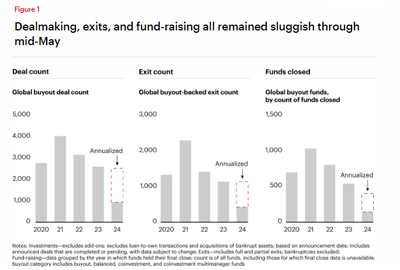
Given that 2024 deal value will likely approach that of the buoyant years preceding 2021’s anomalous postpandemic spike, it’s tempting to assume that normal isn’t so far off. But activity relative to the mountain of dry powder available remains stunted by historical standards. For comparison, 2024 deal value is on track to roughly match 2018’s total, yet there is more than 1.5 times as much buyout dry powder today as there was back then. With the exception of very large headline deals like the $15.5 billion acquisition of Truist Insurance led by Stone Point Capital and Clayton, Dubilier & Rice or Permira’s $6.9 billion bid to take Squarespace private, there’s little empirical evidence that the market is truly on the upswing.
How soon that might change is the million-dollar question.
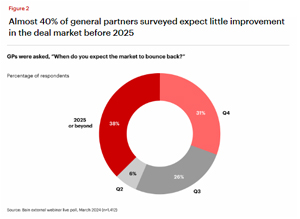
When Bain & Company surveyed more than 1,400 market participants in March to find out when they expected dealmaking activity to bounce back, around 30% said they don’t expect any pickup until the fourth quarter, and close to 40% predicted it would take until 2025 or beyond (see Figure 2). Yet informal discussions with general partners (GPs) globally suggest that deal pipelines are already starting to refill, and many see the green shoots of a recovery beginning to poke through.
The bigger issue is the industry’s persistently low levels of distributed to paid-in capital (DPI). The prolonged slump in exits is having a measurable impact on funds’ ability to raise new capital and keep their LPs satisfied. Finding ways to generate DPI strategically across the portfolio is rapidly becoming a point of competitive differentiation. It may determine which funds meet their fund-raising goals in the years ahead and which fall by the wayside.
The macro environment—which Karen Harris, managing director of Bain’s Macro Trends Group, described in a recent Dry Powder podcast as “calm, but not stable”—is probably the biggest hurdle to closing transactions.
Although the Federal Reserve has held steady for almost a year, interest rates haven’t retreated as expected in 2024. And while the US economy appears to be defying gravity, the yield curve is still inverted, inflation-driven prices are still too high (way too high if you factor in financing costs), and ongoing geopolitical uncertainty in the Middle East, Ukraine, and China continues to rattle nerves. The looming US presidential election, meanwhile, only dials up the uncertainty.
In Europe, slow (or no) growth will likely induce the European Central Bank to follow Switzerland and ease rates this year. And though that may spark consumer spending, especially in markets where adjustable-rate mortgages predominate, Europe’s elevated public spending requirements (defense, infrastructure, the debt brake in Germany) remain an anchor. Overall, the growth picture will likely be muted.
Added to the challenge of managing rate-related issues within existing portfolios, this broad-based macro uncertainty has left dealmakers distracted and wary on either side of any transaction. Through May, that caution was playing out across the value-creation cycle. Here’s a closer look at the implications.
Global video game revenue to reach $257 billion by 2028, outpacing combined revenues of other media types, finds Bain & Company
Friday, September 06, 2024
● Demand for immersive games, interoperability is increasing, shows survey of 5,000+ consumers
● Nearly 80% of 2- to 18-year-olds are gaming, fueling industry growth
● Mobile gamers represent more than half of the global gaming market
LOS ANGELES-- Global revenue from video games is expected to climb by 6% annually to reach $257 billion by 2028, stealing revenue share from other media types, according to new research by Bain & Company. The global video game market reached $196 billion in 2023, generating more revenue than streaming and box-office sales combined.
For its inaugural Gaming Report, Bain surveyed more than 5,000 consumers across six countries, including Brazil, Indonesia, Japan, the United Arab Emirates, the United Kingdom, and the United States to learn more about the habits and expectations of gamers worldwide.
"We're seeing a surge in global video game audiences, driven by young people who are spending more time on games and less time on video and other media," said Daniel Hong, leader of Bain's global Media & Entertainment practice. "Players say they want more immersive games and more interoperability across devices and platforms. They're also spending more time in game environments, socializing, shopping, and consuming other media. Bain is watching five key trends that will dictate the future for game publishers and developers."
Five trends to watch in gaming
Of the people Bain surveyed, more than half (52%) said they play games on a regular basis. Younger consumers spend a greater share of their entertainment budget on video games when compared to older players. To understand these dynamics, Bain mapped out five key trends to watch.
1.Young gamers drive growth. The clearest source of future growth comes from the youngest players: those 2 to 18 years old. Nearly 80% of 2- to 18-year-olds are gamers, spending 30% of their entertainment time gaming. Older players (those ages 45 and older) are a smaller market, with 31% identifying as gamers. Older players tend to spend less time on average (2.5 hours per week compared with 9.5 hours for 13- to 17-year-olds) playing games, and mostly do so on their mobile phones.
2.Gaming is about more than gameplay. A third of those surveyed listed a game that offers an immersive experience as being their top game. For gamers younger than 18, that percentage was closer to half. Immersive gamers are more engaged, spending about one and a half hours more per week in the game when compared with those playing games that are not immersive.
3.Gamers are cocreating the gaming experience. Video has been dramatically changed over the past two decades by the rise of user-generated content (UGC). Nearly 80% of gamers say they have played a game with UGC, and one in seven have created content in a video game. Generative AI will accelerate this trend by empowering players with tools to fine-tune their gaming experience.
4.Gamers want to play across platforms and devices. Nearly 70% of gamers play on at least two devices, and half of survey respondents say they would like to see more accessibility across devices in future games. Ninety-five percent of game development studios with more than 50 people are working on cross-platform games.
5.Gaming IP is taking share in other media. Interoperability across devices is a factor in two of the top three features gamers say they want. Another top factor included the desire to have new content added regularly to games. Additionally, game-related shows and movies have a significant impact in terms of consumer engagement, with an average 28% lift in average concurrent users (ACUs) six months after release.
Growing demand for consolidation and mobile games
Bain predicts that as technology in non-gaming devices (mobile phones, TVs, non-gaming PCs) advances quickly and cloud gaming becomes less expensive and more common, players will access games without a console, gaming PC, or other dedicated gaming device. One sign this shift is underway: Although console sales continue to grow in absolute dollars, their penetration level has been flat for about a decade while the global gaming population has steadily increased over the same period. Mobile gamers make up most of new growth, representing slightly more than half of the global gaming market. And while 70% of gamers say they play on several devices, almost all (90%) say they wish to consolidate—many say they are willing to pay for that consolidation.
"Game console and device providers have been hearing for years that their industry will become more device agnostic, and we're seeing indications that this transition is beginning to take place," said Anders Christofferson, leader of Bain's gaming sector and partner within Bain's Media & Entertainment practice. "As consolidation happens, a few industry leaders will capture customer relationships, using that engagement to ultimately gain market share. Gaming companies will need to redefine their relationships with customers, competitors, and the various other players that make up the video game industry landscape as this shift plays out."
Boosting performance through effective marketing
The audience for video games is becoming increasingly saturated, and effective marketing is more important than ever. Bain found competition for players' attention is fierce, with 67% of game players saying that they often consume other media while gaming. This is likely to make it more difficult to maintain high advertising rates, as advertisers may require proof of attention, rather than just reach. Given these challenges, successful marketing will make or break many game developers.
When compared to other software companies, game companies tend to spend more on marketing. On average, gaming companies with revenue less than $1 billion spend about 25% of their revenue on marketing. That's higher than spending at other software companies which spend about 15%. Yet much of that spending is being misdirected as companies fail to market their games effectively in a crowded field.
One strategy Bain suggests to overcome marketing challenges: using generative AI in early efforts to accelerate marketing campaigns with precision-targeted ads. This includes generating marketing copy and images, quality control, content tailoring and tagging, and measurement.

Company
Bain & Company
Management
Brian P. Murphy, Associate Partner, Procurement
Description
Bain & Company is a global management consulting firm that advises leaders on strategy, marketing, organization, operations, IT, and M&A, across all industries. The company has expertise in strategy, marketing, organization, operations, information technology, digital transformation and design, advanced analytics, transformations, sustainability, corporate finance, and mergers and acquisitions across all industries and geographies

