-
Technology
-
Industry
-
Solutions
-
- ASSET MANAGEMENT
- CUSTOMER EXPERIENCE MANAGEMENT
- CYBER SECURITY
- DATA CENTER
- DOCUMENT MANAGEMENT
- ELECTRONIC DATA INTERCHANGE
- ENTERPRISE DATA MANAGEMENT
- ENTERPRISE RESOURCE PLANNING
- ENTERPRISE RISK MANAGEMENT
- ENTERPRISE-GRADE WEB DATA SOLUTIONS
- FACILITY MANAGEMENT
- FIELD SERVICE
- IDENTITY AND ACCESS MANAGEMENT
- INFRASTRUCTURE
- IT SERVICE MANAGEMENT
- MANAGED IT SERVICES
- PAYMENT AND CARD
- PROJECT MANAGEMENT
- SOFTWARE TESTING
- STORAGE
- VIDEO SOLUTIONS
- WORKFLOW
-
-
Platforms
-
Functions
- Leadership Perspectives
- Innovation Insights
- Research
- Magazines
- News
- CXO Awards


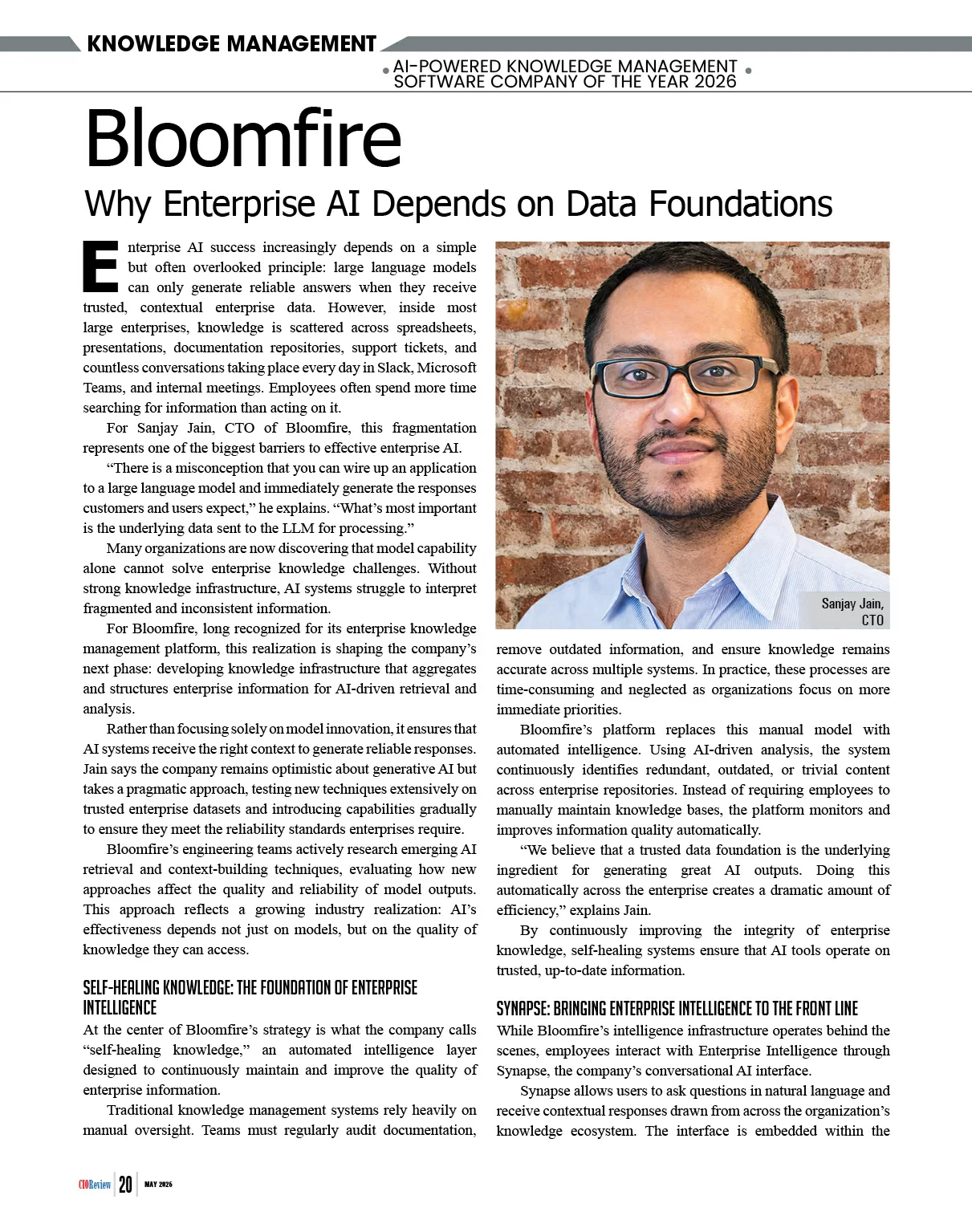
 Sanjay Jain, CTO
Enterprise AI success increasingly depends on a simple but often overlooked principle: large language models can only generate reliable answers when they receive trusted, contextual enterprise data. However, inside most large enterprises, knowledge is scattered across spreadsheets, presentations, documentation repositories, support tickets, and countless conversations taking place every day in Slack, Microsoft Teams, and internal meetings. Employees often spend more time searching for information than acting on it.
For Sanjay Jain, CTO of Bloomfire, this fragmentation represents one of the biggest barriers to effective enterprise AI.
“There is a misconception that you can wire up an application to a large language model and immediately generate the responses customers and users expect,” he explains. “What’s most important is the underlying data sent to the LLM for processing.”
Many organizations are now discovering that model capability alone cannot solve enterprise knowledge challenges. Without strong knowledge infrastructure, AI systems struggle to interpret fragmented and inconsistent information.
For Bloomfire, long recognized for its enterprise knowledge management platform, this realization is shaping the company’s next phase: developing knowledge infrastructure that aggregates and structures enterprise information for AI-driven retrieval and analysis.
Rather than focusing solely on model innovation, it ensures that AI systems receive the right context to generate reliable responses. Jain says the company remains optimistic about generative AI but takes a pragmatic approach, testing new techniques extensively on trusted enterprise datasets and introducing capabilities gradually to ensure they meet the reliability standards enterprises require.
Bloomfire’s engineering teams actively research emerging AI retrieval and context-building techniques, evaluating how new approaches affect the quality and reliability of model outputs. This approach reflects a growing industry realization: AI’s effectiveness depends not just on models, but on the quality of knowledge they can access.
Self-Healing Knowledge: The Foundation of Enterprise Intelligence
Traditional knowledge management systems rely heavily on manual oversight. Teams must regularly audit documentation, remove outdated information, and ensure knowledge remains accurate across multiple systems. In practice, these processes are time-consuming and neglected as organizations focus on more immediate priorities.
How does automated knowledge management improve data quality and support reliable AI outputs?
At the center of Bloomfire’s strategy is what the company calls “self-healing knowledge,” an automated intelligence layer designed to continuously maintain and improve the quality of enterprise information.

We believe that a trusted data foundation is the underlying ingredient for generating great AI outputs. Doing this automatically across the enterprise creates a dramatic amount of efficiency.

Traditional knowledge management systems rely heavily on manual oversight. Teams must regularly audit documentation, remove outdated information, and ensure knowledge remains accurate across multiple systems. In practice, these processes are time-consuming and neglected as organizations focus on more immediate priorities.
Bloomfire’s platform replaces this manual model with automated intelligence. Using AI-driven analysis, the system continuously identifies redundant, outdated, or trivial content across enterprise repositories. Instead of requiring employees to manually maintain knowledge bases, the platform monitors and improves information quality automatically.
“We believe that a trusted data foundation is the underlying ingredient for generating great AI outputs. Doing this automatically across the enterprise creates a dramatic amount of efficiency,” explains Jain.
By continuously improving the integrity of enterprise knowledge, self-healing systems ensure that AI tools operate on trusted, up-to-date information.
Synapse: Bringing Enterprise Intelligence to the Front Line
Why is conversational AI important for improving access to enterprise knowledge in daily workflows?
While Bloomfire’s intelligence infrastructure operates behind the scenes, employees interact with Enterprise Intelligence through Synapse, the company’s conversational AI interface.
Synapse allows users to ask questions in natural language and receive contextual responses drawn from across the organization’s knowledge ecosystem. The interface is embedded within the Bloomfire platform and is also accessible through widely used enterprise tools like Slack, Microsoft Teams, and Salesforce.
By bringing AI-driven insights directly into everyday workflows, Synapse reduces friction and encourages employees to rely on trusted enterprise knowledge. Synapse represents the user-facing interface to Bloomfire’s knowledge retrieval and AI context delivery system, helping employees access relevant information from across enterprise repositories.
Breaking Down Organizational Knowledge Silos
In what way does centralized knowledge access improve collaboration and decision-making across organizations?
Technology challenges are only part of the knowledge management problem. In many organizations, information barriers are deeply rooted in culture and behavior.
Employees often rely on colleagues for answers rather than searching documentation. Valuable knowledge becomes trapped within departments, messaging threads, or individual expertise.
Bloomfire’s platform addresses this challenge by aggregating knowledge from across the enterprise ecosystem including traditional repositories, ticketing systems, documentation tools, and conversational sources. The result is a centralized knowledge access layer that gives employees a comprehensive view of organizational knowledge. By removing these barriers, organizations enable employees to solve problems independently and collaborate more effectively.
Building Trust through AI Observability
As AI systems become more deeply embedded in enterprise workflows, trust and transparency become essential.
Many generative AI tools operate as black boxes, producing answers without explaining how those answers were generated. For organizations relying on AI to support customer interactions, troubleshooting, or internal decision-making, this lack of transparency presents significant risks.
Bloomfire addresses this challenge through AI observability capabilities designed to make AI responses explainable. Users can request detailed breakdowns showing which sources informed an AI-generated answer and how the system arrived at its conclusions.
“We want users to be able to say, ‘Tell me exactly why you generated this response,’” Jain explains. “The system will break down the context of how and why it responded in that way.”
This transparency allows organizations to adopt AI with greater confidence while maintaining strong governance across their knowledge ecosystems.
Measuring the Real ROI of Enterprise Intelligence
Historically, the value of knowledge management platforms has been difficult to quantify. Metrics such as time saved or content reduction capture only part of the impact.
Bloomfire believes that as AI adoption expands, organizations will begin measuring value in new ways, focusing on outcomes rather than efficiency alone.
Engineering teams may accelerate product development cycles. Marketing teams may increase publishing velocity. Sales teams may generate more personalized outreach using data-driven insights.
As Sanjay describes it, the real promise of Enterprise Intelligence is helping employees move “from zero to one,” allowing them to complete tasks faster and with better information.
Expanding Enterprise Intelligence across Industries
Bloomfire’s approach is gaining momentum across industries where complex knowledge ecosystems play a central role.
One example is the company’s collaboration with Worley Consulting, the consulting arm of one of the world’s largest engineering firms. After adopting Bloomfire internally, Worley began introducing the platform to their own clients, recognizing the importance of strong knowledge foundations in complex engineering environments.
The partnership reflects a broader realization across industries: successful AI initiatives require not just advanced models but knowledge infrastructures capable of supporting them.
Bloomfire is also expanding its platform through APIs and extensible capabilities, allowing organizations to embed Enterprise Intelligence directly into their applications and workflows. By enabling enterprises to integrate Bloomfire’s intelligence layer into custom systems, the company aims to ensure that trusted knowledge powers decisions wherever work happens.
The Future of Enterprise Intelligence
Bloomfire believes the enterprise AI landscape is entering a new phase. While early adoption focused on deploying AI capabilities quickly, the next stage will prioritize the infrastructure required to sustain them at scale.
For Bloomfire, that means continuing to invest in technologies that strengthen the foundations of enterprise knowledge. Such flexibility positions Bloomfire as a core infrastructure component within broader digital ecosystems, a distinction reinforced by its recognition as the 2026 AI-Powered Knowledge Management Software Company of the Year.
As organizations move from experimentation to large-scale adoption, the companies that succeed will not simply deploy AI tools; they will build the knowledge infrastructure that makes those tools truly intelligent.
Enterprise Intelligence and the Future of Knowledge Management Software
Organizations generate vast volumes of information across documents, presentations, conversations, ticketing systems and collaboration platforms. Much of this knowledge remains fragmented across repositories, team channels and informal communication threads. Executives responsible for knowledge management platforms face a familiar dilemma: information exists everywhere, yet employees struggle to retrieve reliable answers quickly enough to support real work. Traditional knowledge bases addressed storage and search, though they rarely solved the deeper issue of fragmented institutional knowledge. The emergence of AI-driven knowledge platforms has shifted expectations, placing emphasis on systems that transform scattered information into dependable, context-rich intelligence.
Enterprise leaders increasingly recognize that the quality of underlying information determines the value of AI-generated answers. Many early deployments focused on connecting applications to large language models and expecting useful outputs to emerge automatically. Experience across enterprises now suggests that this assumption overlooks a central requirement: structured, accessible and interpretable knowledge assets. Documents, spreadsheets, presentations and other formats contain valuable institutional context, though extracting meaning from them requires systems capable of interpreting varied data types. Effective knowledge management platforms therefore concentrate less on the model itself and more on preparing the information that feeds it. Careful extraction of meaning from enterprise content allows AI systems to generate responses that reflect the organization’s actual expertise rather than generic approximations.
Trust represents another defining concern for executives evaluating knowledge platforms. AI-generated answers offer speed, yet speed alone cannot justify adoption in environments where employees depend on accurate information for customer support, technical troubleshooting or strategic planning. Systems that behave like opaque black boxes risk undermining user confidence. Leaders increasingly look for platforms that surface the reasoning behind responses and clarify how specific documents or sources influenced the output. Visibility into the information pathways behind answers helps employees evaluate accuracy while strengthening confidence in automated guidance. Enterprises that lack this transparency often discover that employees revert to manual verification, limiting the practical value of AI assistance.
Knowledge accessibility also extends beyond technical design into organizational behavior. Information frequently resides in departmental silos or informal conversations that never reach formal repositories. Employees may attempt a quick search, fail to locate the answer and then request assistance from colleagues through messaging platforms. That pattern consumes time while reinforcing dependency on individual experts. Modern AI-powered search systems reduce that friction by connecting structured knowledge repositories with conversational data sources such as collaboration channels or meeting transcripts. Aggregating these sources creates a more complete view of institutional knowledge and enables employees to resolve questions independently. Greater self-service improves productivity while reducing repetitive internal inquiries.
Bloomfire represents a compelling example of this approach to AI-powered knowledge management software. The platform concentrates on building a trusted knowledge foundation that allows AI systems to generate accurate and explainable answers. Its technology extracts meaning from diverse enterprise content formats and supplies that context to language models so responses reflect real organizational expertise rather than generic data patterns.
Bloomfire also addresses governance and trust through automated knowledge maintenance that identifies redundant or outdated information and improves data reliability without constant manual auditing. Its Synapse interface allows employees to interact with organizational knowledge conversationally while also examining how specific sources contributed to a generated answer. Integration across tools such as Slack, Microsoft Teams and Salesforce expands knowledge access into the environments where employees already work. Organizations pursuing an AI-driven knowledge foundation will find Bloomfire a disciplined and forward-looking choice for turning fragmented information into enterprise intelligence. ...Read more
AI-Powered Knowledge Management Software Companies Info
Q1
What Should Enterprises Expect from AI-Powered Knowledge Management Software?
Enterprise teams need more than a chat window connected to a large language model. AI-Powered Knowledge Management Software should prepare, structure and retrieve internal knowledge so answers reflect the organization’s own documents, conversations and expertise. For CIOs, the difference is visible when an answer points back to current internal material instead of producing generic guidance. The practical value comes when employees can move past scattered files, stale knowledge bases and repeated colleague requests, then find answers they can trust during daily work.
Q2
How Does Bloomfire Support Trusted Enterprise Knowledge?
Fragmented information weakens AI results before an employee ever asks a question. Bloomfire addresses that problem with AI-Powered Knowledge Management Software built around a trusted data foundation. It brings together knowledge from spreadsheets, presentations, documentation repositories, support tickets, Slack, Microsoft Teams and internal conversations, then applies a self-healing knowledge layer that identifies redundant, outdated or trivial content without making teams run constant manual audits. Stale content can keep circulating through answer engines long after people stop relying on the original file.
Q3
Why Does Explainability Matter in AI Knowledge Platforms?
Fast answers are useful only when employees can understand where they came from. AI-Powered Knowledge Management Software should let users inspect the context behind a response, especially when information supports customer support, technical troubleshooting or internal decisions. When a response can be traced to relevant material, users can challenge weak answers, correct bad inputs and improve the knowledge base. Explainable systems reduce the need to double-check every answer in separate files and make it easier for teams to adopt AI without treating it like a black box.
Q4
What Role Does Conversational Search Play in Daily Work?
Employees rarely want another portal to manage. Most questions begin in the flow of work, not during a planned search session. They want to ask a direct question and receive a useful answer inside the tools they already use. AI-Powered Knowledge Management Software can make that possible by connecting conversational search with structured enterprise knowledge. The strongest systems reduce switching between repositories, chat threads and ticketing records while still preserving the context behind each response.
Q5
How Does Bloomfire Bring Enterprise Intelligence into Existing Workflows?
Bloomfire’s Synapse interface lets employees ask natural-language questions and receive contextual responses from across organizational knowledge sources. Its AI-Powered Knowledge Management Software is embedded in the Bloomfire platform and can also be accessed through Slack, Microsoft Teams and Salesforce. The company is also extending its platform through APIs so enterprises can place trusted knowledge inside custom applications rather than forcing teams to leave their working environment. That access matters when people need answers during sales conversations, service work or project planning.
Q6
How Should Buyers Evaluate Knowledge Management Software for AI Readiness?
Buyers should test how the system handles real documents, outdated content, missing context and questions that require a clear explanation. AI-Powered Knowledge Management Software should not simply store information; it should improve information quality, retrieve relevant context and show why an answer makes sense. A demo built around clean sample data says less than a pilot built around messy internal content. A practical review might include a support ticket, a product document and a meeting summary to see whether the platform can connect them accurately.

Company
Bloomfire
Management
Sanjay Jain, CTO
Description
Bloomfire is an AI-powered knowledge management platform that helps enterprises centralize, govern, and activate their organizational knowledge. The company delivers Enterprise Intelligence through self-healing data foundations, contextual search, and explainable AI, enabling teams to access trusted insights, accelerate decision making, and embed intelligence directly into daily workflows.