-
Technology
-
Industry
-
Solutions
-
- ASSET MANAGEMENT
- CUSTOMER EXPERIENCE MANAGEMENT
- CYBER SECURITY
- DATA CENTER
- DOCUMENT MANAGEMENT
- ELECTRONIC DATA INTERCHANGE
- ENTERPRISE DATA MANAGEMENT
- ENTERPRISE RESOURCE PLANNING
- ENTERPRISE RISK MANAGEMENT
- ENTERPRISE-GRADE WEB DATA SOLUTIONS
- FACILITY MANAGEMENT
- FIELD SERVICE
- IDENTITY AND ACCESS MANAGEMENT
- INFRASTRUCTURE
- IT SERVICE MANAGEMENT
- MANAGED IT SERVICES
- PAYMENT AND CARD
- PROJECT MANAGEMENT
- SOFTWARE TESTING
- STORAGE
- VIDEO SOLUTIONS
- WORKFLOW
-
-
Platforms
-
Functions
- Leadership Perspectives
- Innovation Insights
- Research
- Magazines
- News
- CXO Awards



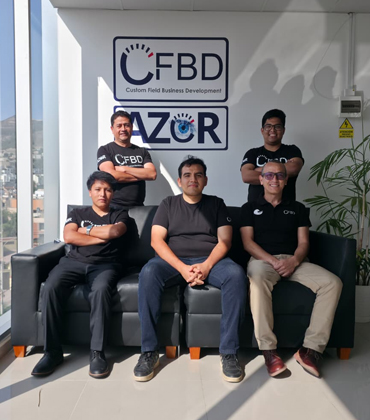 Carlos Barrientos Di Liberto, CEO
Serving government and enterprise clients, CFBD’s technical team immerses itself in each environment, adopts the client’s vision as its own and applies the technology best suited to the actual need. Throughout its evolution, this client-centric approach has remained constant, guiding the company in delivering solutions that create real impact on clients' and partners' operations.
“What truly differentiates us isn't just the code, but our empathy and commitment,” says Carlos Barrientos Di Liberto, CEO.
From Raw Feeds to Focused Decisions
The AZOR Orchestrator serves as the common operating layer within the AZOR ecosystem, bringing together information from VMS environments, sensors and AI-processed sources. This centralized environment helps reduce information silos and technological fragmentation.
AZOR extends that environment beyond passive monitoring by converting unstructured video into structured, searchable metadata. Through proactive intelligent surveillance, it continuously detects and tracks multiple people or objects, evaluates speed, trajectory, dwell time and distance, and then organizes the observations into a searchable knowledge library by type, color and behavior. The structured metadata enables forensic searches in seconds, replacing hours of manual review while generating visual dashboards for decision-making.

What truly differentiates us isn't just the code, but our empathy and commitment.

That intelligence is useful beyond traditional security monitoring. Safety, logistics and facilities teams can use the same structured information to identify workflow bottlenecks, spatial usage patterns and other operational anomalies.
Within the semi-automated workflow, AZOR Analytics serves as the intelligence layer, developing cutting-edge, customized computer vision analytics for various market verticals. Wherever there is a camera, there is a target, and AZOR Analytics can process the camera stream in real time to identify risk patterns and help organizations achieve their objectives.
The AZOR Panel– its analyst-facing alert interface–receives only AI-filtered events for validation. This reduces continuous screen monitoring, limits analyst fatigue and allows instant validation of incidents.
Interactive mapping and automated geolocation help teams locate devices and incidents across large sites, while analytical rules like loitering detection help reduce false positives. CFBD also emphasizes responsible AI, using dynamic object blurring to protect privacy in non-essential footage while preserving forensic metadata.
Recent work with a centralized C4 operations center shows its workflow in practice. The client needed to connect private video devices and use the information more effectively for public safety. CFBD integrated the devices with AI for predictive public safety, sending real-time alerts through AZOR. The deployment improved efficiency and response while enriching information for safety decisions and supporting citizen engagement.
Bridging Legacy Infrastructure with Next-Gen Computing
CFBD’s hybrid architecture allows organizations to adopt next-gen capabilities without triggering costly ‘rip-and-replace’ cycles of legacy infrastructure. Software like Windows XP can be encapsulated within modern hyperconverged infrastructure, keeping its data accessible to cloud and edge AI pipelines while extending asset lifecycles.
Edge Gateways bridge analog and IP camera networks by converting legacy feeds into digital streams for AI analysis. AI models then process high-definition video close to the source before sending lightweight metadata, alerts and keyframes to the AZOR Orchestrator. This edge-to-cloud approach reduces bandwidth consumption by 80 to 90 percent while maintaining sub-second response times.
The hybrid model also keeps cost and sustainability in focus. It lowers initial capital expenditure by avoiding complete hardware replacements. Extending hardware lifecycles and using hyperconverged virtualization reduce electronic waste while making ongoing operational expenditure more predictable and scalable.
CFBD’s engineering philosophy returns to a simple principle that technology should solve the problem in front of the user. Its focus remains on turning complexity into practical intelligence that clients can act on and build upon, while applying solutions around what they actually need.
Architecture Fit Before AI Analytics Investment
A software engineering and AI analytics purchase can fail long before model accuracy becomes a concern. The bigger challenge is often the handoff between existing infrastructure and new analytics, especially when camera networks and edge devices were never designed to share context. Replacing everything may simplify architecture on paper, but it can strain capital requirements and stretch deployment timelines. Buyers need to know whether a platform can work across existing technology boundaries without turning modernization into a wholesale infrastructure project.
Integration depth is therefore more revealing than the number of AI features on a product sheet. A useful platform should accept heterogeneous inputs and expose their data through a common control layer without forcing every piece of existing hardware to conform to one technical standard. It should also preserve the usefulness of legacy assets while making their information accessible to newer analytics. That matters in distributed environments where hardware replacement may be slow or economically unjustified. The real question is whether modernization can proceed around installed infrastructure rather than requiring a clean slate.
Real-time analytics creates an attention problem of its own. Video feeds and sensor events can overwhelm staff when every detection is treated as equally important. Buyers should examine how a platform separates routine activity from events that merit human review, and then look at how quickly those events reach the people responsible for validation. The difference between raw monitoring and useful analytics lies in this filtering step. A system that produces more alerts without improving prioritization merely transfers workload from observation to triage.
Architecture becomes more consequential as data volumes rise. Sending every high-definition stream to a centralized cloud environment can create avoidable bandwidth costs and response delays. Edge processing can reduce that burden when analytics are performed close to the source and only selected information moves upstream. Yet edge deployment introduces management demands. Devices and application services still need a coherent way to exchange information and support later investigation. Buyers should also examine how much infrastructure complexity is added when analytics move closer to the source.
“CFBD’s hybrid architecture connects legacy environments to newer computing infrastructure through hyperconvergence and virtualization.”
Searchability deserves equal importance. Once video or sensor data has been transformed into structured metadata, teams should be able to move from live detection to later investigation without manually reviewing hours of footage. Useful systems retain descriptive attributes and behavioral context in forms that can be queried quickly. The buying question is whether that context survives across live monitoring and retrospective analysis rather than being trapped in separate workflows. Fast retrieval matters because delayed investigation can erase much of the advantage gained from real-time detection.
CFBD merits consideration for buyers facing this mix of integration pressure and analytics workload. Its AZOR Ecosystem, a real-time data orchestration platform, centralizes video and sensor information. AZOR Panel, a centralized monitoring interface, receives AI-filtered events for human validation. AZOR Analytics, a video analytics component, supports real-time and forensic analysis, while edge gateways can process video near the source and pass lighter event data upstream. Its hybrid architecture connects legacy environments to newer computing infrastructure through hyperconvergence and virtualization. The fit is strongest where replacement costs and operator overload are material constraints. For organizations that need AI analytics without discarding usable infrastructure, CFBD is a practical choice. ...Read more
Software Engineering and AI Analytics Platforms in Latin America Info
Q1
What Does a Software Engineering & AI Analytics Platform in Latin America Help Organizations Do?
A Software Engineering & AI Analytics Platform in Latin America brings software engineering, artificial intelligence and data analysis into one working environment. It can connect video, sensor and system information that would otherwise sit in separate tools, then make those inputs easier to search and interpret. The practical gain is a clearer path from raw data to useful information. Teams can review events in context, spot relevant patterns and spend less time manually checking every incoming feed.
Q2
How Does CFBD Apply Software Engineering and AI Analytics in Practice?
CFBD uses its AZOR platform to put the Software Engineering & AI Analytics Platform in Latin America approach into practice. AZOR Orchestrator gathers data from sensors, video systems, and AI sources. AZOR Panel shows AI-filtered events for analysts to check, and AZOR Analytics uses custom computer vision analytics on live camera streams. This setup helps users turn unstructured visual data into organized alerts and searchable records, bringing together data input, analysis, and human review in one place.
Q3
What Types of Data Can This Kind of Platform Bring Together?
A Software Engineering & AI Analytics Platform in Latin America can work across video streams, sensor signals, event metadata and information from existing computing systems. The goal is not to collect more data for its own sake. It is to make different sources easier to read together. Once unstructured inputs become searchable information, users can investigate events, identify patterns and build a more consistent picture of activity, even when the underlying systems were introduced at different times.
Q4
Which Capabilities Matter When Evaluating AI-Driven Engineering Platforms?
A Software Engineering & AI Analytics Platform in Latin America should support flexible integration, real-time processing, searchable analytics, privacy controls and a clear role for human review. Architecture matters too. A platform that works with existing systems may limit the disruption of replacing equipment or software that still serves a purpose. Buyers should also look at whether analytics produce useful alerts rather than simply adding more data, and whether the system can expand in stages as requirements change.
Q5
How Does CFBD Connect Legacy Infrastructure With Modern AI Workloads?
CFBD supports the Software Engineering & AI Analytics Platform in Latin America category with a hybrid architecture that links older systems to newer computing environments. Its approach can place legacy software inside hyperconverged infrastructure, while edge gateways convert older camera feeds into digital streams for AI analysis. Processing can happen close to the data source before metadata, alerts and selected visual information move into AZOR, allowing existing assets to take part in a modern analytics workflow.
Q6
How Can AI Analytics Improve Day-to-Day Decisions?
A Software Engineering & AI Analytics Platform in Latin America can filter large volumes of information into events, patterns and context that people can act on. Computer vision analytics can structure video information, while dashboards and alert interfaces help users focus on what needs review. The practical benefit is better continuity between data collection and decision-making. Organizations can keep useful infrastructure in service, reduce information silos and build a more consistent view across connected systems.
Company
CFBD
Management
Carlos Barrientos Di Liberto, CEO
Description
CFBD develops software and AI-driven solutions that turn fragmented video and sensor data into actionable operational intelligence. Its AZOR Ecosystem connects legacy and modern infrastructure, centralizing information while reducing analyst burden and preserving existing assets.
