-
Technology
-
Industry
-
Solutions
-
- ASSET MANAGEMENT
- CUSTOMER EXPERIENCE MANAGEMENT
- CYBER SECURITY
- DATA CENTER
- DOCUMENT MANAGEMENT
- ELECTRONIC DATA INTERCHANGE
- ENTERPRISE DATA MANAGEMENT
- ENTERPRISE RESOURCE PLANNING
- ENTERPRISE RISK MANAGEMENT
- ENTERPRISE-GRADE WEB DATA SOLUTIONS
- FACILITY MANAGEMENT
- FIELD SERVICE
- IDENTITY AND ACCESS MANAGEMENT
- INFRASTRUCTURE
- IT SERVICE MANAGEMENT
- MANAGED IT SERVICES
- PAYMENT AND CARD
- PROJECT MANAGEMENT
- SOFTWARE TESTING
- STORAGE
- VIDEO SOLUTIONS
- WORKFLOW
-
-
Platforms
-
Functions
- Leadership Perspectives
- Innovation Insights
- Research
- Magazines
- News
- CXO Awards












Innovation & Governance Through Business Alliances
Larissa Tosch, CIO, Glatfelter Insurance Group

Larissa Tosch, CIO, Glatfelter Insurance Group
A company who innovates is not the same as a company who is innovative. I believe the distinction is in the culture and the execution. This article discusses innovation, governance, and business/IT alliance in the context of an IT department that exists within an insurance company.
Innovation is not limited to grand inventions, gadgets, and solving world hunger. It is anything that challenges convention while simultaneously asking ourselves how far outside the box we can go while still gaining customer acceptance. Creating an innovative culture begins with leaders who are willing to ask, “how can we make this work” in lieu of “here’s why it won’t work”. An innovative culture cannot persist where ideas are consistently ignored or failures are punished.
With that said, we must carefully choose where the risk of failure is acceptable. Consider this: the insurance industry is one of risk mitigation... and innovation inherently creates risk. In today’s world, expectations for technology are high and the general tolerance for error is low. This is true for our customers, our employees, business partners, and vendors. A true culture of innovation is one that is focused on fulfilling a business need, resolving a business issue, or enabling new business capabilities. Technological advancement cannot follow a “build it and they will come” mantra, unless it solves a real problem at a price that is worth the investment.
“Innovation and governance are interdependent polarities, and must therefore be maintained in balance.”
The choice to innovate requires a willingness, at a personal level, to be uncomfortable. Behaviors that promote fear of failure and loss aversion will also promote the status quo. In a highly regulated industry, comprised of risk-averse business professionals with high expectations, how does an internal IT department innovate successfully? How do we encourage innovation without creating chaos? We do this through governance.
 Governance, in this context, is not bureaucratic, but a means to mitigate chaos. If IT and the business unit operate as allies, both innovation and governance are driven by a shared commitment to making the company better. It is no longer acceptable for technologists (whether a DBA, a technician, a developer, or an analyst) to build exactly what the business unit specifies. By building only to the literal voice of the customer (without an understanding of the business need), IT deliverables will at best provide incremental improvement. To be successful, IT must become a strategic, as only those initiatives with well-articulated business propositions will gain executive sponsorship. While most IT departments begin as service/cost centers, a mature department establishes a partnership to realize business value through technology.
By understanding the business and the technology, IT professionals can offer suggestions that the business may not have even considered possible. While our business unit partners are far better versed in technology than they were twenty years ago, it is unreasonable for us to expect business professionals to understand the detailed inner workings of information technology. IT should consider business knowledge as part of their continuing education goals, and should utilize their business unit partners as subject matter experts.
A successful IT department must maintain existing systems that meet functional business needs while building new ones in scalable ways to meet future (and uncertain) business strategies. For example, a regulatory insurance update may be required at the same time as Microsoft de-supports a version of their Office suite. The business effort cannot wait for technology update, and the vendor cannot wait on for business effort. An appropriate governance model assures that both areas are incorporated.
Innovation and governance are interdependent polarities, and must therefore be maintained in balance. Addressing one at the expense of the other will not yield positive results for the organization. If too heavily governed, the IT department becomes an order-taker and fails to recognize points of inflection where technology can help the business to advance. As a result, the technology becomes stale and the business perceives IT as a mechanism to merely keep the lights on. If the focus is solely on innovation, the IT department becomes a loose-cannon and fails to deliver regulatory items. As a result, the day-to-day business operation suffers and IT is perceived as being a cost center that fails to deliver.
Establishing and maintaining this balance requires an IT/business alliance, a relationship that shares a common purpose and mutual benefit. With the ongoing dependence on technology, it is crucial for this alliance to articulate a clear vision, set ambitious goals, accept that certain constraints will exist, and then focus on helping the people to meet the vision, goals, and within the constraints.
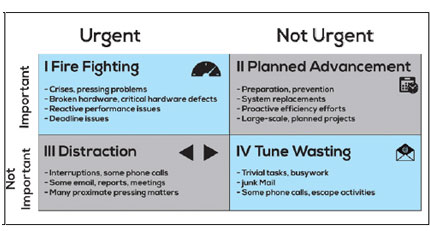
Using Covey’s theory of time management, IT activities can be organized into quadrants based upon importance and urgency.
The obvious goal is to spend more time in Quadrant II, ultimately reducing investment in Quadrant I. We do this by architecting solutions to provide better efficiency, scalability, and quality. While those solutions are being built, we must continue managing work in I and III (always challenging IV). By utilizing both innovation and governance, IT departments can foster positive business relationships to deliver innovative long-term strategies while not sacrificing short-term regulatory deliverables.
Innovation is typically absorbed in Quadrant II where the effort is important but non-urgent. This allows for effective planning and tolerable risk. To support for such efforts, we must sometimes stop-the-bleeding in Quadrant I with a temporary solution. You must ask yourself how much time you’re willing to invest in a short-term solution relative to the value it brings. In most cases, an interim solution adds business unit value quickly, while buying more time and opportunity to explore innovative ideas for the longer-term solution.
In some organizations, interim solutions are frowned upon, but that often results in a frustrated business unit (who sees no value until it’s finished), and sacrifices “good now” in the interest of “perfect later”. It is only through trust and collaboration that both can be accomplished in the best interest of the organization. A culture of governance and innovation enable such an alliance.