-
Technology
-
Industry
-
Solutions
-
- ASSET MANAGEMENT
- AUGMENTED & VIRTUAL REALITY
- COLLABORATION
- CONVERSATIONAL
- CUSTOMER EXPERIENCE MANAGEMENT
- CUSTOMER RELATIONSHIP MANAGEMENT
- CYBER SECURITY
- DATA CENTER
- DIGITAL CUSTOMER EXPERIENCE
- DOCUMENT MANAGEMENT
- EHS SOFTWARE
- ELECTRONIC DATA INTERCHANGE
- ENTERPRISE DATA MANAGEMENT
- ENTERPRISE DATA QUALITY MONITORING
- ENTERPRISE RESOURCE PLANNING
- ENTERPRISE RISK MANAGEMENT
- ENTERPRISE-GRADE WEB DATA SOLUTIONS
- FACILITY MANAGEMENT
- FIELD SERVICE
- GAMIFICATION
- IDENTITY AND ACCESS MANAGEMENT
- INFRASTRUCTURE
- IT SERVICE MANAGEMENT
- MANAGED IT SERVICES
- PAYMENT AND CARD
- PROJECT MANAGEMENT
- SOFTWARE TESTING
- STORAGE
- VIDEO SOLUTIONS
- WORKFLOW
-
-
Platforms
-
Functions
- Leadership Perspectives
- Innovation Insights
- Research
- Magazines
- News
- CXO Awards


UltronAI: A Retail AI Foundation Model Built on SKU-Accurate Product Identification

 A Retail AI Foundation Model Built on SKU-Accurate Product Identification
What causes errors and false positives in traditional self-checkout retail systems today?
At self-checkout counters, a customer scans an item, places it in the bagging area and the system flags an error. An associate is called, even though nothing was done incorrectly.
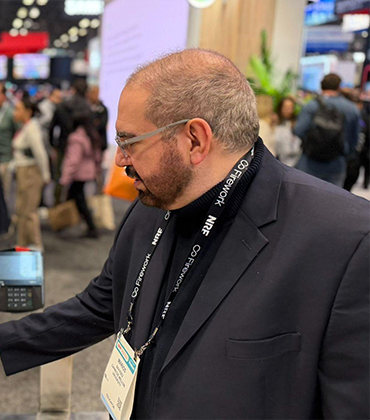
Marios Savvides, Founder and CEO of UltronAI, explains, this happens more often than expected.
Many retail systems rely on behavioral signals to determine what is happening at checkout. But those signals can be misleading because they do not confirm the product itself.
Barcode scanners only register what they read, not what is being processed. Packaging variations, scanning angles or deliberate barcode switching create gaps in visibility. As a result, customers are flagged for normal actions when a barcode fails, while deliberate discrepancies can still go undetected, leading to false positives and unnecessary friction.
UltronAI delivers SKU-accurate product identification during the transaction itself, allowing the system to verify what is actually scanned in real time. This approach draws on more than two decades of recognition research originally developed for national security applications.
From Assumption to Verification at Checkout
How does real-time visual recognition improve product verification accuracy during checkout transactions?
“At the end of the day, you cannot cheat what the camera sees. If an AI system can identify a face among millions of people, recognizing a product among thousands of stock-keeping units (SKU) becomes a solvable problem,” says Savvides.
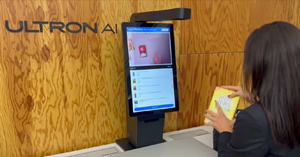 Cameras positioned above checkout lanes use multi-view recognition and real-time edge inference to match the physical item with the transaction as it occurs. If a barcode fails to register, the system recognizes the product and adds it to the purchase without interrupting checkout. If the scanner reads one item while another is detected, the discrepancy is immediately flagged.
The UltronAI platform can recognize more than 250,000 products at 40–45 frames per second, serving as a scalable retail foundation model.
Real-Time Performance That Fits Retail Economics and Scales with Change
Why is edge-based AI deployment important for cost efficiency and scalability in retail environments?
Rather than relying on cloud inference or high-cost infrastructure, UltronAI operates on compact edge hardware.
Retail environments are cost-sensitive, making large infrastructure investments difficult to justify. Running advanced recognition models on low-power devices, such as Hailo AI accelerator chips that consume roughly two watts, makes the system technically and economically viable. In a demonstration at NRF, UltronAI integrated with an ELO POS platform, where the camera identified products faster than the barcode scanner.
The platform also integrates with existing retail infrastructure through APIs and hardware platforms, working with ODM and OEM partners, and runs across NVIDIA Jetson devices, Qualcomm processors and Intel chipsets, allowing deployment without disrupting current systems.
This flexibility is critical in dynamic retail environments, where products and assortments constantly evolve. UltronAI supports zero-shot SKU enrollment, enabling new products to be onboarded using a single image without retraining.
A Full Portfolio of Retail AI Applications
In what ways can computer vision enhance inventory management and in-store operational intelligence?
Beyond self-checkout, UltronAI has built an integrated suite of seven product offerings spanning the store: AP secure barcode checkout, CV-only checkout, multi-camera checkout, staffed lane augmentation, scan-and-go cart validation and shelf inventory monitoring in both fixed and mobile deployments.
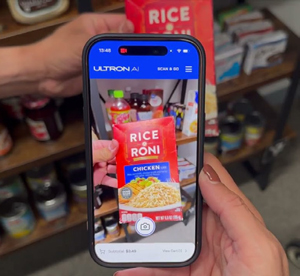 The platform’s shelf and inventory capability analyzes images to detect when items are misplaced, running low or out of stock. Store teams receive alerts that enable faster restocking and prevent lost sales, improving visibility across the store.
The same foundation supports augmented store intelligence. Through AR-enabled devices, associates can access product information, inventory insights and shelf compliance data directly in the aisle, helping them locate items and maintain planogram accuracy more efficiently.
This expansion is grounded in a broader body of work. UltronAI has filed more than 80 patents in computer vision and AI, with over 50 already granted, reflecting two decades of innovation rooted in Carnegie Mellon University’s research in large-scale recognition systems. Savvides was named a 2025 Fellow of the National Academy of Inventors, one of the highest professional distinctions for academic inventors, and has also received recognition from leading defense research organizations.
Building on this foundation, UltronAI is now exploring augmented reality experiences powered by smart glasses, enabling associates to locate products instantly while giving shoppers access to real-time product information and recommendations.
By combining scalable AI models with low-cost deployment, UltronAI is making advanced computer vision practical for everyday retail environments, extending product identification from checkout into a system-wide layer of operational intelligence. This is why the company stands out as a Top AI-Powered Computer Vision Retail Solutions Provider for 2026.

At the end of the day, you cannot cheat what the camera sees. If an AI system can identify a face among millions of people, recognizing a product among thousands of stock-keeping units (SKU) becomes a solvable problem.

The platform also integrates with existing retail infrastructure through APIs and hardware platforms, working with ODM and OEM partners, and runs across NVIDIA Jetson devices, Qualcomm processors and Intel chipsets, allowing deployment without disrupting current systems.
This flexibility is critical in dynamic retail environments, where products and assortments constantly evolve. UltronAI supports zero-shot SKU enrollment, enabling new products to be onboarded using a single image without retraining.
A Full Portfolio of Retail AI Applications
In what ways can computer vision enhance inventory management and in-store operational intelligence?
Beyond self-checkout, UltronAI has built an integrated suite of seven product offerings spanning the store: AP secure barcode checkout, CV-only checkout, multi-camera checkout, staffed lane augmentation, scan-and-go cart validation and shelf inventory monitoring in both fixed and mobile deployments.
The platform’s shelf and inventory capability analyzes images to detect when items are misplaced, running low or out of stock. Store teams receive alerts that enable faster restocking and prevent lost sales, improving visibility across the store.The same foundation supports augmented store intelligence. Through AR-enabled devices, associates can access product information, inventory insights and shelf compliance data directly in the aisle, helping them locate items and maintain planogram accuracy more efficiently.
This expansion is grounded in a broader body of work. UltronAI has filed more than 80 patents in computer vision and AI, with over 50 already granted, reflecting two decades of innovation rooted in Carnegie Mellon University’s research in large-scale recognition systems. Savvides was named a 2025 Fellow of the National Academy of Inventors, one of the highest professional distinctions for academic inventors, and has also received recognition from leading defense research organizations.
Building on this foundation, UltronAI is now exploring augmented reality experiences powered by smart glasses, enabling associates to locate products instantly while giving shoppers access to real-time product information and recommendations.
By combining scalable AI models with low-cost deployment, UltronAI is making advanced computer vision practical for everyday retail environments, extending product identification from checkout into a system-wide layer of operational intelligence. This is why the company stands out as a Top AI-Powered Computer Vision Retail Solutions Provider for 2026.

