-
Technology
-
Industry
-
Solutions
-
- ASSET MANAGEMENT
- CUSTOMER EXPERIENCE MANAGEMENT
- CYBER SECURITY
- DATA CENTER
- DOCUMENT MANAGEMENT
- ELECTRONIC DATA INTERCHANGE
- ENTERPRISE DATA MANAGEMENT
- ENTERPRISE RESOURCE PLANNING
- ENTERPRISE RISK MANAGEMENT
- ENTERPRISE-GRADE WEB DATA SOLUTIONS
- FACILITY MANAGEMENT
- FIELD SERVICE
- IDENTITY AND ACCESS MANAGEMENT
- INFRASTRUCTURE
- IT SERVICE MANAGEMENT
- MANAGED IT SERVICES
- PAYMENT AND CARD
- PROJECT MANAGEMENT
- SOFTWARE TESTING
- STORAGE
- VIDEO SOLUTIONS
- WORKFLOW
-
-
Platforms
-
Functions
- Leadership Perspectives
- Innovation Insights
- Research
- Magazines
- News
- CXO Awards


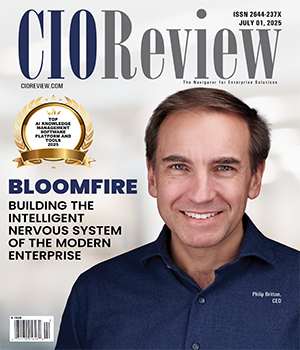
Knowledge is frequently cited as one of a company’s most vital resources, but often remains undervalued and underleveraged. According to recent research, 46 percent of employees say their workdays would be significantly more productive if knowledge flowed more freely. Companies that invest in knowledge management reduce barriers to accessing information by 59 percent. Still, most enterprises struggle with a fundamental challenge: ensuring people can find, trust, and act on the right information, at the right time. Bloomfire, the pioneering knowledge management platform based in Austin, Texas, has spent more than a decade trying to solve this. Now, under the leadership of CEO Philip Brittan, the company is evolving its mission from knowledge sharing to something even more ambitious: powering Enterprise Intelligence. “We’ve been successful in the knowledge management and AI-powered enterprise search space for years,” Brittan says. “We have some of the world’s leading Fortune 500 companies using us. Customer needs and expectations are evolving, and we’re innovating to meet them.” It’s about redefining how knowledge flows through organizations, how insights surface and drive action, and how companies can use collective intelligence as a strategic differentiator. For Bloomfire, this is more than just a new direction—it’s the beginning of a much-needed and valuable new category. From Repository to Intelligence Engine Bloomfire made its mark by providing a platform that helped businesses centralize and share internal knowledge. The company’s intuitive interface, powerful search tools, and deep integrations earned it a strong foothold with enterprises seeking to eliminate silos and boost employee productivity. But as workplace tools and AI have advanced, expectations have changed. The question has evolved from “Where is this information?” to “Why didn’t I have this answer before I even asked?” Bloomfire’s response has been to rethink its platform as an active, learning network—a digital nervous system that dynamically senses, connects, and delivers self-healing knowledge throughout an organization. Instead of relying on manual tags or categories, the platform uses AI and context to anticipate needs, recommend content, and connect employees to the people and decisions that matter most. This transition reflects what Bloomfire calls “Enterprise Intelligence”—a strategic approach to managing institutional knowledge that emphasizes not just access, but knowledge quality, insight, integration, and impact. Unifying Knowledge in a Fragmented World The case for Enterprise Intelligence is driven by urgency. Organizations are under pressure from multiple fronts: rapid digital transformation, the widespread adoption of AI, economic constraints, and a shift in employee expectations regarding tools and transparency. Most companies now operate in a fragmented tech landscape, where data lives across dozens of platforms—CRM systems, cloud drives, project management tools, and internal wikis. Navigating that chaos has become a daily frustration for workers and a major business cost. Bloomfire’s own research highlights the problem. In a recent industry study on The Value of Enterprise Intelligence, knowledge workers reported spending up to a full day each week searching for information across systems. That time isn’t just unproductive—it’s a momentum killer.
Digital Magazine
Top Revenue Cycle Management Systems 2025
Healthcare providers save lives every day, but getting paid for their services is a different challenge. In most industries, payments are straightforward, but healthcare payments are fragmented. Hospitals receive paper checks, virtual cards, electronic transfers, and extensive documentation—Explanation of Benefits (EOBs), remittance advice, and denial notices—filled with complex codes and conditions. Manually sorting through these documents to match payments with patient accounts leads to delays and human error, slowing revenue collection and tying up valuable resources. This is where CereSoft comes in. CereSoft’s AI-powered automation platform simplifies the complex healthcare revenue cycle management (RCM) process by capturing, analyzing, and transforming payment data into clean, digital files. By automating these tasks, hospitals can reduce delays, minimize errors, and free up staff to focus on patient care. “We extract information using intelligent document understanding, convert it into electronic data interchange (EDI) files, and send it directly to providers’ billing systems. This reduces manual labor, simplifies EOB parsing, and creates significant business benefits for banks, providers, and others in the RCM process,” says Dr. H.H. Chen, CEO of CereSoft. Automation That Pays Off Hospitals and healthcare providers access CereSoft’s services through the MedAR portal, a cloud-based system that delivers real-time visibility into payment statuses and reconciliation progress. Each evening, providers send their daily batches of payment documents to CereSoft. By the following morning—typically within a 15-hour turnaround—the processed, digitized data is ready for use. This streamlined workflow enables large hospital groups that process billions of dollars in transactions each year to quickly reconcile incoming funds, close financial cases faster, and reduce errors that could lead to delays or denials. CereSoft’s impact on healthcare finance is significant. Its automation of document handling and reconciliation helps providers reduce administrative labor, improve data accuracy, and accelerate cash flow. Instead of spending hours manually matching payments to patient accounts, managing denials, or sorting through unstructured correspondence, staff can focus on higher-value tasks such as resolving exceptions or improving patient-facing services.

Top AI Native Procurement Platform 2025

When Workday acquired their procurement startup Scout RFP in 2019, co-founders Alex Yakubovich and Stan Garber thought the hardest part was behind them. Instead, they ran straight into the same friction everyone else experiences. Need a document signed? Delayed. Ordering event materials? Complicated. Adding a new software seat? A bureaucratic maze. These weren’t edge cases—they were everyday headaches. As they spoke with others in the industry, the pattern became clear: procurement pain points weren’t isolated—they were everywhere. So, they set out to fix it. But not by guessing. From day one, they brought strategic procurement and operations leaders into the process—not as testers, but as true partners. These collaborators helped shape the product through ongoing feedback, telemetry insights, and roadmap alignment sessions. One thing quickly became obvious: solving procurement at scale required more than just streamlining—it needed AI. Not as a bolt-on, but at the core. That’s how Levelpath was born—an AI-native platform built from the ground up with a unified data model and deeply embedded intelligence, designed to make procurement faster, smarter, and friction-free—from the first request to final approval. This isn’t AI tacked on as a feature; it powers how the entire system works. Instead of clunky intake forms and manual handoffs, users interact with a smart, conversational interface that guides requests in real time—ensuring accuracy, alignment, and momentum from the start. “We’ve spent years in the procurement space, building the technology behind it. Our goal isn’t just to modernize—it’s to create a foundation that makes procurement faster, more accurate, and fully transparent,” says Alex Yakubovich, CEO. By addressing the most persistent procurement challenges—fragmented intake, low user adoption, slow approval cycles, and siloed collaboration—Levelpath gives teams full visibility and control. The platform eliminates manual work and unifies legal, finance, and procurement through real-time updates, alerts, and audit trails. It automates complex workflows by understanding context and intent, dynamically routing requests, pre-filling data, and predicting next steps based on historical patterns. This eases the burden on users and simplifies tasks like submitting purchase requests or managing vendor onboarding.
CXO INSIGHTS

The Procurement Clock: Maximizing Value through Early Project Engagement
Steve Walker, Director, IT Procurement and Category Management, Delaware North

The Importance of Platforms for a Knowledge Management Strategy at Enel Green Power North America
Brian Stice, Director, Training & Knowledge Management, North America, Enel Green Power

The Perils of Big Data In Procurement
Fabio Baldassari, Senior Procurement Director, Niagara Bottling

Driving Innovation and Modernization
Brian Shultz, Chief Information Officer, Cruise Planners

Challenges To Data Analysis In Hospitality Industry
Mike Kuzmar, Vice President Business Intelligence and First Analytics, First Hospitality

Integrating Digitization in Revenue Management
Kremena Matzelle, Vice President of Revenue Management, Vision Hospitality Group

Leading With Purpose: Elevating Revenue Strategy Through Connection
Lorenzo Pedone, Director of Revenue Management, InterContinental Miami Hotel


IN FOCUS

Rise of AI-Powered Knowledge Management Software Platforms and Tools
In today's fast-paced digital economy, efficiently harnessing, managing, and utilizing knowledge has become a critical asset for organizations of all sizes. Traditional knowledge management systems (KMS) have long served as repositories of organizational information.

Beyond Billing: RCM Systems Driving Healthcare Value
RCM systems enhance healthcare efficiency by streamlining billing and claims processing, improving operational challenges and stakeholder satisfaction.
EDITORIAL
Building Smarter Businesses with AI-Driven Systems
Modern businesses are under pressure to move faster, make better decisions and reduce inefficiencies. To meet these expectations, organizations are turning to AI-powered platforms that simplify complex operations, automate routine work and seamlessly connect teams with the information they need, whenever and wherever.
Continue ReadingIn this edition of CIOReview, we explore how businesses are increasingly leveraging intelligent systems to streamline their day-to-day operations, optimize outcomes and stay ahead of the industry.
Traditional knowledge management systems often become cluttered and hard to use, resulting in employees wasting time searching for documents or answers. AI-based knowledge platforms solve this by organizing information intelligently, surfacing relevant insights automatically and learning from how teams work. They are turning scattered knowledge into a living, accessible resource.
Hospitals face a different kind of complexity: managing their revenue cycle. Billing errors, payment delays and administrative overhead take up valuable time. AI-driven revenue cycle management systems convert payment data into clean digital files, reducing manual entry and improving accuracy. These platforms speed up reimbursement, cut down costly mistakes and free up medical staff to focus on patient care instead of tedious paperwork.
Procurement is another area where AI is making a tangible difference. Disconnected tools, slow approvals and a lack of transparency continue to hinder companies from performing at their best. AI-powered procurement platforms fix this by streamlining the entire process. Teams can track requests, approvals and spending in real-time. Legal, finance and procurement stay aligned through shared dashboards, alerts and audit trails. The result is faster decision-making, reduced error margin and better spend control.
These systems may serve different functions but share the same goal—helping organizations work smarter. They reduce noise, eliminate delays and give teams the clarity and confidence to act quickly.
The future of work isn’t about doing more; it’s about doing things better. AI-powered platforms give companies the tools to focus on what matters and stay ahead in a fast-moving world.
We hope this edition of CIOReview helps you find the right partner for your business requirements. Let us know your thoughts!
