-
Technology
-
Industry
-
Solutions
-
- ASSET MANAGEMENT
- CUSTOMER EXPERIENCE MANAGEMENT
- CYBER SECURITY
- DATA CENTER
- DOCUMENT MANAGEMENT
- ELECTRONIC DATA INTERCHANGE
- ENTERPRISE DATA MANAGEMENT
- ENTERPRISE RESOURCE PLANNING
- ENTERPRISE RISK MANAGEMENT
- ENTERPRISE-GRADE WEB DATA SOLUTIONS
- FACILITY MANAGEMENT
- FIELD SERVICE
- IDENTITY AND ACCESS MANAGEMENT
- INFRASTRUCTURE
- IT SERVICE MANAGEMENT
- MANAGED IT SERVICES
- PAYMENT AND CARD
- PROJECT MANAGEMENT
- SOFTWARE TESTING
- STORAGE
- VIDEO SOLUTIONS
- WORKFLOW
-
-
Platforms
-
Functions
- Leadership Perspectives
- Innovation Insights
- Research
- Magazines
- News
- CXO Awards


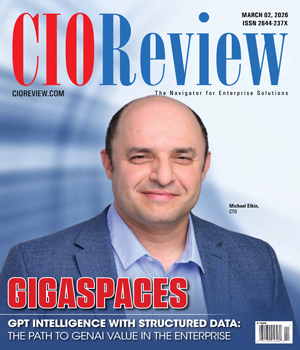
Enterprise AI has moved beyond conversational fluency. Success for enterprise operators now depends on intelligence that can operate inside systems where revenue is generated and obligations are enforced, while decisions are unfolding in real time. Conversational ability alone no longer changes outcomes. Timely execution does. For decades, critical enterprise systems such as ERP platforms, CRM databases and operational data stores have resisted natural language interaction. Business intelligence systems filled the gap but only offered analysis of what had already happened. GigaSpaces addressed this constraint by moving AI from after-the-fact analysis into live operational execution. Its flagship solution, eRAG allows intelligence to operate directly on structured operational data where business rules, obligations and execution logic already reside. By emphasizing semantic accuracy, the platform enables probabilistic language models to function reliably inside deterministic enterprise systems. eRAG enables natural language interaction with live operational systems. Rather than focusing on answering more questions, it is designed to support earlier intervention in decisions, allowing users to adjust actions while execution is underway. “Operators can now ask in real-time why a shipment is delayed or why a sensor reading has spiked and receive answers while assets are still in motion,” says Michael Elkin, CTO. This ability to intervene during execution rather than after the fact earned GigaSpaces recognition as the Top AI-Powered Structured Operational Data Solution of 2026. Much of its capabilities is rooted in GigaSpaces’ origins. For more than two decades, the company has specialized in low-latency, in-memory computing and Digital Integration Hubs that support high-throughput operational systems. When large language models became viable, GigaSpaces, with its extensive experience in structured data, is enabling AI to operate directly within live enterprise systems and understand not just data, but its organizational context. A Digital Teammate that Learns the Business In enterprise systems, meaning is rarely self-evident. A column labeled “T_15_STAT” may signal an urgent delivery condition, while a “Friday Report” may represent a specific internal revenue construct. These definitions are obvious to employees, but invisible to language models unless that context is learned.
Digital Magazine
Top Regulatory Private Data Network Compliance Software 2026
The AI race has fundamentally changed how enterprises think about data protection. Organizations are rushing to deploy large language models and AI-powered workflows, only to discover that traditional security architectures weren’t built for this moment. Sensitive data now flows into AI systems at unprecedented scale. Every interaction is a potential exposure point; proprietary information fed into prompts, confidential documents analyzed by third-party models, competitive intelligence absorbed into training datasets. Employees are feeding sensitive content into AI tools faster than security teams can establish guardrails. The question is how to embrace AI without hemorrhaging valuable assets. This challenge sits at the heart of what Kiteworks has built—an AI Data Gateway, Kiteworks Private Data Network (PDN). It helps organizations create a governed channel between their sensitive repositories and AI systems, ensuring only appropriately classified content reaches powerful but potentially risky AI tools. Kiteworks MCP Server extends this protection by enabling AI assistants to interact with enterprise content under strict policy controls. “With Kiteworks, innovation doesn’t come at the cost of compliance,” says Yaron Galant, chief product officer. “Our clients get intelligent automation, and security teams maintain oversight of every data exchange with comprehensive governance controls and end-to-end audit tracking.”

Managed Compute Cloud Solution of the Year 2026

Why is compute infrastructure limiting innovation across organizations today? Across startups and enterprises alike, innovation is increasingly constrained not by ideas, but by compute. Infrastructure is expensive, fragmented across clouds and data centers, and chronically underutilized. Developers spend time managing servers, scaling policies, and security configurations instead of building. CIOs face rising infrastructure bills while large portions of owned compute sit idle. Kinesis Cloud exists to remove this constraint by abstracting infrastructure entirely and making compute fluid, accessible, and commitment-free across environments. It is built to treat all compute, across public clouds, private data centers, and third-party facilities, as a single unified pool, dynamically selecting where workloads run based on cost, performance, compliance, or latency needs. As a result, organizations can run applications and AI workloads without managing servers, capacity planning, or long-term cloud commitments, whether they are deploying a new product, training models, or scaling globally. Instead of asking teams to adapt their work to infrastructure, Kinesis Cloud adapts infrastructure to how teams actually build. Abstracting Infrastructure So Builders Can Build How does Kinesis Cloud abstract infrastructure for modern AI workloads? At its core, Kinesis Cloud is a serverless, fully managed compute platform designed for modern AI and high-performance workloads. Infrastructure is unified into a single intelligent layer that automatically handles scaling, availability, security, and optimization across public clouds, private data centers, and hybrid environments. “Developers define what they want to run. The platform determines how and where it runs,” says Baris Saydag, co-founder and CEO. This abstraction removes friction by eliminating the operational tasks that typically slow teams down. Developers no longer need to provision servers or plan capacity in advance, configure scaling or availability policies, manage security controls or certificates, or lock themselves into long-term infrastructure commitments. Instead, compute adjusts automatically as demand changes, allowing teams to focus entirely on building and iterating without infrastructure becoming a bottleneck. Compute scales dynamically in real time, and billing is pay-per-use down to the millisecond. Teams pay only for what they consume, eliminating the cost of idle capacity and reducing spend compared with traditional cloud models. The platform automatically allocates and scales CPU and GPU resources across environments while optimizing both performance and cost. Organizations can innovate without provisioning, tuning, or overpaying for unused capacity.
Top Enterprise Grade Voice AI Agents Platform 2026
As organizations strive to deliver faster, more accurate and empathetic service, Voicing AI is elevating enterprise customer interactions by making digital conversations more natural and effective. It goes far beyond a wrapper for a language model, delivering an end-to-end synthetic voice agent platform that manages voice, chat and email in over 30 languages and integrates deeply with enterprise systems to drive efficient, reliable resolution. With sub-350ms response times, most natural voices and industry-leading accuracy in response generation, Voicing AI combines the speed and scale of automation with the judgment and empathy of human agents. Voicing AI listens, interprets intent, chooses the right path and completes tasks like updating bookings, changing itineraries or processing payments. The platform uses enterprise-approved knowledge to guide responses and contextual memory preserves context across interactions. It also features horizontal tuning across key use cases like customer service, collections and IT support, and is fine-tuned from industry-baseline 85 to enterprise-grade 97 percent accuracy through vertical-specific training. The agentic AI's three core components—covering communication, reasoning and task execution—ensure that every step is seamlessly coordinated. This architecture also supports multi-turn memory, enabling long-span, context-aware conversations that replicate the depth of human understanding. "Our goal is to bring humanity back to digital interactions and help enterprises build service experiences that customers can trust," says Abhi Kumar, co-founder of Voicing AI. He emphasizes that the platform is built with governed intelligence that operates within enterprise and regulatory boundaries, enabling it to act on the enterprise's behalf without stepping outside approved knowledge or compliance frameworks.

CXO INSIGHTS

How Cloud Computing Impacts Precision Agriculture Technology
Ruohan Liu, Senior Director, Global Operations, Agriculture Supply Innovation, PepsiCo

Specify, Simplify and Satisfy: The Future of Online Help
Janie Frank, CX Partner Communications Manager, Hunter Douglas, Inc

Self-Managed Storage Units With Embedded Artificial Intelligence
Federico Masias, Innovation Officer, Baird & Warner

From The Front Lines to Leading the Charge
Steven V. Hagen, Sr. Director of E-Commerce, Store POS & Store Tech Product, Advance Auto Parts

Strategic Leadership in Infrastructure Modernization
Adel Bekhiet, Senior Director of Infrastructure and Cloud Services, Northwestern Mutual

Fueling AI Excellence
Sean MacCarthy, VP of Analytics, Good Sam

Prioritize Record-Keeping and Mock Exams to Ensure Compliance
Colin Kinney, Senior Vice President, Global Chief Compliance Officer, Virtus Investment Partners


IN FOCUS
Elevating Operations: The Role of AI in Structured Data Solutions
AI-powered structured operational data solutions have emerged as a foundational capability for modern operational ecosystems where efficiency, accuracy, and coordination are critical.
Enhancing Compliance: Strategies for Modern Data Network Challenges
The regulatory compliance software space for private data networks is undergoing a measured but unmistakable transformation. As enterprise data environments grow in complexity, compliance is no longer viewed as a static obligation, but rather as a dynamic capability that must operate in real-time.
EDITORIAL
Operational Intelligence that Acts in Real Time
Enterprise AI is no longer measured by conversational fluency but by its ability to intervene while business decisions are still unfolding. Across industries, CIOs are demanding systems that operate within structured data environments, enforce governance, and produce measurable operational impact. This edition of CIOReview highlights platforms and leaders redefining how intelligence integrates with execution.
Continue ReadingEarning recognition as AI-Powered Structured Operational Data Solution of the Year 2026, GigaSpaces sets the benchmark for real-time operational reasoning. Its eRAG platform moves AI from retrospective analytics into live operational systems, enabling natural language interaction with structured enterprise data while preserving semantic accuracy and governance. By embedding intelligence directly within ERP, CRM, and logistics workflows, eRAG supports intervention during execution rather than after the fact. In renewable energy and logistics deployments, this real-time reasoning prevented contractual penalties and reshaped pricing strategy, demonstrating measurable business value.
Extending this theme of execution over abstraction, Kinesis Cloud is recognized as Managed Compute Cloud Solution of the Year 2026. By abstracting infrastructure across public and private environments, it enables fluid, commitment-free compute that scales dynamically for AI workloads. In data security, Kiteworks is recognized as Top Regulatory Private Data Network Compliance Software 2026, unifying external data exchanges within a governed Private Data Network that eliminates the gap between classification and enforcement. Meanwhile, Voicing AI is recognized as Top Enterprise Grade Voice AI Agents Platform 2026, delivering sub-350 millisecond multilingual voice agents that automate full workflows while operating within enterprise guardrails.
Leadership insight reinforces these priorities. Steven V. Hagen of Advance Auto Parts underscores simplicity, collaboration and strategic focus in digital commerce execution. Gary Fling of Phibro Animal Health Corporation emphasizes disciplined cloud transformation and cost-conscious value delivery.
Across structured data, fluid compute, governed exchange and intelligent automation, a common direction emerges. Enterprise advantage will belong to organizations that embed AI within operational systems while preserving control and accountability. We invite readers to explore how these leaders are translating intelligence into action at enterprise scale.
