- Technology
- Industry
- Solutions
-
- ASSET MANAGEMENT
- CUSTOMER EXPERIENCE MANAGEMENT
- CYBER SECURITY
- DATA CENTER
- DOCUMENT MANAGEMENT
- ELECTRONIC DATA INTERCHANGE
- ENTERPRISE DATA MANAGEMENT
- ENTERPRISE RESOURCE PLANNING
- ENTERPRISE RISK MANAGEMENT
- ENTERPRISE-GRADE WEB DATA SOLUTIONS
- FACILITY MANAGEMENT
- FIELD SERVICE
- IDENTITY AND ACCESS MANAGEMENT
- INFRASTRUCTURE
- IT SERVICE MANAGEMENT
- MANAGED IT SERVICES
- PAYMENT AND CARD
- PROJECT MANAGEMENT
- SOFTWARE TESTING
- STORAGE
- VIDEO SOLUTIONS
- WORKFLOW
-
- Platforms
- Functions
- Leadership Perspectives
- Innovation Insights
- Research
- Magazines
- News
- CXO Awards



 Bill Kantor, CEO and Founder
FUNNELCAST, a sales forecasting and pipeline optimization platform, takes a different view. It aims not simply to report the past or predict the future, but to help businesses change the future.
Bill Kantor, CEO and founder, sees a forecast as the starting point for action. Kantor describes the value proposition as helping businesses sell more and optimize, rather than merely report past results or predict future performance. That distinction puts the emphasis on decisions leaders can make, rather than on forecast precision.
Business-to-business sales rarely offer the conditions for precise predictions. Deals vary in size, timing, and probability. Unlike planetary motion, sales outcomes are shaped by changing circumstances—and sales teams can influence them.
FUNNELCAST begins with a baseline estimate of expected performance, then examines which controllable inputs could improve the result. Its models rank potential actions by impact. Key inputs include sales cycle length, win rate, deal size, and new-opportunity creation.
 Kantor challenges the idea that forecast accuracy is the best measure of a system. A team can make a forecast easier to hit by setting a conservative target and delivering against it. But that may come at the expense of growth. “You don’t want to be accurate in a sales prediction,” he says, describing the danger of allowing a low target to become the operating ambition. For FUNNELCAST, the better question is how a company can improve the outcome indicated by its model.
A Range of Possible Outcomes
The platform uses statistical modeling to assess individual opportunities. But Kantor is fast to point out that a deal score is a probability, not a fractional outcome: a deal either closes or it does not. Probabilities become useful in aggregate.
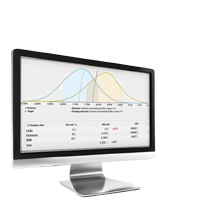
FUNNELCAST uses Monte Carlo simulation to turn those deal probabilities into a range of possible sales outcomes for the business. Leaders can consider the range and the likelihood of reaching a revenue goal, rather than rely on one definitive figure.
Time is essential to the calculation. A win rate has little meaning without a period attached. A 30 percent win rate achieved in a week means something different from the same rate achieved in a year. FUNNELCAST applies survival analysis, a method used in reliability research and biostatistics, to model the likelihood that a deal will close over time.

There's no single criteria for choosing what to work on. Leaders need to consider how resources distributed across a range of deals can produce the strongest overall outcome for the risk they are willing to assume, rather than simply protect the committed number.

The approach describes outcomes by sales stage or business segment and estimates when prospective opportunities may become wins. Leaders can examine both existing CRM opportunities and business they still need to create.
Accounting for the Pipeline Ahead
The balance between existing and future pipeline depends on the sales cycle and forecast horizon. A company with a one-year sales cycle may have little chance of creating and closing a new opportunity within a quarter. For a business with a 30-to-60-day cycle, newly generated opportunities may account for a substantial share of quarterly revenue.
For longer-range planning, next year’s forecast may depend largely on opportunities that do not yet exist. Companies must model both existing and future pipeline and the inputs they can influence.
A Portfolio, Not a Commit List
FUNNELCAST questions the practice of concentrating resources on deals that salespeople and managers feel confident committing. Kantor compares that approach to putting an entire investment portfolio into Treasury bills: it may offer predictability, but can limit potential returns. A short list of likely deals can leave the broader opportunity set underused.
 Prioritizing deals individually is not enough. Deal probability alone can favor small opportunities; deal size alone can expose the business to risk. Their product may help, but leaders must still consider the portfolio. “There’s no single criteria for choosing what to work on, because the deals you don’t work on affect the performance of a deal portfolio,” Kantor says. “Leaders need to consider how resources distributed across a range of deals can produce the strongest overall outcome, rather than simply protect the committed number.”
A Practical Fit With CRM
FUNNELCAST is built around CRM data and connects through APIs to Salesforce and HubSpot. Kantor says establishing the connections takes only a few minutes. It ingests CRM information without writing back, keeping deployment straightforward.
That foundation supports the company’s proposition: forecasting should help leaders decide where to focus, what to change, and how those changes may affect revenue. Its models do not remove uncertainty from selling. They give teams a structured way to examine it and act on factors within their control.
FUNNELCAST has been named Top Sales Forecasting And Pipeline Optimization Platform for 2026. The recognition reflects its focus on forecasts as tools for better sales decisions, not simply as scorecards for the past or promises about the future. For Kantor, the point is to use insight to improve performance: “How do you make it X plus 20%, or whatever percent you want it to be?”
How to Evaluate Sales Forecasting Platforms Beyond Accuracy
A sales forecast may indicate whether a team is likely to meet its revenue target without showing how far performance could improve. That leaves sales leaders with a difficult allocation decision. Concentrating resources on opportunities already expected to close can protect a committed number, but it may also leave additional revenue unrealized. A forecasting platform should help leadership judge both the revenue outlook and the actions capable of changing it.
That starts with the treatment of deal probabilities. An individual opportunity closes in full or not at all; its probability becomes useful for forecasting when considered alongside other deals. A single expected revenue figure can obscure the range of outcomes behind it, particularly when a pipeline contains relatively few opportunities of uneven size. Sales leaders need to see the likelihood of achieving a target and the extent of possible shortfalls or gains. They should also understand how the amount and quality of CRM data constrain the conclusions a model can support. More precise-looking numbers do not necessarily mean more dependable forecasts.
Timing can change the picture substantially. A reported win rate says little about revenue expected this quarter unless it accounts for how long opportunities take to close. A deal that may eventually be won is not necessarily revenue available within the reporting period. Time-based probability models allow forecasts to reflect the progression of opportunities through a sales cycle, including differences between business segments. This helps leadership distinguish achievable near-term revenue from deals more likely to close later, rather than treating eventual wins as interchangeable across planning periods.
“Funnelcast also applies survival analysis to model the timing of wins, covering opportunities already in the pipeline and prospective deals not yet created.”
The forecast horizon also determines how much weight to give business that has not yet entered the CRM pipeline. When sales cycles are long relative to the reporting period, current opportunities may account for most near-term revenue. Shorter cycles make deals created and closed within the period much more consequential. Over a longer horizon, even a business with extended sales cycles can depend heavily on opportunities yet to be generated. A platform that models prospective pipeline separately can show when increasing opportunity creation is likely to affect revenue, instead of assuming that all growth must come from deals already underway.
Forecasts become more useful when those timing estimates inform decisions about where to intervene. Sales-cycle duration, win rates, deal size and the pace of new opportunity creation offer different ways to influence results. Leadership needs to compare their potential effects before redirecting attention or resources. A list ranked only by close probability may favor safe commitments, while concentrating on large deals alone introduces considerable uncertainty. The more demanding question is how to allocate effort across the pipeline to improve overall revenue without relying on a narrow set of opportunities.
Funnelcast connects to Salesforce and HubSpot through APIs and ingests CRM data without writing changes back to either system. Its forecasting process uses deal-level probabilities and Monte Carlo simulation to estimate a distribution of possible revenue outcomes rather than a single predicted figure. Funnelcast also applies survival analysis to model the timing of wins, covering opportunities already in the pipeline and prospective deals not yet created. Its modeling examines how changes in win rates, deal sizes, sales cycles and opportunity creation could affect revenue. Those scenario comparisons give sales leaders a way to assess which controllable changes may improve results before committing resources to a particular portion of the pipeline....Read more

Company
FUNNELCAST
Management
Bill Kantor, CEO and Founder
Description
FUNNELCAST helps B2B sales organizations move beyond conventional forecasting by turning CRM data into actionable insights. Through statistical modeling, pipeline analysis, and scenario planning, the platform helps revenue leaders identify growth opportunities, allocate resources effectively, and improve sales outcomes.
