-
Technology
-
Industry
-
Solutions
-
- ASSET MANAGEMENT
- CUSTOMER EXPERIENCE MANAGEMENT
- CYBER SECURITY
- DATA CENTER
- DOCUMENT MANAGEMENT
- ELECTRONIC DATA INTERCHANGE
- ENTERPRISE DATA MANAGEMENT
- ENTERPRISE RESOURCE PLANNING
- ENTERPRISE RISK MANAGEMENT
- ENTERPRISE-GRADE WEB DATA SOLUTIONS
- FACILITY MANAGEMENT
- FIELD SERVICE
- IDENTITY AND ACCESS MANAGEMENT
- INFRASTRUCTURE
- IT SERVICE MANAGEMENT
- MANAGED IT SERVICES
- PAYMENT AND CARD
- PROJECT MANAGEMENT
- SOFTWARE TESTING
- STORAGE
- VIDEO SOLUTIONS
- WORKFLOW
-
-
Platforms
-
Functions
- Leadership Perspectives
- Innovation Insights
- Research
- Magazines
- News
- CXO Awards



 Shan Muthuvelu, President and CEO
As enterprises push beyond the functional limits of core ERP platforms like SAP and Oracle, they increasingly encounter gaps in areas such as asset intelligence, supplier collaboration, and multi-enterprise orchestration. Traditional custom development fills these gaps at the cost of rising complexity, brittle integrations, and long upgrade cycles. Most low-code/no-code (LCNC) platforms ease workflow automation but fall short when applied to ERP-scale systems that demand deep data consistency, extensibility, and long-term architectural integrity.
To address this, Karolium positions itself as an enterprise zero-code platform designed explicitly for ontology-driven extension of existing ERPs. Rather than replacing core systems, the platform introduces pre-composed, enterprise-grade models that plug into existing technology stacks, allowing organizations to add missing capabilities while preserving their foundational infrastructure.
At the core of Karolium’s approach are AI-driven, ontology-based data models that abstract and normalize enterprise data across source and target systems. Unlike rigid schemas, these models allow global and vendor-specific structures to coexist, enabling enterprises to adapt processes without creating downstream integration friction. In Karolium’s view, this architecture eliminates much of the technical debt traditionally associated with customization and point integrations.
“Our scalable, fully secured, plug-and-play LCNC PaaS platform understands your data, context, machines, processes, and disruptions across your business ecosystem to deliver proven, enterprise-grade, re-composable solutions that accelerate your IT and OT transformation,” says Shan Muthuvelu, president and CEO. “It also reduces total cost of ownership and technical debt from high-cost licenses, integrations, and customizations by up to 35% within 2 to 5 years.”
Because most enterprises prefer extension over replacement, Karolium is designed to complement platforms such as SAP with AI-adaptive applications that enhance, rather than disrupt, existing operations. A sample use case with one of its intelligent asset management solution (IAM) exemplifies this model. The module integrates with ERP and master data management (MDM) systems to ingest asset records, bills of materials, machine specifications, and material status directly from existing environments.
The solution operates through two complementary layers built on the same underlying ontology. One supports engineering teams by enabling rapid asset modeling, new engineering metrics, and sensor integration, often deployable within 24 hours. The other serves operations teams, delivering AI-driven predictions augmented by human intelligence. Together, they provide a unified system for managing warnings, incidents, actions, and work order execution, improving coordination and decision-making across functions without fragmenting data ownership.
Our scalable, fully secured, plug-and-play LCNC PaaS platform understands your data, context, machines, processes, and disruptions across your business ecosystem to deliver proven, enterprise-grade, re-composable solutions that accelerate your IT and OT transformation.

The same ontology-based extension model applies across supplier and partner ecosystems. On-premise deployments enable supplier registration, qualification, compliance management, collaboration workflows, quality processes, and supplier intelligence, while remaining tightly aligned with existing ERP governance. This allows IT teams to maximize prior SaaS and ERP investments, reduce maintenance overhead, and accelerate cloud application development without introducing parallel systems.
That approach comes to life in one of its success stories, where a global 3PL provider demonstrates how the model delivers measurable impact. The company sought to consolidate more than 40 legacy warehouse management systems into Manhattan Associates’ MAWM platform while implementing ISO audits for raw materials across global warehouses. Karolium developed unified enterprise ontology that integrated supplier collaboration, advanced shipping notice (ASN) management, inventory tracking, and audit processes, preserving compatibility with vendor-specific data models. Within two weeks, existing models were remodeled, and solutions for MDM, inventory conversion, ASN collaboration, and ISO audit management were delivered. The full system became operational in six weeks through the use of self-learning APIs and bi-directional orchestration.
While Karolium is often associated with supply chain transformation, the company emphasizes that its architecture is not confined to a single domain. The same ontology-driven foundation extends end-to-end across the enterprise. HR management is one example. Its HR Scorecarding module applies the same data modeling framework to employee performance tracking and effectiveness measurement, transforming ERP data into decision-ready insights. The platform’s design places no functional restrictions on what IT teams can build or scale within it.
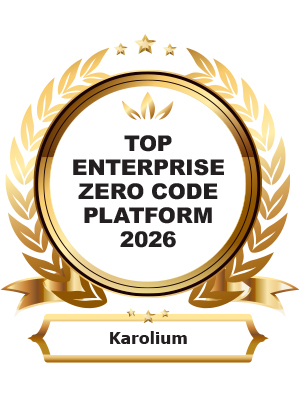
That consistency of mechanism, not breadth of features, is what differentiates Karolium’s platform. By enabling enterprises to layer AI-adaptive, zero-code applications onto existing ERPs, the company aims to preserve operational continuity while enabling continuous transformation. Industry recognition, including recent awards, reflects acknowledgment of this architectural approach and its adoption in complex enterprise environments.
Enterprise Zero-Code Platforms for Complex Modernization
Enterprise software leaders face mounting pressure to modernize without destabilizing core systems. Low-code and no-code tools have proliferated, yet many organizations discover that these platforms address surface-level automation but fall short in complex ERP or supply chain environments. Simpler workflows can be configured quickly, but large-scale data migrations, cross-system orchestration and governance-sensitive extensions expose architectural limits. Technology teams then inherit opaque configurations, hidden logic and mounting technical debt that is difficult to troubleshoot and scale.
Another structural gap emerges in the tension between build and buy. Traditional enterprise suites such as SAP or Oracle offer mature functionality and structured data foundations, yet they lack flexibility. Conventional low-code platforms promise adaptability, but custom builds often become black boxes that replicate only fragments of enterprise-grade capability. Executives evaluating zero-code solutions should look for platforms that combine the strengths of packaged applications with the adaptability of custom development without forcing trade-offs that cap innovation.
Interoperability becomes decisive in this context. Large enterprises operate dozens of systems with distinct data models. A viable zero-code environment must manage these distinctions without imposing rigid schemas. It should allow shared enterprise data constructs to coexist alongside vendor-specific models and adapt when upstream or downstream APIs change. The ability to remap and remodel data quickly, particularly during migrations or system consolidations, separates experimental tools from enterprise-ready platforms.
Speed also warrants scrutiny, but not in isolation. Rapid deployment is meaningful only when it does not create future maintenance burdens. Leaders should examine whether new applications can be introduced without proliferating parallel systems or shadow IT. A credible platform should sit above existing ERP and legacy environments, extending rather than replacing them while embedding intelligence directly into established workflows. Governance alignment, audit readiness and continuity of processes should remain intact as new capabilities are introduced.
Artificial intelligence now plays a material role in this evaluation. Embedded intelligence must do more than automate tasks; it should assist in mapping disparate data models, adapting to evolving APIs and supporting predictive decision-making across engineering, operations, or compliance. Leading solutions enable integration, orchestration and analytics within a unified environment, reducing reliance on brittle point integrations.
Karolium stands out in this landscape through its ontology-driven approach and true zero-code architecture. It avoids rigid data structures, instead using AI to map source and target models and generate shared ontological constructs that can coexist with application-specific schemas. In complex transformations, such as consolidating dozens of warehouse management systems while introducing ISO audit processes, it has enabled rapid data remodeling, bi-directional orchestration and deployment within weeks rather than months.
Its Intelligent Asset Management connects ERP, MDM and IoT environments, while enabling engineering teams to apply AI-supported predictions within governed workflows. By positioning itself above core ERP platforms and legacy applications, Karolium augments rather than disrupts, embedding AI into supplier collaboration, compliance and quality processes without creating parallel architectures. For enterprises intent on modernization without escalating complexity or debt, Karolium represents a disciplined, future-ready choice....Read more
Company
Karolium
Management
Shan Muthuvelu, President and CEO
Description
Karolium is a next-generation, enterprise zero-code platform that combines advanced AI, flexible data models, and seamless integration to optimize and extend existing systems. It empowers businesses to rapidly customize applications, integrate intelligence, and drive innovation across supply chain, asset management, HR, and more.