-
Technology
-
Industry
-
Solutions
-
- ASSET MANAGEMENT
- CUSTOMER EXPERIENCE MANAGEMENT
- CYBER SECURITY
- DATA CENTER
- DOCUMENT MANAGEMENT
- ELECTRONIC DATA INTERCHANGE
- ENTERPRISE DATA MANAGEMENT
- ENTERPRISE RESOURCE PLANNING
- ENTERPRISE RISK MANAGEMENT
- ENTERPRISE-GRADE WEB DATA SOLUTIONS
- FACILITY MANAGEMENT
- FIELD SERVICE
- IDENTITY AND ACCESS MANAGEMENT
- INFRASTRUCTURE
- IT SERVICE MANAGEMENT
- MANAGED IT SERVICES
- PAYMENT AND CARD
- PROJECT MANAGEMENT
- SOFTWARE TESTING
- STORAGE
- VIDEO SOLUTIONS
- WORKFLOW
-
-
Platforms
-
Functions
- Leadership Perspectives
- Innovation Insights
- Research
- Magazines
- News
- CXO Awards







Contributory Virtus Investment Partners on the invitation from our Editorial

Delek US Holdings
Ido Biger, EVP, Chief Information and Data OfficerA BI Manager, A Chief Data Officer, A Data Driven CIO
Ido Biger, EVP, Chief Information and Data Officer

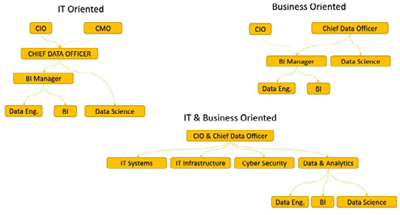
Four years have passed since I was appointed to the dual role CIO & Chief Data Officer, enough time to comprehend the evolving responsibility of migrating from someone who’s in charge of the data culture and insights-based decision making to the person who’s able to complete the desired cycle of prescriptive data analytics by embedding these insights in the operational systems.
It’s been over 7 years since I started my first role as a chief data officer of an organization, and as such it was a necessity to overcome the main obstacle of making a business measurable value out of the data. As a BI Manager, it is a known fact that your main responsibility is to enable the means for the organization to consume data by extracting the data from multiple sources and creating the data products designed and required by the analytical units. As a Chief Data Officer, you’re obligated to make sure the utilization of the data is being done on the highest level possible through overseeing the analytical units, both professionally as well as process wise. It is typically the role of the CDO to establish and manage the data science team, which will enable the advanced analytics capabilities throughout the organization.
Let’s go back to the data layers models that were presented by Gartner almost a decade ago.
 As it can be seen in the diagram, the main role of the BI manager is to enable both the descriptive as well as the diagnostic layer. By gathering the relevant data sources, extracting the information, maintaining a robust and transformed semantic layer, implementing a comfortable self-service BI platform and technically supporting and delivering the business units analytical needs, the BI team allows the company to answer the “what” and “why” questions.
The CDO on top of that, is enabling 2 main things: advanced analytical capabilities is the first, creating and establishing a data driven approach throughout the organization is the second. It is crucial that the BI manager will report (directly or dotted) to the CDO. It was tested in several organizations, and I’ve never heard of a CDO that wasn’t managing the BI Team without a huge struggle thus not being able to bring the necessary value that was expected. By appointing a CDO without the privilege to hold both sides of the equation (creating the data platform and building the analytical layers on top of it) means that practically you’re sending a soldier to the field without ammunition. The BI manager will see the CDO as yet another customer (and someone that thinks highly of him/herself) which will politically, for sure, lead the CDO to the bottom of the data food chain.
“You see, being the Chief data officer of a telco company and later on an airline, allowed me to understand the business processes alongside the technical processes behind the numbers”
The predictive layer would be accomplished by the CDO only when the data platforms and the advanced analytical skills would reside together under his/her responsibility. In order to push the organization to step forward to the prescriptive layer - he would need strong support from both the business units (at least one VP that will walk the talk with the process) and the IT division.
So here is where my story comes into place. You see, being the Chief data officer of a telco company and later on an airline, allowed me to understand the business processes alongside the technical processes behind the numbers. As a data leader, you have the privilege to touch and feel pretty much all the systems that are being reflected in the semantic data layer. The data leader has the unique opportunity to see the full overview and direct link between the business outcome, the technical enablement and the data that reflects all of it.
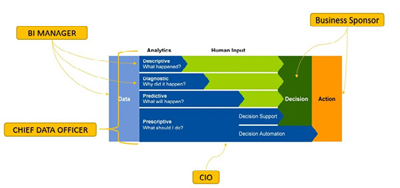 The only thing missing here to complete the prescriptive full potential is to adjust and deploy the insights from the advanced analytical layer (seen here) and the predictive analytical layer back to the operational processes that created the data in the first place. And that is where my role as a CIO comes in place - this allows the organization to become a true data driven company.
Let’s take a very simple example, that will summarize everything that was written above:
As a BI manager for a company that produces air conditioners, you’d be able to gather and organize all of the necessary data and serving it through a BI platform to the analytical units, in order to better understand the behavior of the products in the houses and apartments of its customers. The business will better understand what would cause the problems, what the life cycle of the air conditioners looks like and where are the critical points in which the customer loses his patience. The data can be gathered from the AC themselves (IOT), the CRM systems, the technician report, the weather data, demographic and social information etc.
As the Chief Data Officer you’d build the relevant information and data platform, alongside the desired ML models in order to predict the next steps, the outcome of the previous data / touch points, and implement them back to the data products for the relevant alert of the notification / suggestion needed to take place. The CDO would have to engage the VP service and the IT to be able to not only suggest the next step but to implement it back in the operational systems (for example - the technicians task management). The prescriptive cycle would complete only when the business process would change and be adjusted by the insights that would come out of the predictive layer that was built on the diagnostic and descriptive data layers.
By allowing the CIO, to have the CDO reporting to him (or in my case, be both), an organization should feel much more comfortable with knowing that the insights would be reflected and implemented back to the technical processes that will engage the desired business process, thus making itself a Data Driven Company.
As the Technology Enabler of the Business Desires, being a Data Driven CIO might be the game changer as far as analytics utilization in the operational processes.
The articles from these contributors are based on their personal expertise and viewpoints, and do not necessarily reflect the opinions of their employers or affiliated organizations.
EDITOR'S Choice

Fortune Brands Innovations [NYSE: FBIN]
By Juan Guerrero, Director, IT Audit & Data Analytics
The IT Audit Evolution: From Compliance to Strategic Intelligence
Broad River Retail
Wes Dudley, Senior Vice President, Customer Experience
Customer Experience in the Age of Amplified Complexity
Fortune Brands Innovations [NYSE: FBIN]
Scott Barnes, Sr. Director of Enterprise Cyber Security (CISO)
The X-Factor in Cybersecurity: AI and Automation at Work

LHarris Technologies [NYSE: LHX]
Brian Allred, Director of Business Intelligence and Analytics
The Shift from Rigid Dashboards to Conversational Analytics
Ivar's Restaurants
Patrick Yearout, Director of Innovation, Recruitment & Training
From Hiring to Development: Nurturing Teams that CareLatest Issues


