-
Technology
-
Industry
-
Solutions
-
- ASSET MANAGEMENT
- CUSTOMER EXPERIENCE MANAGEMENT
- CYBER SECURITY
- DATA CENTER
- DOCUMENT MANAGEMENT
- ELECTRONIC DATA INTERCHANGE
- ENTERPRISE DATA MANAGEMENT
- ENTERPRISE RESOURCE PLANNING
- ENTERPRISE RISK MANAGEMENT
- ENTERPRISE-GRADE WEB DATA SOLUTIONS
- FACILITY MANAGEMENT
- FIELD SERVICE
- IDENTITY AND ACCESS MANAGEMENT
- INFRASTRUCTURE
- IT SERVICE MANAGEMENT
- MANAGED IT SERVICES
- PAYMENT AND CARD
- PROJECT MANAGEMENT
- SOFTWARE TESTING
- STORAGE
- VIDEO SOLUTIONS
- WORKFLOW
-
-
Platforms
-
Functions
- Leadership Perspectives
- Innovation Insights
- Research
- Magazines
- News
- CXO Awards











Contributory Virtus Investment Partners on the invitation from our Editorial

Symphony Health Solutions
Derek Evans, Sr. Vice President and Practice Head—Commercial EffectivenessAaaS as a Game-changer in Healthcare
Derek Evans, Sr. Vice President and Practice Head—Commercial Effectiveness

In today’s ever-changing healthcare industry, pharmaceutical companies need to handle a mass of healthcare data every day. They are finding it difficult to access the vast amount of information due to lack of appropriate data processing channel. Therefore, they ought to examine the ways for effective and proactive usage of data so as to consolidate and integrate it to drive successful business.
“Big Data reports generated from the AaaS suite empower analysts, consultants, and data scientists with unmatched visibility into data”
Brand decision makers are inundated with research and data but often lack the tools to help them make sense of it all. At the same time, in a swelling tide of “sameness”, companies need to uncover meaningful insights from vast amounts of data which can be applied to drive competitive advantage. This is important because today’s life science companies need to deliver not only effective therapies, but solutions which improve patient health. For this to occur, pharmaceutical companies must demonstrate a drug’s effectiveness and value for patients across the health ecosystem.
One way to proactively assess various data needs is to overlay data sources on a patient’s journey through the healthcare ecosystem. Patient flow modeling was originally developed to model a patient's journey through a Health Care Organization (HCO) from the patient's perspective. Initial patient flows were focused on disease management and treatment with the goal of uncovering organizational inefficiencies and unmet needs in order to identify improvements for optimal care. By definition, this type of modeling shows the unique flow of patients through a specific disease area and captures the nuances of that market's treatment process. Creating such a model requires gathering and sorting copious amounts of patient-level data. Analysts need to quantify how patients in a specific disease area move through that disease.
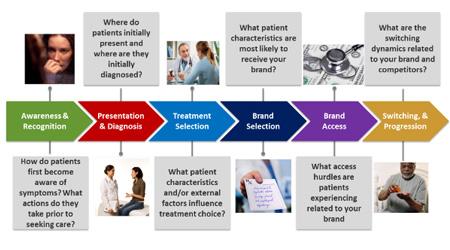 As the process evolved, we expanded the model to yield a more data-centric view of interactions with all stakeholders including: physicians, nurses, paramedical, payers, advocacy groups, and care-givers. The ultimate goal is to diagrammatically represent the entire journey a patient undergoes as a result of having a disease, highlighting all medical, social, emotional and financial factors that affect a patient's journey and well-being. By modifying the graphic we can start to assess what data assets could provide insight into key business questions which are addressed along the journey. This approach aligns internal stakeholders while allowing management to assess gaps in knowledge and data.
For instance, based on the patient journey model, a company could investigate a montage of data assets spanning from provider (EMR/HER), pharmacy, search engine and social media to primary market research, guidelines, government and registry which could be leveraged to inform various questions about patients, physicians, payers, government policies and providers for each step in the patient’s care continuum. This framework allows companies to invest only in areas where information is critical to the understanding the care continuum. Once preliminary data assets are identified they need to be aligned to the future data plans of a company, which are anchored in its strategic position.
Bringing new data and insights into your organization can help drive a new way of thinking. However, adding complexity and load to an already maxed out team leaves little for value-add capabilities with analytics, central for business agility. In the healthcare area, we will continue to see the progression of Analytics as a Service (AaaS). AaaS allows companies to offload the routine functions so internal teams can innovate alongside the business to bring common goals together with a rapid-prototype approach to analytics featuring the end-user at the center. At its core, AaaS is an analytical platform using a cloud-based delivery model, where various tools for data analytics are available and can be configured by the user to efficiently process and analyze huge quantities of data. For more custom, company specific advanced analytics solutions, partners will utilize commercially available analytics solution suites with analytics driven by a variety of providers across platforms. These will be designed in partnership with clients and developed to give the end user valuable insights which are specific to their business needs.
Historically, accurate analyses could take days to weeks using software that is often expensive and difficult to use. Even then it is prone to deep human error, since the entire analysis rests upon the way the data is modeled. Additional resources with substantial expertise are required to ensure that the correct information is extracted and analyzed. However, “Big Data” reports generated from the AaaS suite empower analysts, consultants, and data scientists with unmatched visibility into data. Using an advanced analytics technology, companies can now generate detailed reports in a matter of minutes. Analytics Solution Suites are being deployed that contain innovations in machine learning and predictive analytics that takes human modeling out of the equation. That means faster analysis with tremendous accuracy; whether it’s a thousand rows or millions of rows of data, reports can be generated that are accurate and meaningful. This in turn allows companies to make better informed business decisions.
The articles from these contributors are based on their personal expertise and viewpoints, and do not necessarily reflect the opinions of their employers or affiliated organizations.
EDITOR'S Choice

Fortune Brands Innovations [NYSE: FBIN]
By Juan Guerrero, Director, IT Audit & Data Analytics
The IT Audit Evolution: From Compliance to Strategic Intelligence
Broad River Retail
Wes Dudley, Senior Vice President, Customer Experience
Customer Experience in the Age of Amplified Complexity
Fortune Brands Innovations [NYSE: FBIN]
Scott Barnes, Sr. Director of Enterprise Cyber Security (CISO)
The X-Factor in Cybersecurity: AI and Automation at Work

LHarris Technologies [NYSE: LHX]
Brian Allred, Director of Business Intelligence and Analytics
The Shift from Rigid Dashboards to Conversational Analytics
Ivar's Restaurants
Patrick Yearout, Director of Innovation, Recruitment & Training
From Hiring to Development: Nurturing Teams that CareLatest Issues