-
Technology
-
Industry
-
Solutions
-
- ASSET MANAGEMENT
- CUSTOMER EXPERIENCE MANAGEMENT
- CYBER SECURITY
- DATA CENTER
- DOCUMENT MANAGEMENT
- ELECTRONIC DATA INTERCHANGE
- ENTERPRISE DATA MANAGEMENT
- ENTERPRISE RESOURCE PLANNING
- ENTERPRISE RISK MANAGEMENT
- ENTERPRISE-GRADE WEB DATA SOLUTIONS
- FACILITY MANAGEMENT
- FIELD SERVICE
- IDENTITY AND ACCESS MANAGEMENT
- INFRASTRUCTURE
- IT SERVICE MANAGEMENT
- MANAGED IT SERVICES
- PAYMENT AND CARD
- PROJECT MANAGEMENT
- SOFTWARE TESTING
- STORAGE
- VIDEO SOLUTIONS
- WORKFLOW
-
-
Platforms
-
Functions
- Leadership Perspectives
- Innovation Insights
- Research
- Magazines
- News
- CXO Awards


Contributory Virtus Investment Partners on the invitation from our Editorial

Biogen
Dr. Alejandro P. Bagliano, LATAM South Medical Affairs HeadAI and Pharma Industry
Dr. Alejandro P. Bagliano, LATAM South Medical Affairs Head

You may have heard or read about artificial intelligence (AI) and other terms like big data, data mining, and machine learning, which have increased over the past years. No matter in which industry you are or what type of job you have, these technologies will reshape daily tasks whether you are working at home or office-based. We live at the beginning of a revolution, and it would be wise to consider what is coming.
The health system and the pharmaceutical industry are no strangers to this phenomenon. The inclusion of AI in these areas has already started. Currently, a continuous acceleration is perceived, but what is sure is that it will impact significantly in the next 5 to 10 years.
If you look at the number of works published on health scientific databases like PUBMED, you can see that the amount has been increasing steadily since 2000 but has accelerated in the last five years. (Graphic N°1).
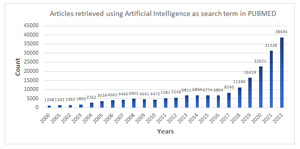 Graphic N°1.
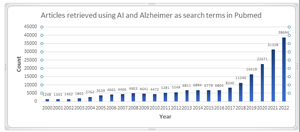
This trend comprises works focusing on a broad spectrum of topics ranging from molecule analysis to disease diagnosis or monitoring. Also, this behavior can be seen if you search for specific diseases like AI and Alzheimer's disease. (Graphic 2).
Graphic N°2
Something that helped AI make this jump in the last years is the fantastic amount of data accumulated that is available and continues to increase at a spectacular speed as we speak. Data is fuel for AI, and advances in the health fields like digital medical records, digital imaging (MRIs, TC SCANs, etc.), medical devices, or even other daily standard devices such as your smartwatch, cellphone, gaming goggles, earphones can obtain a lot of your body information and convert it into digital data (heart rate, blood pressure, breathing rate, eye movement, walking speed, walked distance, speech, and even the difference in the sound of your voice, and many other variables that can be measured.). Another critical factor is that many of these gadgets are broadly available to the population. Cell phones have been evolving into tiny portable computers added with several types of sensors and are used by a high percentage of the population, even in low-income countries. This device allows the user to not only access information via the internet but to generate a lot of potential real-time data. So, the large cohort's data capture is quite simple now.
 After being analyzed, all that information can accurately inform you about your vascular health, cognitive status, daily habits, and many other details that we usually don´t pay attention to, allowing health professionals to detect minor anomalies that can represent early manifestations of a disease. Data mining, machine learning techniques, and other AI-related branches and applications allow us to compare, correlate, or match biological data obtained from an individual and contrast it to large cohort databases. At the same time, it enables thorough adjustments to improve the precision with which it is calculated. And this is only just a tiny glimpse of all the potential possibilities that can be applied in the health area.
On the other hand, pharma companies are taking advantage of the calculus power of computer hardware and these techniques to increase the chance of success in new treatment developments.
 Data mining, machine learning techniques, and other AI-related branches and applications allow us to compare, correlate or match biological data obtained from an individual and contrast it to large cohorts databases.
Only very few molecules of all studied reach the clinical stage. The chance of successfully obtaining a new treatment after all clinical studies is estimated between 10-20 percent. All this process takes around eight years and several hundred million USD. If we take into account the preclinical stage, the time and resources needed increase significantly.
For pharma companies, this technology could significantly reduce the time and resources needed for molecular scouting in the preclinical stages and facilitate to facilitate data gathering and analysis in the clinical stage.
Improving the success rate while reducing time and cost will be critical to obtaining cost-efficient treatments with new technologies such as antisense oligonucleotides (ASOs), Gene therapy, or CRISP editing, as well as other more used technologies like monoclonal antibodies or synthetic drugs.
In the case of medical practice, it won´t replace physicians for sure. Still, it would allow adding a lot of information and details that are not usually processed during daily practice. Allowing earlier detection, more accuracy in diagnosis, and better follow-up of disease progression and treatment results. Physicians will need to learn how to work with these tools and how to get the most out of them. Also, patients will notice changes in how their treatment options can be adjusted with real-time information. And all of this is just the tip of the iceberg.
We have entered on a one-way road, where is no possible turning back. AI will be present everywhere. Our jobs will be impacted by it, reducing many long, hour-consuming tasks, making some skills obsolete, and creating the need for other types of skills more aligned with AI.
The articles from these contributors are based on their personal expertise and viewpoints, and do not necessarily reflect the opinions of their employers or affiliated organizations.
EDITOR'S Choice

Fortune Brands Innovations [NYSE: FBIN]
By Juan Guerrero, Director, IT Audit & Data Analytics
The IT Audit Evolution: From Compliance to Strategic Intelligence
Broad River Retail
Wes Dudley, Senior Vice President, Customer Experience
Customer Experience in the Age of Amplified Complexity
Fortune Brands Innovations [NYSE: FBIN]
Scott Barnes, Sr. Director of Enterprise Cyber Security (CISO)
The X-Factor in Cybersecurity: AI and Automation at Work

LHarris Technologies [NYSE: LHX]
Brian Allred, Director of Business Intelligence and Analytics
The Shift from Rigid Dashboards to Conversational Analytics
Ivar's Restaurants
Patrick Yearout, Director of Innovation, Recruitment & Training
From Hiring to Development: Nurturing Teams that CareLatest Issues