-
Technology
-
Industry
-
Solutions
-
- ASSET MANAGEMENT
- CUSTOMER EXPERIENCE MANAGEMENT
- CYBER SECURITY
- DATA CENTER
- DOCUMENT MANAGEMENT
- ELECTRONIC DATA INTERCHANGE
- ENTERPRISE DATA MANAGEMENT
- ENTERPRISE RESOURCE PLANNING
- ENTERPRISE RISK MANAGEMENT
- ENTERPRISE-GRADE WEB DATA SOLUTIONS
- FACILITY MANAGEMENT
- FIELD SERVICE
- IDENTITY AND ACCESS MANAGEMENT
- INFRASTRUCTURE
- IT SERVICE MANAGEMENT
- MANAGED IT SERVICES
- PAYMENT AND CARD
- PROJECT MANAGEMENT
- SOFTWARE TESTING
- STORAGE
- VIDEO SOLUTIONS
- WORKFLOW
-
-
Platforms
-
Functions
- Leadership Perspectives
- Innovation Insights
- Research
- Magazines
- News
- CXO Awards











Contributory Virtus Investment Partners on the invitation from our Editorial

Halliburton
Robello Samuel, Chief Technical Advisor and Fellow (Well Engg.)At The Edge Of Cloud: What Does The Future Look Like For Drilling Automation?
Robello Samuel, Chief Technical Advisor and Fellow (Well Engg.)

The digital transformation is providing impetus in the advancements in the oil and gas industry. Figure1 shows technological advancements through time. The bifurcation points offer the fusion of new technologies during the industry contraction mode, which translates the environment similar to the industrial revolution. As the industry moves toward automated drilling systems, not only comprehensive 3600 engineering optimization has become very critical, but also the fusion of data analytics at the edge into the system has become increasingly essential. Even though it may sound like a futurist’s pipe dream, the exponential technologies in other industries will provide impetus in accelerating the realization of such a system. With so many technologies advancing at the same time around us, it is up to us to create the layered evolution of an advisory system to rig controls and position ourselves for the final automation—that even if the driller is on the rig floor, auto driller should take it beyond the conditional automation and drill autonomously. It is not just drilling ahead but with data, ML, AI, automation, and people converging to autonomics making the physical drilling system in a self-configuring, self-diagnosis, self-healing, self-optimizing, and self-managing state. The drilling world is on the path to reverse-engineering the brain, and the computer architecture mimicking the driller’s brain’s network. It consists of engineering formalism plus the interpretation of data, thus providing the reaction link between the mathematical formulation and elements of the physical world. The engineering algorithms and connectivity to the exponential technologies have to be seamless and in constant contact with the physical system all the time, anywhere, and everywhere. The other technologies that are handholding are cyber-physical systems, real-time embedded systems, deep Neural Networks and Reinforcement learning, distributedevery time to prescribe and predict what is going to happen for the automated system. Under these conditions, the hybrid model provides better solutions. This creates information fusion with different levels of uncertainty. This way, paradoxes are suppressed, uncertainties are neutralized, and the engineering principles are not violated. The stream-processing frameworks on the cloud provide the capability to process, analyze, and provide solutions at a much faster rate to office and other control centers.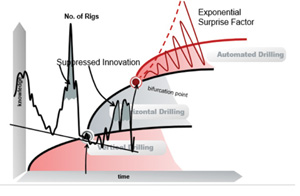 Additionally, the resource elasticity is provided by the use of various transient engineering calculations such as fluid mechanics, solid mechanics, and solvers in the form of ultrafast micro-services. Based on this approach, the proxy engineering models are created, and further, they are usedpublic ledger (blockchain technologies), IOT, IIOT, sensors, cloud computing, digital twins, edge computing and cloud communication, timed models and stream analytics, and hybrid systems–AI/ML/Physics.

Eventually, the rise of machines and intelligence will lead to settling the debate of drilling engineer versus machine as the oil and gas industry is ripe for transformation

Cyber-physical systems (CPSs) integrate cyber capabilities (computation, communication, and control) with physical capabilities (systems governed by the laws of physics and operating in continuous time and other physical processes). Both are tightly coupled and engineered to enhance performance at all disciplines of petroleum engineering. Even though the technologies behind cloud computing existed before the present computing power, communication with the sensors, cost percomputation, fault-tolerant computation in real-time, and web services provide elastic support and scalability to visualize and take actions in near real-time.
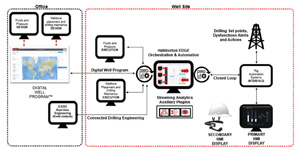 Since there are several uncertainties, a downhole hybrid approach is used, i.e., physics-informed or guided data analytics have to be done in the cloud to describe the process better. The problem encountered is the penalty of computational time when these engineering models are coupled. Surrogates and proxies have to be created instead of calling the engineering calculationswith the information from the data using machine learning. To prevent additional computing time, blockchain can be used to find out the pending events or transactions. Non-blockchain events can also be added in the streaming paths. The programs which used to run explicitly are executed headless and provide the capacity to withstand dynamic data workloads. This helps to not only interpolate but also extrapolate as the data are processed. Based on this approach, the events are predicted and the digital programs are updated with the engineering models and data at rest but in motion. This allows checking the change in the status by running engineering calculations in real-time based on the real-time status change. Figure 2 shows the workflow using cloud computing and it results in intelligent automation paired with Richer Well Construction 4.0 (With Data & Digital Twin).
Eventually, the rise of machines and intelligence will lead to settling the debate of drilling engineer versus machine as the oil and gas industry is ripe for transformation.
The articles from these contributors are based on their personal expertise and viewpoints, and do not necessarily reflect the opinions of their employers or affiliated organizations.
EDITOR'S Choice

Fortune Brands Innovations [NYSE: FBIN]
By Juan Guerrero, Director, IT Audit & Data Analytics
The IT Audit Evolution: From Compliance to Strategic Intelligence
Broad River Retail
Wes Dudley, Senior Vice President, Customer Experience
Customer Experience in the Age of Amplified Complexity
Fortune Brands Innovations [NYSE: FBIN]
Scott Barnes, Sr. Director of Enterprise Cyber Security (CISO)
The X-Factor in Cybersecurity: AI and Automation at Work

LHarris Technologies [NYSE: LHX]
Brian Allred, Director of Business Intelligence and Analytics
The Shift from Rigid Dashboards to Conversational Analytics
Ivar's Restaurants
Patrick Yearout, Director of Innovation, Recruitment & Training
From Hiring to Development: Nurturing Teams that CareLatest Issues