-
Technology
-
Industry
-
Solutions
-
- ASSET MANAGEMENT
- CUSTOMER EXPERIENCE MANAGEMENT
- CYBER SECURITY
- DATA CENTER
- DOCUMENT MANAGEMENT
- ELECTRONIC DATA INTERCHANGE
- ENTERPRISE DATA MANAGEMENT
- ENTERPRISE RESOURCE PLANNING
- ENTERPRISE RISK MANAGEMENT
- ENTERPRISE-GRADE WEB DATA SOLUTIONS
- FACILITY MANAGEMENT
- FIELD SERVICE
- IDENTITY AND ACCESS MANAGEMENT
- INFRASTRUCTURE
- IT SERVICE MANAGEMENT
- MANAGED IT SERVICES
- PAYMENT AND CARD
- PROJECT MANAGEMENT
- SOFTWARE TESTING
- STORAGE
- VIDEO SOLUTIONS
- WORKFLOW
-
-
Platforms
-
Functions
- Leadership Perspectives
- Innovation Insights
- Research
- Magazines
- News
- CXO Awards


Contributory Virtus Investment Partners on the invitation from our Editorial

CA
Yazdan T. Emrani, P.E., Director of Public Works, City of GlendaleImplementing GIS and Asset Management in Public Agencies and Municipalities
Yazdan T. Emrani, P.E., Director of Public Works, City of Glendale

Increasingly public agencies and municipalities are looking at streamlining their individualized GIS operations and moving towards an enterprise-wide GIS. In today’s world of shrinking budgets and tight job markets, it is no longer feasible to have separate entities within an organization having separate and different GIS or asset management operations. It also makes good sense to achieve efficiency and maximize the dollars invested through achieving the main objective for the whole organization and across many departmental and group lines.
Experience has shown that a significant number of infrastructure repairs are performed on an unscheduled basis. These repairs can cost anywhere from 5-16 times the normal planned repairs. In this time of budget cuts and limited resources, the ability to optimize the use of maintenance dollars by employing predictive models in the planning stages is rapidly becoming a reality of infrastructure management. The use of a Predictive Performance GIS and Asset Management model to optimize Capital Improvement Projects (CIP) and maintenance budgets, identify and prioritize repairs, and create "What...If" scenarios where you can input various funding levels and determine the optimum repair scenarios for your infrastructure, is critical.
An integrated GIS and asset management system is a methodical approach of optimizing the allocation of scarce resource to meet a defined objective. This is otherwise known as the“Goldilocks Approach” to operations and maintenance; not too much that you are spending money unnecessarily, and not too little that it will cost you more later due to neglect and deferred maintenance, but just the right amount at the right time.
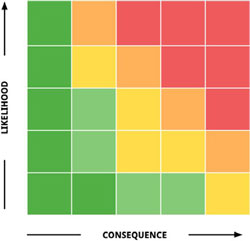
 As an example, many cities have extensive and aging underground sewer infrastructure. Traditionally, age and material have been the only factors used in prioritizing inspections. Infrastructure is widely distributed throughout a large geographical area making it difficult to track and maintain assets, resulting in significant risks to the public and the environment in the event of failure. This traditional approach is not sufficient and does not consider a deeper understanding of the variables leading to failure, or of the impact of failures on the community and the environment.Understanding of the factors relating to sewer pipe criticality allows agencies to focus their inspection programs. Each of these criticality factors can be categorized into two broad areas:
1. Consequence of Failure (COF): Generally related to location, and links the impact of the failure in terms of repair cost, disruption to the public and economy at large, impairment of system operation, and damage to the environment
2. Likelihood of Failure (LOF): Relates the likelihood of failure occurring, and is contingent of the types of pipe material, the existence of observed defects, and impact of external factors on the rate of deterioration (soil conditions, water table level, and frequency of surcharge)
"An integrated GIS and asset management system is a methodical approach of optimizing the allocation of scarce resource to meet a defined objective."
One can use the information for inspection and rehabilitation prioritization process based on consequence and risk of sewer failure, as described above. The first stage of prioritization is to assess the Consequence of Failure, generally related to the cost of performing an emergency repair and the associated disruption cost. It is important to note that where there is little data available on sewer condition, the consequence of failure based on external factors can be used to prioritize inspections to gather needed condition data.

The second stage is to assess the Likelihood of Failure, considering the actual condition of the sewer (structural, operational, grease, roots), and other factors that affect the rate of deterioration. These factors include levels of infiltration, ground water table level, ground conditions and frequency of surcharge.
Utilizing this system, a heat map can be generated where sewer lines are color coded based on their COF and LOF scores, respectively. The highest scoring sewers would have the highest risk of structural or operational failure. If the pipelines have been inspected, and the information is available in the asset management system, the risk of failure can be assessed more accurately. If however, there is little information, general data can be used to perform the preliminary assessment and prioritization. Finally, a GIS map showing the combined scores can be generated to produce a final ranking.
 In conclusion, municipalities can and should leverage technology to maximize their effectiveness. However, to do this, GIS and asset management applications must have the following three characteristics:
1. Simple to use - Technology must be simple, logical, and fail-safe to allow multiple users of different skill sets to use it successfully.
2. Easy to maintain - A system is a “living document” with data constantly in flux. It must be easily adapted to changes in process, technology or facility requirements.
3. Easy to expand - The system’s capacity must be easily expanded to add new features and give the user access to future technological developments.
The articles from these contributors are based on their personal expertise and viewpoints, and do not necessarily reflect the opinions of their employers or affiliated organizations.
EDITOR'S Choice

Fortune Brands Innovations [NYSE: FBIN]
By Juan Guerrero, Director, IT Audit & Data Analytics
The IT Audit Evolution: From Compliance to Strategic Intelligence
Broad River Retail
Wes Dudley, Senior Vice President, Customer Experience
Customer Experience in the Age of Amplified Complexity
Fortune Brands Innovations [NYSE: FBIN]
Scott Barnes, Sr. Director of Enterprise Cyber Security (CISO)
The X-Factor in Cybersecurity: AI and Automation at Work

LHarris Technologies [NYSE: LHX]
Brian Allred, Director of Business Intelligence and Analytics
The Shift from Rigid Dashboards to Conversational Analytics
Ivar's Restaurants
Patrick Yearout, Director of Innovation, Recruitment & Training
From Hiring to Development: Nurturing Teams that CareLatest Issues