-
Technology
-
Industry
-
Solutions
-
- ASSET MANAGEMENT
- CUSTOMER EXPERIENCE MANAGEMENT
- CYBER SECURITY
- DATA CENTER
- DOCUMENT MANAGEMENT
- ELECTRONIC DATA INTERCHANGE
- ENTERPRISE DATA MANAGEMENT
- ENTERPRISE RESOURCE PLANNING
- ENTERPRISE RISK MANAGEMENT
- ENTERPRISE-GRADE WEB DATA SOLUTIONS
- FACILITY MANAGEMENT
- FIELD SERVICE
- IDENTITY AND ACCESS MANAGEMENT
- INFRASTRUCTURE
- IT SERVICE MANAGEMENT
- MANAGED IT SERVICES
- PAYMENT AND CARD
- PROJECT MANAGEMENT
- SOFTWARE TESTING
- STORAGE
- VIDEO SOLUTIONS
- WORKFLOW
-
-
Platforms
-
Functions
- Leadership Perspectives
- Innovation Insights
- Research
- Magazines
- News
- CXO Awards






Contributory Virtus Investment Partners on the invitation from our Editorial

Worley
Britt Howard, Group Director, Assurance AmericasMaslow's Hierarchy of Human Safety Leadership Needs
Britt Howard, Group Director, Assurance Americas
Most people have heard of or studied Maslow's hierarchy of human needs as a model for understanding the motivations for human behavior. A pyramid is typically used to show from the top to the bottom of human needs based on importance from the basic at the bottom to the complex at the top. Each level of the pyramid represents a different human need. These different levels of human needs include physiological comfort, personal safety, group affiliation and belonging, self-esteem, and self-actualization.
I believe these different levels of human needs are consistent with what we need in the safety leadership space as well:
• Physiological comfort - Everyone needs to feel that their job will provide them with the basic economic benefits to support them and their family with food, clothing, shelter, and an adequate income.
• Personal safety - Everyone needs to feel that their job will provide them with a work environment that is free of anticipated and recognized hazards.
• Group affiliation and belonging - Everyone needs to feel that they belong and are connected with a group that shares the same safety goals, values, and interests.
• Self-Esteem - Everyone needs to feel valued and appreciated in the work family.
• Self-Actualization - Everyone wants and or needs to feel like they are in control of their own safety destiny.
Unpacking each one of these Human Safety Leadership Needs:
Physiological Comfort - Everyone needs to feel that their job will provide them with the basic economic benefits to support them and their family with food, clothing, shelter, and an adequate income.
 I like most people need to feel that my job provides a compensation and benefits that effectively support my desired lifestyle for my family and me.
I, like most people, need to feel that my job provides compensation and benefits that effectively support my desired lifestyle for my family and me. Without that physiological comfort, I am distracted in seeking other opportunities where this need can be met. The lack of this need being met can lead to low morale, noncompliance to procedures, safety risk-taking actions, and poor individual work production.
Personal Safety - Everyone needs to feel that their job will provide them with a work environment that is free of anticipated and recognized hazards.
People (including me) want to feel that their work environment has been and is continuously evaluated for personal safety hazards. The personal safety hazard that has been anticipated and recognized are managed through the hierarchy of safety risk controls:
• Elimination – remove the need for the safety risk (e.g., hang holiday decorations at ground level instead of on the roof)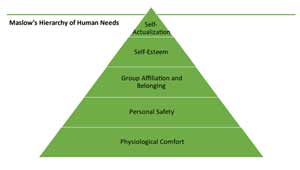
• Substitution – use a material that is non-hazardous or less hazardous than the original selected material (e.g., paint the conference room with water-based paint instead of oil-based paint)
• Engineering – provide a physical barrier between the work-family member and the safety hazard (e.g., use a guard on the weed eater that surrounds the rotating blade)
• Administration – provide standard operating procedures for completing tasks safely and effectively (e.g., read and execute the standard operating instructions for the safe and effective use of an automobile)
• Personal Protective Equipment (PPE) – use PPE to prevent exposure to safety hazards that cannot be eliminated or effectively controlled (e.g., use a brimmed hat when working in direct ultraviolet sunlight to provide shade for the head and face)
Group Affiliation and Belonging - Everyone needs to feel that they belong and are connected with a group that shares the same safety goals, values, and interests.
I use the term work-family to remind me of my connection to my co-workers and to let them know how I feel about them non-intrusively. Feeling connected to work-family members through caring about each other’s safety is a strong lever to pull in influencing safe behaviors. Humans are a social species. We desire and thrive on connecting with each other. This desire to connect is not only in the social setting but at work as well. Feeling connected and belonging at work delivers the best results in work performance, morale, and safe behavior.
Self-Esteem - Everyone needs to feel valued and appreciated in the work family.
Work-family members put forth more effort in everything they do when they feel good about themselves. I have had challenges in my career in the space of being valued as a contributor to my organization. My lack of self-esteem at different times in my career materialized in my being receptive to recruiter calls, feeling devalued by my leadership, being distracted from situational safety awareness, and unintentionally demotivating others.
Fortunately, these periods of my lack of self-esteem have been very few and far between over my 32-plus years of serving in the safety and health leadership space. I try to remember how everyone deserves and needs to be recognized for the value they bring formally (e.g., fair compensation) and informally (e.g., verbal thank you).
One of my greatest positive self-esteem experiences was when my 3 young boys and I were sitting on a bench at an amusement park in Southeast Texas, and a young man walked by and asked if my name was Britt Howard. He said you are not going to remember me because I know you have met and worked with a lot of people in North Dakota. He then looked at my three young boys, ranging in age at the time from 11 - 7 years of age, and said, “Your father is a great safety guy. I worked with him in North Dakota, and he really cares about the workers, and we appreciate that.” Those words from someone that I had served as a Safety Leader made me feel great, and they still resonate in my soul several years after he said them to me and my boys.
Self-Actualization - Everyone wants and or needs to feel like they are in control of their own safety destiny.
One of the most exciting and fulfilling aspects of a work family member’s experience at work is feeling like they are driving their own career through their products of work, delivering innovative ideas, and individual decision-making – accountability inclusive of safety decisions.
I have seen self-actualization realized in the safety leadership space throughout my career in the development of frontline leaders and safety professionals.
One example I will share is when I was part of an executive leadership conference call based in Houston, TX, with a project delivery team that was based in Prudhoe Bay, AK. The call was focused on the Houston leadership team deciding on the capability of the Prudhoe Bay project delivery team in the safety space. As the Houston group was leaning towards declining the approval of the project work because of safety concerns, I spoke up and asked the Prudhoe Bay project delivery team about their experience and confidence in executing the work effectively and safely. The Prudhoe Bay project delivery team shared their more than adequate effective and safe experience in delivering the specific work we were discussing, which convinced the executive leadership team to agree to approve the project work. When I visited the Prudhoe Bay work family a few months later, several of my work family members told me that they had heard about how I advocated for them to be trusted by the executive leadership team and how it had made a positive impact on their relationship with the afar leadership team.
These different levels of human needs (physiological comfort, personal safety, group affiliation and belonging, self-esteem, and self-actualization) are not only applicable to human well-being but to safety leadership individually and collectively.
The articles from these contributors are based on their personal expertise and viewpoints, and do not necessarily reflect the opinions of their employers or affiliated organizations.
EDITOR'S Choice

Fortune Brands Innovations [NYSE: FBIN]
By Juan Guerrero, Director, IT Audit & Data Analytics
The IT Audit Evolution: From Compliance to Strategic Intelligence
Broad River Retail
Wes Dudley, Senior Vice President, Customer Experience
Customer Experience in the Age of Amplified Complexity
Fortune Brands Innovations [NYSE: FBIN]
Scott Barnes, Sr. Director of Enterprise Cyber Security (CISO)
The X-Factor in Cybersecurity: AI and Automation at Work

LHarris Technologies [NYSE: LHX]
Brian Allred, Director of Business Intelligence and Analytics
The Shift from Rigid Dashboards to Conversational Analytics
Ivar's Restaurants
Patrick Yearout, Director of Innovation, Recruitment & Training
From Hiring to Development: Nurturing Teams that CareLatest Issues