-
Technology
-
Industry
-
Solutions
-
- ASSET MANAGEMENT
- CUSTOMER EXPERIENCE MANAGEMENT
- CYBER SECURITY
- DATA CENTER
- DOCUMENT MANAGEMENT
- ELECTRONIC DATA INTERCHANGE
- ENTERPRISE DATA MANAGEMENT
- ENTERPRISE RESOURCE PLANNING
- ENTERPRISE RISK MANAGEMENT
- ENTERPRISE-GRADE WEB DATA SOLUTIONS
- FACILITY MANAGEMENT
- FIELD SERVICE
- IDENTITY AND ACCESS MANAGEMENT
- INFRASTRUCTURE
- IT SERVICE MANAGEMENT
- MANAGED IT SERVICES
- PAYMENT AND CARD
- PROJECT MANAGEMENT
- SOFTWARE TESTING
- STORAGE
- VIDEO SOLUTIONS
- WORKFLOW
-
-
Platforms
-
Functions
- Leadership Perspectives
- Innovation Insights
- Research
- Magazines
- News
- CXO Awards


Contributory Virtus Investment Partners on the invitation from our Editorial

Sigmetrix
Chris Wilkes, CEOMe and My Digital Twin
Chris Wilkes, CEO

Your computer can be a mirror. A complete version of yourself stored in code, that is adjustable, and flexible. Want to change your hair? Do it first to your digital twin. Trying on clothes? Have Amazon virtually fit your digital twin. The world of science fiction is not that far away when it comes to the digital copies of physical world.
“Core to the concept of a digital twin is the need for data communication and management”
Take manufacturing as an example. Today, airline companies design their products in a computer aided design software package. They attach bar codes and serial numbers to every major part of the plane and these parts can be tracked as a complete airplane. Was a hole drilled too wide on a wing socket? Inspection with lasers can record the information inside the airplane’s digital twin.
For manufacturing companies, the keys to a digital twin are having the right data available, and managing that data properly. Having the right data means defining the model and recording the necessary information in a format that can be used by downstream applications. It means having a system that can take manufacturing and inspection data and update details about the digital twin. This means tracking each part through the entire lifecycle from manufacturing to repair and eventually decommission.
The main uses for a digital twin are:
• Predictive Analysis
• Virtual Prototype Improvements
• Warranty & Post-production
Once a digital twin exists, we have the ability to match real world situations to the Digital Twin.
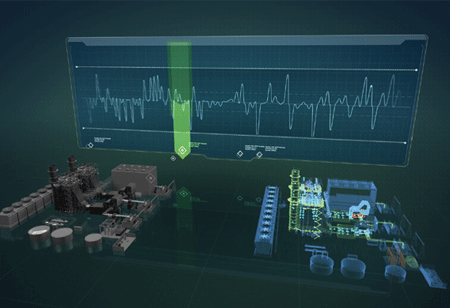 Core to the concept of a digital twin is the need for data communication and management. Measurement and sensory data must be connected from the physical product to its digital twin. In an ideal world, sensors would upload data to the servers in real time with immediate adjustments made to the model. For example, a backhoe operating in Alaska could have a sensor alert that the temperature has dropped below design specification. That data is uploaded to the digital twin. With the new temperature readings, the model can be adjusted to simulate the impact on the components of the backhoe. Perhaps it is determined that the lower temperature makes some of the material more brittle and prone to cracking under stress. Data can be communicated back to the field that given the new temperature, the maximum load needs to be reduced by 20 percent.
Such a case only applies to certain equipment. For most of manufacturing, the live data exchange is not cost-effective. But that doesn’t reduce the benefit of a digital twin. Take a case of the ball valve shown here. In the design phase the sealing surfaces were specified to have very tight tolerances needed because of the high pressure operating environment. Now let’s assume that an error was detected in the field showing that one of the surfaces was not within the design specification. With proper data stored with the digital twins, we can trace the batch of parts all the way back to where it was made and even which equipment was used to machine the part. By feeding that data into the digital twin, we can identify all ball valves that were machined with the same equipment. Field inspections can be ordered or pro-active recalls can occur – saving the manufacturer time, money and reputation. In this case, the digital twin applies to a batch of products and not a single product.
The automotive field is likely to be among the early adopters and will quickly be followed by others. The automotive industry has sufficient systems and processes to begin the process of moving towards digital twins. What is needed is the ability to add individual or batch information to critical parts and sub-assemblies. Many of the newer vehicles are built with hundreds of sensors that are constantly monitoring critical systems. That data has for years been used to provide the driver and ultimately the repair facility with details regarding failures. Today, vehicles are beginning to be equipped with phone home capabilities for the data to be transmitted to the manufacturer. The next step is the coupling of the data with the design information so that predictive analysis can be performed based on the information being gathered. Think about this, if we had monitoring and predictive modeling of the airbag systems, how much sooner could we have known about the defects? How many injuries could have been avoided by seeing the trends earlier? Digital twins are the future of manufacturing by merging the design, manufacturing and warrantee departments into an integrated process.
While none of these cases is fully able to be implemented today, the benefits of a digital twin are strong enough to justify the prediction that within the next few years we will see firms embracing this new technology. The future of product design is the movement from a design and building mentality to an integrated design and manufacturing process.
The articles from these contributors are based on their personal expertise and viewpoints, and do not necessarily reflect the opinions of their employers or affiliated organizations.
EDITOR'S Choice

Fortune Brands Innovations [NYSE: FBIN]
By Juan Guerrero, Director, IT Audit & Data Analytics
The IT Audit Evolution: From Compliance to Strategic Intelligence
Broad River Retail
Wes Dudley, Senior Vice President, Customer Experience
Customer Experience in the Age of Amplified Complexity
Fortune Brands Innovations [NYSE: FBIN]
Scott Barnes, Sr. Director of Enterprise Cyber Security (CISO)
The X-Factor in Cybersecurity: AI and Automation at Work

LHarris Technologies [NYSE: LHX]
Brian Allred, Director of Business Intelligence and Analytics
The Shift from Rigid Dashboards to Conversational Analytics
Ivar's Restaurants
Patrick Yearout, Director of Innovation, Recruitment & Training
From Hiring to Development: Nurturing Teams that CareLatest Issues


