-
Technology
-
Industry
-
Solutions
-
- ASSET MANAGEMENT
- CUSTOMER EXPERIENCE MANAGEMENT
- CYBER SECURITY
- DATA CENTER
- DOCUMENT MANAGEMENT
- ELECTRONIC DATA INTERCHANGE
- ENTERPRISE DATA MANAGEMENT
- ENTERPRISE RESOURCE PLANNING
- ENTERPRISE RISK MANAGEMENT
- ENTERPRISE-GRADE WEB DATA SOLUTIONS
- FACILITY MANAGEMENT
- FIELD SERVICE
- IDENTITY AND ACCESS MANAGEMENT
- INFRASTRUCTURE
- IT SERVICE MANAGEMENT
- MANAGED IT SERVICES
- PAYMENT AND CARD
- PROJECT MANAGEMENT
- SOFTWARE TESTING
- STORAGE
- VIDEO SOLUTIONS
- WORKFLOW
-
-
Platforms
-
Functions
- Leadership Perspectives
- Innovation Insights
- Research
- Magazines
- News
- CXO Awards


Contributory Virtus Investment Partners on the invitation from our Editorial

New York Life Investments
Kevin M. Gleason, Chief Compliance Officer of MainStay Funds and IndexIQ ETFsNavigating the ESG Maze from Standards to Data to Reporting to Regulation
Kevin M. Gleason, Chief Compliance Officer of MainStay Funds and IndexIQ ETFs

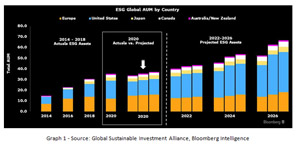
Over the past several years - even with the downturn in markets during 2022—there has been a noticeable change in the importance of environmental, social, and governance (ESG) factors for asset owners, investment professionals, and the public at large. ESG continues to take up an ever-bigger chunk of financial markets and investors’ wallets. McKinsey & Co. estimates that more than 90 percent of S&P 500 companies now publish ESG reports. According to Bloomberg Intelligence, ESG will this year exceed $40 trillion worth of assets with the thought that by 2025 ESG investable assets could hit $54 trillion. For 2022, the amount allocated to sustainable investment funds reached around $2.5 trillion at end of June, research firm Morningstar Inc. says. Graph 1 shows figures which suggest ESG is too entrenched to simply switch off.
Nonetheless, there is still much ambiguity as to what exactly is meant by ESG, where can one find the relevant standards for ESG, and how investment professionals can gather necessary ESG data, apply it in the investment process, and thus benefit the investing public. This article will identify types of data used for ESG analysis. It will highlight several of the non-governmental organizations (NGOs) which establish ESG standards and reporting, many of which have been adopted in the international context. It will then focus on three recent ESG related rule proposals by the Securities and Exchange Commission in the United States to bring
some form of standardization and clarity for investment professionals, asset owners, and the public at large.
Data
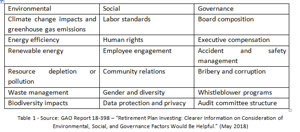
 ESG data spans a range of issues, including measures of carbon emissions, labor and human rights policies, and executive compensation and pay-for-performance. Table 1 provides additional detail.
ESG data serves a variety of purposes and constituencies. Institutional and retail investors are reported to increasingly use ESG factors to assess a wider range of risks and opportunities that may otherwise not be considered in financial reporting and analysis. Asset owners, policy makers, and the public at large are focused on ESG factors as a means to promote sustainable business practices and products. Investment professionals increasingly see ESG’s potential link to company cultural, operational strength, and management to long-term financial risks and strategic goals.
Standards and Reporting
The continued growth of ESG, as well as the increased emphasis that asset owners, investment professionals, and the public at large are placing on ESG issues, is driving demand for ESG metrics. Nonprofit groups, governments, and regulators have drafted or endorsed varying approaches. However, the proposed disclosure regimes have varied by region, and there is a lack of consensus as to which metrics are most relevant or useful.
The Global Reporting initiative (GRI) launched its sustainability focused reporting guidance in 1997 – its Global Sustainability Standards Board sets standards for sustainability reporting. Organizations such as the Global Impact Investing Network (GIIN) and B Lab later developed impact assessment methodologies. The United Nations (UN) has long been an ESG advocate through its Principles for Responsible Investment (PRIs) and its Sustainable Development Goals (SDGs).
 Some organizations provide reporting guidance on an industry basis. For example, in 2018, the Sustainability Accounting Standards Board (SASB) launched a set of standards covering financially material issues for companies in 77 industries. Others take a single issue as the focus for reporting guidance – such as the Task Force on Climate-Related Financial Disclosure (TCFD), which has become the leading framework for corporate climate change disclosure and reporting.
Efforts to streamline and standardize ESG reporting have led to collaboration between NGOs and other organizations. In April of 2021, B Lab and the GIIN, for example, aligned their impact assessment tools, enabling investment professionals to use B Lab’s tool, the B Impact Assessment, and the GIIN’s Impact Reporting and Investment Standards (IRIS+) together. In June 2021, the SASB and the International Integrated Reporting Counsel (IIRC) merged, to become the Value Reporting Foundation. In order to develop consistent global standards and reporting, further cooperation and consolidation is both needed and expected in the future.
Regulation
In the United States, the Securities and Exchange Commission (SEC) is responding to the global movement toward ESG and the development of regulations governing ESG by foreign regulators. The high level of heterogeneity and lack of transparency in many ESG claims has prompted the SEC to crack down on false or overblown ESG assertions by companies and funds – often referred to as “greenwashing.”
 ESG regulations and the data which must be disclosed and reported are in many cases still being developed. But once finalized, they should help investment professionals, asset owners, and the public at large identify and measure risks and opportunities
In late 2021, the SEC sent a series of comment letters related to climate change disclosure, requiring companies to provide more information about their climate risk. Then, the SEC in the spring of 2022 proposed requirements for companies to disclose information about climate-related risks – such as drought, wildfires, or market shifts – that are likely to have an impact on their business, as well as climate goals or planning processes that the company had developed in response to climate risks. Companies would also be required to report their greenhouse gas emissions. The SEC’s proposed rule would require standardized climate-related information in statements and reports to the commission with the goal to provide “consistent, comparable, and reliable – and therefore decision-useful – information to investors.”
Furthermore, in May of 2022, the SEC proposed an ESG fund disclosure rule that would require additional reporting from funds and advisers about their ESG approach and impact. The proposed rule, which would amend certain registration and reporting forms, applies to funds, including registered investment companies and business development companies, and advisers, including registered investment advisers and certain unregistered private fund advisers. The proposal includes a layered approach: the more that funds incorporate ESG factors into their investment process, the more they will need to disclose. The proposed rule lays out three categories of ESG funds – integration funds, ESG-focused funds, and impact funds -- which have different levels of disclosure based on their degree of ESG inclusion in the investment process.
Also, in May of 2022, the SEC proposed an amendment to the existing Names Rule under the Investment Company Act of 1940. This proposed update, which would apply to all registered investment companies, would expand the rule to include funds that have names suggesting investments with certain characteristics, including ESG-related names. The proposed rule would require a fund to disclose how it defines terms in its name and selects investments that are consistent with that name. In its reporting, a fund would indicate which holdings count toward the 80 percent of assets invested in accordance with the fund’s name. The rule would require that funds dropping below the 80 percent requirement follow certain guidelines to come back into compliance, generally within 30 calendar days. In addition, the rule would prevent integration funds that consider ESG among other factors from using ESG-related terms in the fund name.
Conclusion
ESG regulations and the data which must be disclosed and reported are in many cases still being developed. But once finalized, they should help investment professionals, asset owners, and the public at large identify and measure risks and opportunities -- such as how a hotter planet will affect industries like farming and insurance, how strikes will impact everything from aviation to garbage collection, and how dark secrets buried in a company’s supply chains can suddenly derail its fortunes. Without measuring, reporting, and understanding such ESG data, companies and their investors may face considerable losses.
The articles from these contributors are based on their personal expertise and viewpoints, and do not necessarily reflect the opinions of their employers or affiliated organizations.
EDITOR'S Choice

Fortune Brands Innovations [NYSE: FBIN]
By Juan Guerrero, Director, IT Audit & Data Analytics
The IT Audit Evolution: From Compliance to Strategic Intelligence
Broad River Retail
Wes Dudley, Senior Vice President, Customer Experience
Customer Experience in the Age of Amplified Complexity
Fortune Brands Innovations [NYSE: FBIN]
Scott Barnes, Sr. Director of Enterprise Cyber Security (CISO)
The X-Factor in Cybersecurity: AI and Automation at Work

LHarris Technologies [NYSE: LHX]
Brian Allred, Director of Business Intelligence and Analytics
The Shift from Rigid Dashboards to Conversational Analytics
Ivar's Restaurants
Patrick Yearout, Director of Innovation, Recruitment & Training
From Hiring to Development: Nurturing Teams that CareLatest Issues