-
Technology
-
Industry
-
Solutions
-
- ASSET MANAGEMENT
- CUSTOMER EXPERIENCE MANAGEMENT
- CYBER SECURITY
- DATA CENTER
- DOCUMENT MANAGEMENT
- ELECTRONIC DATA INTERCHANGE
- ENTERPRISE DATA MANAGEMENT
- ENTERPRISE RESOURCE PLANNING
- ENTERPRISE RISK MANAGEMENT
- ENTERPRISE-GRADE WEB DATA SOLUTIONS
- FACILITY MANAGEMENT
- FIELD SERVICE
- IDENTITY AND ACCESS MANAGEMENT
- INFRASTRUCTURE
- IT SERVICE MANAGEMENT
- MANAGED IT SERVICES
- PAYMENT AND CARD
- PROJECT MANAGEMENT
- SOFTWARE TESTING
- STORAGE
- VIDEO SOLUTIONS
- WORKFLOW
-
-
Platforms
-
Functions
- Leadership Perspectives
- Innovation Insights
- Research
- Magazines
- News
- CXO Awards











Contributory Virtus Investment Partners on the invitation from our Editorial

Allergan
Eric Walter Theodore Chojnicki, Director CMC Project ManagementPost-Genomic Era Drug Development Project Management Requires Knowledge Management
Eric Walter Theodore Chojnicki, Director CMC Project Management

The successful development of a drug in the post-genomic era of drug development requires infrastructure and good project management practices for the management of the knowledge necessary to facilitate strategic decisions. A Strategic Decision—being a decision in which constrained businesses resources and assets are allocated under conditions of uncertain RISK and probability of desired outcome between alternatives. The goal being the minimization of RISK and maximization of the likelihood of attaining the organization’s overall business strategy thereby increasing value to stakeholders, shareholders and customers. In order to address the need to make strategic decisions relative to go/no go decisions for the development of drug assets decision analysis and a stage-gate approach in conjunction with classic portfolio management practices is being adopted by the industry.
“Complexity of trials and the need to develop and validate companion testing methodologies for patient identification equate to a need to increase efficiencies in drug development”
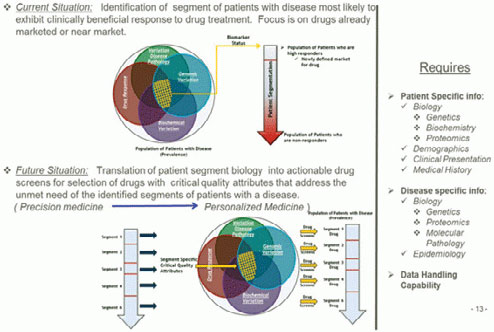
The advent of recombinant nucleic acid techniques, DNA sequencing, and combinatorial chemistry in conjunction with the exponential growth of informatics starting in the late 1970s, has created a perfect storm in business dynamics for the biopharma-ceutical industry (Figure 1). The result of these dynamic changes has been the emergence of precision medicine and an increasing focus to develop targeted therapeutics. Precision medicine is an approach to medical treatment that combines advanced research and techniques with detailed information about the individual patient's condition, in order to improve outcomes. Targeted therapeutics being drugs whose mechanism of action is based upon an underlying understanding of the molecular basis or the disease, or in the case of targeted monoclonal antibodies; antigens specific to the disease state. An inherent attribute of targeted drugs that have such inherent specificity for molecular is—underlying variation in the biophysical properties of the molecular target will impact the potential therapeutic utility of the drug. Variation in the biophysical properties of the target can be brought about by variation in the population of the genome encoding for the molecular target or molecular entities that attribute to the mechanism of action of the target. The impact on the current practice in drug development has made the industry focus on identification of patient populations most likely to exhibit clinically beneficial response to drugs near commercialization or already commercialized. The future state will be to leverage this information into actionable drug screens to identify drug candidate molecules.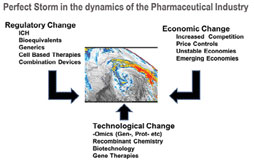
The impact that healthcare and drug prices have on GDPs of both developed and emerging economies has resulted in downward pricing pressure on drugs. Precision medicine and targeted therapeutics mean that the markets for the therapeutics are also segmented and realization of the full value of future drug assets will require multiple trials in segmented patient populations and across multiple therapeutic areas. Future trials will require the added complexity of developing and co-validating testing methodology to identify patient populations for enrollment into trials and post-marketing identification. The increasing number and complexity of trials and the need to develop and validate companion testing methodologies for patient identification equate to a need to increase efficiencies in drug development.
 Development cost and time of development are for the foreseeable future— the critical control factors for the biopharmaceutical industry. In order to attain these goals it will require both fundamental changes from how drugs have been developed in the past and changed in the fundamental structure of the industry. The number of opportunities for traditional development of “blockbuster” drugs will decrease and marketing drugs to smaller markets and across therapeutic areas on a global scale with high efficiency will be required for profitability. The successful pharmaceutical company of the future will be one that can formulate strategies globally and execute with operational excellence locally in diverse geographies. T his will require the ability to accommodate differing economies, regulatory frameworks, medical infrastructures, supply chain requirements and payer/payee relationships and practices. That the industry is at current grappling with how to attain these goals is evidenced by the increasing rate of consolidation in the industry in search of economies of scale and economic synergies. These actions, in and of themselves, will not be sufficient to address the fundamental structural changes required by the business environment facing the industry. Fundamental changes in the infrastructure and practices of the industry to facilitate strategy formulation and excellence in operational execution practices in combination with consolidation will be required in order to avoid decisional stasis. The least desirable outcome being, actions absent in a decision and dictated by simple situational response. A napriori “bad decision” does not exist. The “correctness” or “incorrectness or badness” of a decision is dictated by the resulting outcome being desired or not with respect to outcome.
Project management and information technologies in the current and future dynamic business environment of the biopharmaceutical industry will need to be intimately aligned in order to enable the infrastructure and process for strategic decisions. Successful project management will require the project management practitioner to build into his or her plans, the scope of work, resources and time required to deliver the knowledge to enable strategic decisions in association with the traditional deliverables associated with drug development; documents, supplies of drug, trial reports, regulatory filings etc. This will require close coordination between the project management practitioner and his/ her IT colleagues to insure that concomitant plans for the rapid gathering, assurance of quality and validity of data, and integration and interpretation of the information is in place prior to its dissemination. Information Technology will increasingly play a pivotal role in the assurance of successful drug development. Information technology being critical by virtue of its necessity managing the dissemination and management of the knowledge from bench to patient and patient to bench required in the post-genomic era of drug development.
The articles from these contributors are based on their personal expertise and viewpoints, and do not necessarily reflect the opinions of their employers or affiliated organizations.
EDITOR'S Choice

Fortune Brands Innovations [NYSE: FBIN]
By Juan Guerrero, Director, IT Audit & Data Analytics
The IT Audit Evolution: From Compliance to Strategic Intelligence
Broad River Retail
Wes Dudley, Senior Vice President, Customer Experience
Customer Experience in the Age of Amplified Complexity
Fortune Brands Innovations [NYSE: FBIN]
Scott Barnes, Sr. Director of Enterprise Cyber Security (CISO)
The X-Factor in Cybersecurity: AI and Automation at Work

LHarris Technologies [NYSE: LHX]
Brian Allred, Director of Business Intelligence and Analytics
The Shift from Rigid Dashboards to Conversational Analytics
Ivar's Restaurants
Patrick Yearout, Director of Innovation, Recruitment & Training
From Hiring to Development: Nurturing Teams that Care


