-
Technology
-
Industry
-
Solutions
-
- ASSET MANAGEMENT
- CUSTOMER EXPERIENCE MANAGEMENT
- CYBER SECURITY
- DATA CENTER
- DOCUMENT MANAGEMENT
- ELECTRONIC DATA INTERCHANGE
- ENTERPRISE DATA MANAGEMENT
- ENTERPRISE RESOURCE PLANNING
- ENTERPRISE RISK MANAGEMENT
- ENTERPRISE-GRADE WEB DATA SOLUTIONS
- FACILITY MANAGEMENT
- FIELD SERVICE
- IDENTITY AND ACCESS MANAGEMENT
- INFRASTRUCTURE
- IT SERVICE MANAGEMENT
- MANAGED IT SERVICES
- PAYMENT AND CARD
- PROJECT MANAGEMENT
- SOFTWARE TESTING
- STORAGE
- VIDEO SOLUTIONS
- WORKFLOW
-
-
Platforms
-
Functions
- Leadership Perspectives
- Innovation Insights
- Research
- Magazines
- News
- CXO Awards


Contributory Virtus Investment Partners on the invitation from our Editorial

PPD
Jonathan Aceves, Global Regulatory Affairs Director - Regulatory ScienceRegulatory Strategy: A Keydifferentiator To Accelerate Theaccess Of Biosimilars To The Markets
Jonathan Aceves, Global Regulatory Affairs Director - Regulatory Science

The regulatory environment for biosimilars has changed dramatically over the last decade. From a cautious set of expectations and a clear stepwise approach to drug development, there is now an evolution based upon experience, reassurance, and technical advancement that will continue to generate discussion and changes in requirements for developers to leverage and adapt in the race for market access and more with the new legislations that increase the access to the US market.
USA FDA Guideline Review
The FDA introduced a regulatory pathway for drug developers with the enactment of the Biologics Price Competition and Innovation Act of 2009 (BPCI Act). The BPCI Act creates an abbreviated licensure pathway for biological products shown to be biosimilar to or interchangeable with an FDA-licensed reference product. This licensure pathway permits a biosimilar biological product to be licensed under 351(k) of the Public Health Service Act (PHS Act) based on less than a full complement of product-specific preclinical and clinical data, i.e., an abbreviated licensure pathway.
In 2012, the first set of guidance documents to facilitate this approach were issued for comment. Following the consultation process, these guidelines were finalized and published in April 20152 and accompanied by a question and answer document in 2018.
These guidelines specify the importance of the totality of data and that approval may not rely on one clinical trial. The recommendation is that data is collected in a stepwise manner. The need for additional studies at each step in this progressive approach will be determined by the degree of residual uncertainty that remains at each step regarding the similarity of the products and whether or not the study can address these uncertainties. European Medicines Agency (EMA) Guideline Review
The EMA considered the need for guidance earlier than many other agencies, with the first version of the Guideline on Similar Biological Medicinal Products being adopted in September 2005. Updates to this guidance were adopted in October 2014 as revision 1. Revisions included clarifications to the terminology 'biosimilar’ or ‘similar biological medicinal product’ and a discussion of the possibility of following the generic legal basis for some types of products. Expectations of the EU guidance are very similar to those issued by the FDA. Overall, the development process should follow a stepwise approach, starting with a comprehensive physicochemical and biological characterization. The extent and nature of the non-clinical in vivo studies and clinical studies to be performed depend on the level of evidence obtained in the previous step(s), including the robustness of the physicochemical, biological, and non-clinical in vitro data. Clinical data cannot be used to justify substantial differences in quality attributes.
 The PK trial should be designed and powered to demonstrate equivalence to the reference product, preferably in healthy volunteers
2021 and Beyond
The future of biosimilar development is changing focus. The Medicines and Healthcare Products Regulatory Agency (MHRA) in the UK published updated guidance (06 May 2021) to consider the UK requirements post Brexit. The document outlines the position on the choice of reference product and the stepwise approach to comparability, starting with a comprehensive physicochemical and biological characterization, followed by a pivotal comparative pharmacokinetic (PK) study. Testing should involve multiple batches of reference products to understand any batch variability. For critical quality attributes (CQA), developers should consider more than ten different batches sourced over a suitable period of time would be required to provide robust comparability data. Exceptions can be justified in certain cases (for example, for orphan drug products, in the case that fewer batches of reference products are available).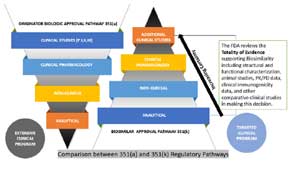
The MHRA continues to endorse the information published by the Committee for Human Medicinal Products (CHMP) for both quality and non-clinical data requirements.
The clinical comparability exercise should always include a pivotal comparative PK trial, which may include the measurement of pharmacodynamic (PD) markers if available. The PK trial should be designed and powered to demonstrate equivalence to the reference product, preferably in healthy volunteers.
Conclusions
Advances in the understanding of complex human biology have fostered the development of biological medications, whose sales are expected to surpass those of ‘conventional’ therapies by 2026.
The expiration of patents in the next 3 to 5 years of several blockbuster biological medications will also generate a ‘second’ and ‘third’ wave of biosimilar clinical development.
The experience gathered during these years in the molecular characterization of complex biological drugs and their pharmacokinetic and pharmacodynamic behaviors is prompting manufacturers and regulatory authorities to consider whether the current pathway to approval should evolve towards a more simplified frame without sacrificing the quality and clinical evidence needed to ensure safe and efficacious drugs are approved on the market.
The British Regulatory Agency MHRA issued a draft guidance in 2021, where different expectations are described, the need for clinical efficacy studies, and similar considerations could be potentially anticipated by the EMA in the future.
While we share the enthusiasm and expectations about this ‘simplified’ pathway and the opportunity to bring biosimilar medications faster to the market, we wonder whether this is going to be a ‘one-size-fits-all’ approach or if later entries. i. e., the third or fourth biosimilar for the same originator product will be those benefitting more from this simplified pathway, leveraging the bulk of data gathered by their predecessors.
We are starting a new era where there are a lot of new challenges that we need to answer, like:
• The new technologies for chemical characterization and in-vitro will be enough to prove interchangeability.
• PK/PD data will be enough to support clinical efficacy for biosimilars.
• The interchangeability trials should allow multi-brand/multi-country interchangeability.
• The market access limitations by country/ state represent the patients' treatment access challenge.
• The cost limitations for the developers will represent a challenge to select the best approach to prove interchangeability and extrapolation of indications.
The current framework globally is not aligned or considers the new challenges that we have defined before, and the agencies need to be constantly evolving to match the new evidence obtained; the industry should be working together with the regulators to accelerate this evolution for this reason the RA strategy of Clinical Development will represent one of the key drivers to define the success of product introduction to the market.
The articles from these contributors are based on their personal expertise and viewpoints, and do not necessarily reflect the opinions of their employers or affiliated organizations.
EDITOR'S Choice

Fortune Brands Innovations [NYSE: FBIN]
By Juan Guerrero, Director, IT Audit & Data Analytics
The IT Audit Evolution: From Compliance to Strategic Intelligence
Broad River Retail
Wes Dudley, Senior Vice President, Customer Experience
Customer Experience in the Age of Amplified Complexity
Fortune Brands Innovations [NYSE: FBIN]
Scott Barnes, Sr. Director of Enterprise Cyber Security (CISO)
The X-Factor in Cybersecurity: AI and Automation at Work

LHarris Technologies [NYSE: LHX]
Brian Allred, Director of Business Intelligence and Analytics
The Shift from Rigid Dashboards to Conversational Analytics
Ivar's Restaurants
Patrick Yearout, Director of Innovation, Recruitment & Training
From Hiring to Development: Nurturing Teams that CareLatest Issues