-
Technology
-
Industry
-
Solutions
-
- ASSET MANAGEMENT
- CUSTOMER EXPERIENCE MANAGEMENT
- CYBER SECURITY
- DATA CENTER
- DOCUMENT MANAGEMENT
- ELECTRONIC DATA INTERCHANGE
- ENTERPRISE DATA MANAGEMENT
- ENTERPRISE RESOURCE PLANNING
- ENTERPRISE RISK MANAGEMENT
- ENTERPRISE-GRADE WEB DATA SOLUTIONS
- FACILITY MANAGEMENT
- FIELD SERVICE
- IDENTITY AND ACCESS MANAGEMENT
- INFRASTRUCTURE
- IT SERVICE MANAGEMENT
- MANAGED IT SERVICES
- PAYMENT AND CARD
- PROJECT MANAGEMENT
- SOFTWARE TESTING
- STORAGE
- VIDEO SOLUTIONS
- WORKFLOW
-
-
Platforms
-
Functions
- Leadership Perspectives
- Innovation Insights
- Research
- Magazines
- News
- CXO Awards











Contributory Virtus Investment Partners on the invitation from our Editorial

Moody’s
David D. Snepp, Sr Dir, Defense, Intelligence, & Law EnforcementShell Games: When Technology & Data Combine to Assist Law Enforcement in Detecting Illicit Financial Crimes
David D. Snepp, Sr Dir, Defense, Intelligence, & Law Enforcement

As law enforcement nationwide confronts an increasingly sophisticated and murky world of shell company evasion techniques, a recent speech by FBI Director Christopher Wray outlined a new five-year intelligence program strategy to leverage technology and data like never before in the Bureau’s 115-year history. Speaking to the Intelligence and National Security Alliance in late February, Wray stressed law enforcement is under ever-increasing pressure to find 'the needle and ever-growing haystack.’
The age-old game of a small pea or rock concealed under three shells shuffled with lightning speed has mesmerized through the millennia by street hustlers. Today, ‘shell companies’ are no less confounding to law enforcement. Even more sophisticated, nefarious activities across a wide swath of illicit activities, such as money laundering, tax evasion, fraud, counterfeit goods, or sanctions evasion, are hidden and obscured by legitimate corporate entity structures.
Shell companies, while ‘legal’ in structure, are manipulated and constructed to obscure ownership and origins of money, facilitating the movement of funds related to criminal activities. The challenge for law enforcement analysts and investigators is to detect and track these entities in the virtual sea of legal companies and do so against a time clock where, as director Wray told the audience, “Time matters.”
For experts on anti-money laundering, counter-threat financing, and corporate corruption like Naomi Starosta, JD, shell companies present intriguing and career-absorbing focus. Starosta, director of the product strategy, joined Moody’s two years ago and immediately delved into the company’s vast data and analytics on more than 475 million corporate entities ‘to explore and innovate,’ she says, "around the tough nuts to crack in compliance, anti-money laundering, counter-terrorism financing, counterfeit, and other scourges of the world where billions in illicit funds travel.”
As part of a team of data scientists, engineers, and technologists, Starosta blended her law degree, academic background in terrorism studies, and deep interest in law enforcement to the task of developing analytics that peel away proverbial onion layers that conceal, obscure, and muddle corporate registries and ownership. The result is a first-in-class data advancement called shell company indicator, ‘SCI.’
Blended into Moody’s Orbis deep data intelligence platform, SCI integrates various data points and utilizes advanced analytics to flag potential shell entities. By analyzing patterns, SCI identifies irregularities and risk factors commonly associated with shell companies, such as unusually high operational revenue in relation to employees, obscure ownership structures, or rapid formation and dissolution, which are often indicative of illicit activities.
 By integrating data and advanced analytics into their operational frameworks, law enforcement can significantly reduce the time and resources traditionally required to trace illicit financial flows.
“In developing SCI, we started with 'why does someone create a shell company.’ Law enforcement knows it’s about some sort of evasion, such as tax or sanctions. However, it could also be about evading detection as a politically exposed person who has been bribed. It’s no different than any of the predicate crimes that produce a financial gain whether selling fentanyl-laced drugs, counterfeit products, or selling children or other human trafficking,” says Starosta.
 One of the many patterns that SCI tracks is mass business registration. Often viewed as a leading edge in identifying a shell company, the task of following the thread of dozens of registrations demands powerful analytics and quality data. Ted Datta heads financial crime compliance and third-party risk from Moody’s offices in London. Datta has deployed SCI to detect sanctions evasion networks, including those involved in Houthi UAS drone production.
As only one example of unraveling complex ownership across multiple geo-political jurisdictions, Datta examined the Sa’id Al-Jamal network to reveal a mass registration pattern that ultimately led to the identification of Vanessa Group Limited. Further analysis (as shown in the diagram below) traces the company back to a single individual, ‘Fadi Deniz,’ who was identified in the US Treasury's targeting of networks involved in financing ‘Houthi aggression.’
Drones and UAS are critical components of technology that are a major law enforcement concern in the United States. A ‘Joint Special Event Threat Assessment’ alert from DHS in early March posed potential threats drones present to law enforcement. Warning of possible disruptions during the Mardi Gras Celebration, the task force didn't find any credible threat reporting but noted, ‘we assess that unauthorized UAS operations have the potential to disrupt law enforcement and security operations, increasing public safety risks.’ Understanding the companies involved in UAS production, including those supplying advanced navigational systems, and whether any are masked through shell companies goes to the work Datta and Starosta are involved.
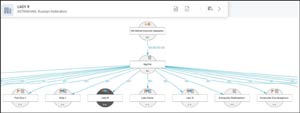 It’s this type of precision that gives law enforcement the ability to pierce the veil of what appears to be a legitimate company with accuracy and speed as the primary objective. All too often, investigators and analysts piece together disparate data sets, taking valuable time to identify and lead to an actionable intelligence point of discovery. “We know it takes weeks, if not months, for investigators to cut through and separate the wheat from the chaff,” Starosta explains in detailing the capabilities and value of SCI to expose criminal enterprises.
By integrating data and advanced analytics into their operational frameworks, law enforcement can significantly reduce the time and resources traditionally required to trace illicit financial flows. Aided by data visualization graphs and network mapping (screenshot at right), the investigation now includes a comprehensive view of a target entity and the ability to connect dots much more quickly, which leads to successful law enforcement actions.
The development of such investigative resources for identifying shell companies allows for more precise ‘tipping and cueing’ and a real shift in the battle against financial crimes, echoing director Wray’s commitment to embracing innovation in the face of evolving security threats.
The articles from these contributors are based on their personal expertise and viewpoints, and do not necessarily reflect the opinions of their employers or affiliated organizations.
EDITOR'S Choice

Fortune Brands Innovations [NYSE: FBIN]
By Juan Guerrero, Director, IT Audit & Data Analytics
The IT Audit Evolution: From Compliance to Strategic Intelligence
Broad River Retail
Wes Dudley, Senior Vice President, Customer Experience
Customer Experience in the Age of Amplified Complexity
Fortune Brands Innovations [NYSE: FBIN]
Scott Barnes, Sr. Director of Enterprise Cyber Security (CISO)
The X-Factor in Cybersecurity: AI and Automation at Work

LHarris Technologies [NYSE: LHX]
Brian Allred, Director of Business Intelligence and Analytics
The Shift from Rigid Dashboards to Conversational Analytics
Ivar's Restaurants
Patrick Yearout, Director of Innovation, Recruitment & Training
From Hiring to Development: Nurturing Teams that CareLatest Issues