-
Technology
-
Industry
-
Solutions
-
- ASSET MANAGEMENT
- CUSTOMER EXPERIENCE MANAGEMENT
- CYBER SECURITY
- DATA CENTER
- DOCUMENT MANAGEMENT
- ELECTRONIC DATA INTERCHANGE
- ENTERPRISE DATA MANAGEMENT
- ENTERPRISE RESOURCE PLANNING
- ENTERPRISE RISK MANAGEMENT
- ENTERPRISE-GRADE WEB DATA SOLUTIONS
- FACILITY MANAGEMENT
- FIELD SERVICE
- IDENTITY AND ACCESS MANAGEMENT
- INFRASTRUCTURE
- IT SERVICE MANAGEMENT
- MANAGED IT SERVICES
- PAYMENT AND CARD
- PROJECT MANAGEMENT
- SOFTWARE TESTING
- STORAGE
- VIDEO SOLUTIONS
- WORKFLOW
-
-
Platforms
-
Functions
- Leadership Perspectives
- Innovation Insights
- Research
- Magazines
- News
- CXO Awards


Contributory Virtus Investment Partners on the invitation from our Editorial

AfterWork Ventures
Adrian Petersen, Co-founderShow Us Your Traction. A No-Bs Guide to Communicating with Investors
Adrian Petersen, Co-founder

We’ve talked to over 1000 founders over the past year and quite often walked away not understanding what stage the company was at and how it made money. If we have, it’s because we’ve dug our heels in and asked a series of probing questions. Your job as a founder is to be a master storyteller and ensure the investor has all the information they need to seriously consider investing in your company. Here are some ideas to help you do just that.
1.Common Mistakes We See
Here are some common statements we hear and the questions they leave unanswered. As you’ll see, these stats don’t tell the full story or communicate how your company is going. In fact, they bring up more questions than they answer.
Doing this will differentiate you from other businesses vying for a spot in your investor’s portfolio. It’s proof that you ‘get’ what matters to investors, can identify the important levers in your business, and articulate where your focus lies. Besides, all will be revealed in any decent diligence process. Remember, investors want to join you on the journey. If they didn’t, they’d bypass the blood, sweat, and tears just and buy Amazon shares instead! You don’t have to have everything figured out just yet.
 2. Decide on the Metrics That Matter to Your Business
Avoid metrics that have the highest numbers and instead focus on metrics that are the most important. Investors want to see how you think about your ’North Star’ metric to understand what moves your growth needle and how additional funds will supercharge your business. Turn areas of weakness into your strength by showing the investor you understand which levers to focus on to really drive success.
 Your job as a founder is to be a master storyteller and ensure the investor has all the information they need to seriously consider investing in your company
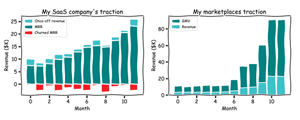
These metrics will be different for different types of companies and will definitely change over time. For example, SAAS businesses will answer questions that get to the heart of monthly recurring revenue (MRR) like:
• What percentage of your total revenue is recurring?
• How much MRR did you add last month from new customers?
• How much MRR did you lose last quarter from churn?
• How much MRR did you add last year from upselling existing customers?
 Meanwhile, a marketplace business should focus on Gross Merchandise Value (total amount of sales that pass through the platform), Gross Transaction Value (percentage made off the GMV), and one-off transaction fees (like initial set up fees). Be as clear as possible about your model before getting into how much you make.
3. Decide The Appropriate Time Frame To Tell Your Growth Story
Revenue doesn’t mean anything without context. It’s very different to say you’ve had $300,000 in revenue over the life of your company, to $300,000 in monthly recurring revenue. There are two things to consider:
What interval shows my trajectory best? The answer depends on your sales cycle length and how fast your company is growing. If your sales cycle is short and you’re growing quickly, put your weekly numbers on show. If you have a longer enterprise sales cycle, a monthly or quarterly interval might be more appropriate. No matter what, avoid annual numbers! They don’t provide granularity, and things change far too fast in startup land for it to tell a good story.
 How far back do I show?As always, it depends on the story you’re telling. It might be best to show the story since you’ve landed on your current model since your latest pivot, or you may want to walk an investor through the entire history of your company, explaining the impact of pivots on your traction.
4. Make A Simple Stacked Bar Chart To Convey Your Story.
Put it in your pitch deck or email it over before your meeting. Once again, don’t be afraid to show the bad parts! Companies don’t live in spreadsheets: very few companies grow consistently and predictably, and everyone loses customers and makes mistakes. Show this in your story and explain your learnings along the way. The above approach will ensure investors come away with a better understanding of your company and hold your communication ability in high esteem. As an added bonus, you’ll save 20 minutes in an hour meeting. Giving you extra valuable time to go deeper in other areas.
The articles from these contributors are based on their personal expertise and viewpoints, and do not necessarily reflect the opinions of their employers or affiliated organizations.
EDITOR'S Choice

Fortune Brands Innovations [NYSE: FBIN]
By Juan Guerrero, Director, IT Audit & Data Analytics
The IT Audit Evolution: From Compliance to Strategic Intelligence
Broad River Retail
Wes Dudley, Senior Vice President, Customer Experience
Customer Experience in the Age of Amplified Complexity
Fortune Brands Innovations [NYSE: FBIN]
Scott Barnes, Sr. Director of Enterprise Cyber Security (CISO)
The X-Factor in Cybersecurity: AI and Automation at Work

LHarris Technologies [NYSE: LHX]
Brian Allred, Director of Business Intelligence and Analytics
The Shift from Rigid Dashboards to Conversational Analytics
Ivar's Restaurants
Patrick Yearout, Director of Innovation, Recruitment & Training
From Hiring to Development: Nurturing Teams that CareLatest Issues