-
Technology
-
Industry
-
Solutions
-
- ASSET MANAGEMENT
- CUSTOMER EXPERIENCE MANAGEMENT
- CYBER SECURITY
- DATA CENTER
- DOCUMENT MANAGEMENT
- ELECTRONIC DATA INTERCHANGE
- ENTERPRISE DATA MANAGEMENT
- ENTERPRISE RESOURCE PLANNING
- ENTERPRISE RISK MANAGEMENT
- ENTERPRISE-GRADE WEB DATA SOLUTIONS
- FACILITY MANAGEMENT
- FIELD SERVICE
- IDENTITY AND ACCESS MANAGEMENT
- INFRASTRUCTURE
- IT SERVICE MANAGEMENT
- MANAGED IT SERVICES
- PAYMENT AND CARD
- PROJECT MANAGEMENT
- SOFTWARE TESTING
- STORAGE
- VIDEO SOLUTIONS
- WORKFLOW
-
-
Platforms
-
Functions
- Leadership Perspectives
- Innovation Insights
- Research
- Magazines
- News
- CXO Awards











Contributory Virtus Investment Partners on the invitation from our Editorial

Midmark Corporation
Adam Foresman, Director of Quality and Operational ExcellenceState of the Art Quality Management Systems
Adam Foresman, Director of Quality and Operational Excellence

The medical device industry has experienced a significant shift in the regulatory landscape in the last decade. These shifts represent improved clinical data and proactive post market surveillance processes leading to higher performing devices. Regulatory agencies, Notified Bodies, Auditing Organizations, manufacturers,distributors, and medical clinics a like were impacted by ISO 13485:2016, ISO 14971:2019, European Medical Device Regulations(MDR)2017/745, Medical Device Single Audit Program (MDSAP), and United States and Australian unique device identifier (UDI) requirements,among other regulatory changes.
Medical device manufacturer quality management system (QMS) auditors can now cover multiple jurisdictions simultaneous for time efficiency[1].For example, most MDSAP Auditing Organizations are also EU Notified Bodies, able to audit against both MDSAP and EU requirements. Under standardized audit programs like MDSAP, the intent of new regulations can overlap and blend across jurisdictions, even if a jurisdiction is not in audit scope.
There gulatory landscape changes, along with the overlapping nature of the the auditing structure, is leading auditing organizations to provokeQMS growth in medical device companies. This is beneficial for the industry when the QMS growth -equates to improved device and QMS process risk management practices, better design controls, statistical techniques, and stressing clinician and patient-impacting product quality.
This new auditing paradigm shift can be challenging, however, for manufacturers with limited resources or manufacturers who interpret the standards or regulations as static. There is plenty of interpretation onhow a QMS should mature, become, then maintain a QMS status of being “State of the art.”
What does “state of the art” mean for a QMS?
Regulations, standards, and guidance documents currently provide no clear direction on how a QMS can be state of the art or how that is truly defined. State of the art does not necessarily mean “best in class”; which is often the interpretation. It means being in alignment with industry norms and standards.
ISO 14971:2019 added a definition that state of the art to be “generally accepted good practice in technology and medicine and not necessarily to the most technically advanced solution.”It refers to medical device design being state of the art like the figure below,but not a manufacturer’s QMS.
State of the art spectrum for medical device technology [2]
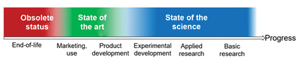
The EU MDR references the term state of the art 12 times, and the EU In-Vitro Diagnostics Regulation (IVDR) references state of the art 20 times [3]. The previous regulation the EU Medical Device Directive (MDD) explicitly referenced state of the artonly once in anannex (section 2 of Annex 1). The EU MDR does not provide an explicit definition. In EU MDR guidance document MEDDEV 2.7/1 Rev 4 covering clinical evidence requirements,it states “The state of the art embodies what is currently and generally accepted as good practice. [3]” This is also related to medical devices being state of the art and not a manufacturer’s QMS. Other MDSAP jurisdictions such as Australia, Brazil and Japan have similar state of the art regulatory requirements as the EU as regulatory agencies often use concepts from the others.
 A state-of-the-art QMS has a long-range growth program built in beyond an incremental plan-do-check-act continuous improvement process
The United States FDA references state of the art in the Quality System Regulation Medical Device Current Good Manufacturing Practices (CGMP) preamble as it pertains to manufacturing practices [4]. This can be interpreted to apply to a subset of the QMS on the manufacturer’s production activities.
The Medical Device Coordination Group (MDCG)asserted that standards should be considered state of the art even if they are not in the Official Journal(OJ) of the European Union [5]. Many regulatory agency auditors refer to this as “taking into account” non-harmonized standards in medical device design and QMS processes. Historically, medical device manufacturers have focused on OJ-published or other jurisdictional-harmonized standard lists only.
How can a manufacturer demonstrate QMS adherence to being state of the art?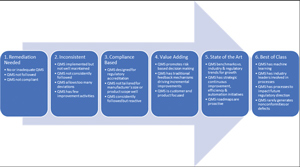
QMS auditor inquiries and nonconformities are written against the same regulatory and standard clauses as before; however, the burden to show compliance is increasing. Regulatory agency auditors have higher expectations compared to a decade ago.
Example audit inquiries using this newer approach include the following:
• Is the manufacturer using novice statistical techniques when more advanced analytical methods are available or appropriate? Previously, a simple pareto may have been sufficient to summarize complaint data.
• Is this manual process leading to a missing Corrective Action and Preventive Action program input source? Processes may drift and not become out of specification which is more challenging to detect than electronic processes.
• Are there laptops, tablets, and other electronics in appropriate areas of the facility?
• Did test method qualification consider short- and long-term variation sources?
• Was the manufacturer’s supplier using the same test method included in the study?
• How are manufacturers assessing the effectiveness of their training beyond a standard quiz? Can any product quality data be linked to training program?
• Where do manufacturer’s design inputs and post market surveillance processes consider non-harmonized and superseded standards? Is there a written gap analysis added to the product’s risk management file documenting these activities?
• Does the risk management documentation consider environmental and cybersecurity risks in addition to patient harm?
• Is an FMEA tool an appropriate risk management tool to use in this instance? Have all users and customers interacting with the device been considered in the fault tree analysis?
• A documentation request taking less time to retrieve.
Are effective internal audits and CAPAs the same as a state-of-the-art QMS?
A state-of-the-art QMS goes beyond having an internal audit program and CAPA program.It is having a true visionary development mind set. Internal audits classically emphasize compliance to current regulations, company policies, and procedures. CAPA programs traditionally concentrate on addressing nonconformities or eliminating potential nonconformities. State-of-the-art QMS systems evolve even when there are no potential nonconformities. Many professionals in the medical device manufacturing industry have seen QMS systems that did not add this value to drive evolution.
State-of-the-art QMS Tactics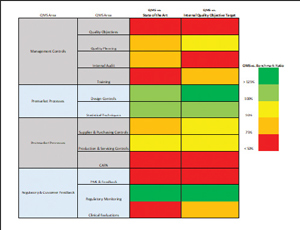
Here aretactics medical device manufacturers can use to start their state of the art QMS journeys:
• Quality objective and quality plans.
• Use a maturity model to detail. Quality objectives may be different from the industry state-of-the-art targets.Refer to the QMS maturity model below.
• Heat map, benchmarking,and SWOT analysis. These identify areas of QMS strengths and weakness vs. industry best practices and link to regulatory or standard clauses. Refer to the example of a benchmark and a heat map below.
• Roadmap and project charters. These identify required resources, ensuring alignment within the company, and highlight that these efforts are not CAPA in nature. Consider a maturity model like the one below.
• Regulation monitoring processes. Improve gap analysis documentation practices for superseded standards and standards not yet harmonized.
• Jurisdictional reviews. Review jurisdictional regulatory requirements from markets not currently being pursued. For example, review MEDDEV 2.7/4 even though not distributing a medical device into EU. Remember that many auditors are trained and may be influenced by the direction of these markets when auditing you.
• External trainings. Notified Body/Auditing Organization often lead industry-wide training. See how the latest interpretation of the regulations from the auditing organization directly.
• Quality, automation, and manufacturing conferences. What latest software programs are available for manufacturers? Many are low cost or free such as JASP for statistical analyses. Which paper-based systems would benefit the most from automation?
• Collaboration with other medical device manufacturers. Attend networking events. Ask for a manufacturing floor tour and return the favor.
• Literature review. Perform QMS journal reviews in addition to medical device clinical evaluation reviews.Examples include MedTech Outlook, ASQ Quality Progress, or FDA’sTraining and Continuous Improvement webpage including the CDRH Learn page [6].
QMS Maturity Model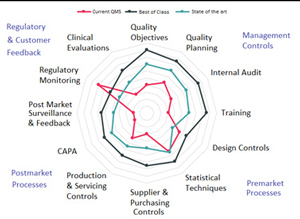
QMS Benchmarking Example
Benchmarking scores may be summed for a cumulative QMS score vs. state of the art. A QMS maturity model may be used to support the benchmark scoring scale definitions.
QMS Heat Map Example
Using the data from the benchmarking chart, this heat map compares current QMS against external industry state-of-the art norms and internal quality targets. Either or both comparisons may be used; however, use both if the QMS is significantly behind than state of the art to monitor milestone progress.
A state-of-the-art QMS has a long-range growth program built in beyond an incremental plan-do-check-act continuous improvement process. There is ongoing monitoring of the QMS processes vs. industry best practices and regulatory expectations. Proactive improvements require strategic planning often with cross functional and executive buy-in,but when executed well benefit clinicians, patients, regulators, as well as manufacturer’s business results. Regulatory agencies are coming to expect it. Be prepared!
The articles from these contributors are based on their personal expertise and viewpoints, and do not necessarily reflect the opinions of their employers or affiliated organizations.
EDITOR'S Choice

Fortune Brands Innovations [NYSE: FBIN]
By Juan Guerrero, Director, IT Audit & Data Analytics
The IT Audit Evolution: From Compliance to Strategic Intelligence
Broad River Retail
Wes Dudley, Senior Vice President, Customer Experience
Customer Experience in the Age of Amplified Complexity
Fortune Brands Innovations [NYSE: FBIN]
Scott Barnes, Sr. Director of Enterprise Cyber Security (CISO)
The X-Factor in Cybersecurity: AI and Automation at Work

LHarris Technologies [NYSE: LHX]
Brian Allred, Director of Business Intelligence and Analytics
The Shift from Rigid Dashboards to Conversational Analytics
Ivar's Restaurants
Patrick Yearout, Director of Innovation, Recruitment & Training
From Hiring to Development: Nurturing Teams that CareLatest Issues