-
Technology
-
Industry
-
Solutions
-
- ASSET MANAGEMENT
- CUSTOMER EXPERIENCE MANAGEMENT
- CYBER SECURITY
- DATA CENTER
- DOCUMENT MANAGEMENT
- ELECTRONIC DATA INTERCHANGE
- ENTERPRISE DATA MANAGEMENT
- ENTERPRISE RESOURCE PLANNING
- ENTERPRISE RISK MANAGEMENT
- ENTERPRISE-GRADE WEB DATA SOLUTIONS
- FACILITY MANAGEMENT
- FIELD SERVICE
- IDENTITY AND ACCESS MANAGEMENT
- INFRASTRUCTURE
- IT SERVICE MANAGEMENT
- MANAGED IT SERVICES
- PAYMENT AND CARD
- PROJECT MANAGEMENT
- SOFTWARE TESTING
- STORAGE
- VIDEO SOLUTIONS
- WORKFLOW
-
-
Platforms
-
Functions
- Leadership Perspectives
- Innovation Insights
- Research
- Magazines
- News
- CXO Awards











Contributory Virtus Investment Partners on the invitation from our Editorial

JEA
Kymberly Traylor, Director of Network & TelecommunicationsTelecom & Grid Modernization
Kymberly Traylor, Director of Network & Telecommunications

Traditionally, utilities have purchased, deployed, and attempted to integrate vendor “point [” solutions within the telecommunications domain. Most of these networks do not offer true interoperability. The convergence of expanding data (high bandwidth, low latency) and legacy transport systems demanded JEA develop a migration strategy. As the Director of Network & Telecommunications for JEA, I found myself in this dilemma: How do we support our lines of business in the leap from legacy technologies to Grid Modernization? The time for action is now; it is no longer a choice - it’s a necessity.
JEA had redesigned its data model for the aforementioned grid modernization efforts and we needed to undertake a similar initiative in regard to our networks. This would enable transport of exploding low latency data grid use cases that are common in our environment. JEA embarked on this effort over the past year to quantify and qualify its utility operations use cases based on the National Institute of Standards and Technology (NIST) Framework and Roadmap of Smart Grid Interoperability Standards, Release 4.0. We identified and characterized more than 100 utility operational Electric, and Water use cases for current and future state. Some of these core use cases included: Pole-Top Reclosers, Distribution Line Sensors, Faulted Circuit Indicators, Smart Regulators, Dynamic Water Consumption Monitoring, Capacitor Banks, Distributed Generation Devices, Multiple-EV Charging Stations, and Smart Inverters. Our plan to use further leverage IIoT capabilities to increase our service reliability and provide our employees with real-time asset status information that offers multiple options depending on the type, location, and bandwidth needs of the installed sensors.
 Providing reliable utility service to Northeast Florida is critical to meet our mission of improving lives and building community. Developing a robust telecom system with fiber deep in our system and wireless solutions will allow us to serve our community well.” ~ JEA Managing Director & CEO Jay Stowe
In the summer of 2021, JEA went to the marketplace with a solicitation to assist us in developing a Telecom Grid Modernization Strategy. The desired strategy would optimize a path toward a “should-be” wired/wireless network of the future, beginning with JEA’s current state network infrastructure, balancing a given set of constraints (e.g. budget, risk, security, obsolesce, resources, etc.) to arrive at an optimal future state network to support JEA. This strategy will migrate proprietary networks to a ubiquitous low latency, high bandwidth wired/wireless platform which will transition JEA’s network operations into the utility of the next decade.
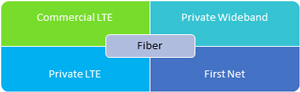 Through a series of technology and business use case workshops, we reviewed the following technology options focusing on interoperable, secure, resilient, scalable, and flexible solutions that would allow us to adapt to future modern technology. (see Figure 1)
During the development of our strategy, it became evident that a hybrid approach made the most sense, as there is no single solution that will meet all of JEA’s grid modernization needs. This model allows us to take an enterprise approach and leverage “best-of-breed” technology. In addition, we will be able to meet our customers where their needs are, i.e. high bandwidth, low latency, edge compute, automation, video, analytics etc. Our goal is to create a vendor-agnostic architecture to meet our organizational requirements.
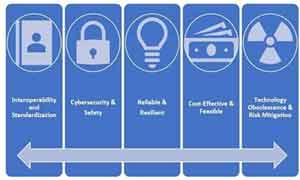 The development of the telecommunications strategy was based upon common industry principles that are critical to telecommunications. (See Figure 2) –
Over During the next nine to 9-12 months, we plan to run a pair of pilots leveraging core use cases to determine the best combination of wireless and wirel
ine solutions for JEA. Based upon the outcome of these pilots we will complete our enterprise integrated grid planning and architecture design in conjunction with our business partners.
As JEA looks to modernize the grid, we need to keep in mind that we are not solving yesterday’s problems, but those of tomorrow.
The articles from these contributors are based on their personal expertise and viewpoints, and do not necessarily reflect the opinions of their employers or affiliated organizations.
EDITOR'S Choice

Fortune Brands Innovations [NYSE: FBIN]
By Juan Guerrero, Director, IT Audit & Data Analytics
The IT Audit Evolution: From Compliance to Strategic Intelligence
Broad River Retail
Wes Dudley, Senior Vice President, Customer Experience
Customer Experience in the Age of Amplified Complexity
Fortune Brands Innovations [NYSE: FBIN]
Scott Barnes, Sr. Director of Enterprise Cyber Security (CISO)
The X-Factor in Cybersecurity: AI and Automation at Work

LHarris Technologies [NYSE: LHX]
Brian Allred, Director of Business Intelligence and Analytics
The Shift from Rigid Dashboards to Conversational Analytics
Ivar's Restaurants
Patrick Yearout, Director of Innovation, Recruitment & Training
From Hiring to Development: Nurturing Teams that CareLatest Issues


