-
Technology
-
Industry
-
Solutions
-
- ASSET MANAGEMENT
- CUSTOMER EXPERIENCE MANAGEMENT
- CYBER SECURITY
- DATA CENTER
- DOCUMENT MANAGEMENT
- ELECTRONIC DATA INTERCHANGE
- ENTERPRISE DATA MANAGEMENT
- ENTERPRISE RESOURCE PLANNING
- ENTERPRISE RISK MANAGEMENT
- ENTERPRISE-GRADE WEB DATA SOLUTIONS
- FACILITY MANAGEMENT
- FIELD SERVICE
- IDENTITY AND ACCESS MANAGEMENT
- INFRASTRUCTURE
- IT SERVICE MANAGEMENT
- MANAGED IT SERVICES
- PAYMENT AND CARD
- PROJECT MANAGEMENT
- SOFTWARE TESTING
- STORAGE
- VIDEO SOLUTIONS
- WORKFLOW
-
-
Platforms
-
Functions
- Leadership Perspectives
- Innovation Insights
- Research
- Magazines
- News
- CXO Awards


Contributory Virtus Investment Partners on the invitation from our Editorial

Buro Happold
May Winfield, Global Director of Commercial, Legal and Digital RisksThe Challenges of GIS
May Winfield, Global Director of Commercial, Legal and Digital Risks

Geographic Information Systems, or more commonly known as GIS, allow an increased awareness and understanding of our world by drawing on the various attributes and available data of a region or area. Diverse but vast volumes of collated data facilitate analysis of complex ecosystems at scale, thereby enabling more informed decision-making on critical events and generally throughout the lifecycle of a project.
However, how is GIS implemented and used in practice? What are the practical challenges faced?
Examples of Implementing GIS
GIS gives us the ability to provide insights from a project’s very conception, by establishing baselines and high-level constraints to inform project planning and design. The information can be used to help to avoid negative environmental impacts - for example by enabling building locations and lighting designs that protect important wildlife sites, (turtle nesting beaches in one case) from lighting impacts from development. GIS can also identify opportunity areas for things like eco-tourism, helping to create more inspiring and environmentally-sustainable tourism destinations. Buro Happold has used GIS to guide developments on a regional scale, such as the AlUla project in Saudi Arabia where it contributed to the regional planning of the site. (The AlUla THE CHALLENGES OF GIS By May Winfield, Global Director of Commercial, Legal and Digital Risks, Buro Happold Framework for Inclusive Community Development through Tourism was recognised and endorsed by the Leaders’ Declaration at the recent 2020 G20 Riyadh Summit to facilitate the travel and tourism sector’s recovery from the pandemic).
 Other application areas for the use of geospatial data collated in GIS processes, include The Smart Energy Digital Twins – Communiheat project in the UK (https://www.burohappold. com/projects/communiheat/). Buro Happold, with strategic partners, have developed a Smart Energy Digital Twin for a village made up of 700 homes to enable them to switch from fossil fuels to electric heating. This could become the blueprint for further millions of homes, thereby achieving net-zero carbon emissions by 2050. The process involved using diverse datasets from different stakeholders and the result was 75% savings in network reinforcements costs.
 GIS requires a learning curve to understand what is possible, what is required and most importantly, what one wants to achieve
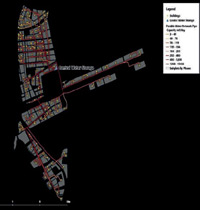
In large Masterplanning projects, there are various infrastructure requirements to meet planning for different demographic aspirations. Such infrastructure projects can range from energy, power, telecommunication, potable water, sewerage systems, etc. Various alternative scenarios need to be explored in a fast-paced design and construction situation. GIS is embedded in Buro Happold master-planning projects to help integrate diverse datasets, enabling BH to undertake computation and analytics to derive the creation of infrastructure networks quickly. Examples can be seen below of potable water and district heat networks design.
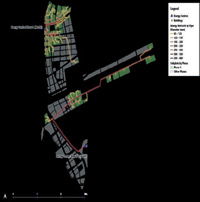 A further example of the important use of GIS - the above graphic represents an award winning Buro Happold master-plan project in Chile, where GIS played a critical role in mobility and transport analysis - to understand the interrelationship between public transport network transit corridor, and commutability of residents of the development.
Potential Issues: A Snapshot
As with Building Information Modelling (BIM) before it, GIS requires a learning curve to understand what is possible, what is required and most importantly, what one wants to achieve. Otherwise there is a risk of just ‘using technology for technology’s sake’ – which often results in disappointment and differing expectations. Clarity of purpose, aims, and results can be achieved in a number of ways. This includes ensuring clear understanding at the outset of the client’s requirements and specifications, and the project team’s responding proposals and plans: Do these take into account the benefits or outcomes that parties envisage will be achieved? Do the documents standardise and set out the processes and data needed to ensure this occurs? Are there gaps in responsibilities or room for vague misunderstandings? One should strongly resist the temptation simply to require a party to “use some GIS” or “perform GIS services”, as sometimes happens. Unsurprisingly, proclaiming that you want someone to use ‘some things’, or do ‘some stuff’, is unlikely to ever get the desired result, particularly in new areas like this where the term “GIS” can mean different things to different parties. The mismatch in expectations is likely to only become apparent much later, during the project or at the stage of delivery.
 To complement agreed scope and deliverables between the client and project team, internal standardised processes, training and understanding is also vital. Individuals within an organisation need to be equipped to know what the organisation can offer to a client, and equally what internal control and risk management procedures will respond to the potential issues that may arise.
Concluding Thoughts
In this increasingly digital and connected world, GIS provides vast potential for improved outputs, better sustainable designs and more informed decision making. However as with all new processes and technologies, there currently lacks standardisation of requirements and understanding. It is important that those uncertainties are considered, outlined and agreed between parties to avoid costly disputes and misunderstandings that would detract from the many benefits GIS has to offer.
The articles from these contributors are based on their personal expertise and viewpoints, and do not necessarily reflect the opinions of their employers or affiliated organizations.
EDITOR'S Choice

Fortune Brands Innovations [NYSE: FBIN]
By Juan Guerrero, Director, IT Audit & Data Analytics
The IT Audit Evolution: From Compliance to Strategic Intelligence
Broad River Retail
Wes Dudley, Senior Vice President, Customer Experience
Customer Experience in the Age of Amplified Complexity
Fortune Brands Innovations [NYSE: FBIN]
Scott Barnes, Sr. Director of Enterprise Cyber Security (CISO)
The X-Factor in Cybersecurity: AI and Automation at Work

LHarris Technologies [NYSE: LHX]
Brian Allred, Director of Business Intelligence and Analytics
The Shift from Rigid Dashboards to Conversational Analytics
Ivar's Restaurants
Patrick Yearout, Director of Innovation, Recruitment & Training
From Hiring to Development: Nurturing Teams that CareLatest Issues