-
Technology
-
Industry
-
Solutions
-
- ASSET MANAGEMENT
- CUSTOMER EXPERIENCE MANAGEMENT
- CYBER SECURITY
- DATA CENTER
- DOCUMENT MANAGEMENT
- ELECTRONIC DATA INTERCHANGE
- ENTERPRISE DATA MANAGEMENT
- ENTERPRISE RESOURCE PLANNING
- ENTERPRISE RISK MANAGEMENT
- ENTERPRISE-GRADE WEB DATA SOLUTIONS
- FACILITY MANAGEMENT
- FIELD SERVICE
- IDENTITY AND ACCESS MANAGEMENT
- INFRASTRUCTURE
- IT SERVICE MANAGEMENT
- MANAGED IT SERVICES
- PAYMENT AND CARD
- PROJECT MANAGEMENT
- SOFTWARE TESTING
- STORAGE
- VIDEO SOLUTIONS
- WORKFLOW
-
-
Platforms
-
Functions
- Leadership Perspectives
- Innovation Insights
- Research
- Magazines
- News
- CXO Awards


Contributory Virtus Investment Partners on the invitation from our Editorial

GKN Automotive
Sacha Porges, Global Director - Lead Customer Quality & New ProgramsThe Impact of Electrificationon Passenger Vehicle Warranties, Contract Pricing, Service & Support
Sacha Porges, Global Director - Lead Customer Quality & New Programs

As we barrel down the road in our transition to an electrified passenger mobility future, I would like to focus on how this brave new world is impacting one of manyimportant areas – warranty – and how the expectations of both OEMs and Tier #1’s who provide theelectrical Hardware with embedded Software are evolving, with resulting significant impacts on Pricing, Service & Support.
For this article, we will look at one of the most important (and complex) elements of a ‘3-in-1’ Electric Drive Unit (or EDU) – the Inverter.
Inverters perform multiple critical functions within an eDrive system:
● Convert Battery DC into 3-phase AC, to power the Motor
● Power ranges from 80kW – 200+kW
● Provide precision control & monitoring of power to protect the PCBA & electrical components
● Maximize energy delivery & efficiency
● Precisely control the eMotor speed and torque
●Ensure functional safety compliance to ISO 26262 requirements (through both hardware and software)
In many cases, eDrive system providers have responsibility for Inverter design & software – but will partner with Suppliers to sub-contract some (or all) of the physical manufacture of these complex componentsdue to high cost of vertical integration.
The Inverter is effectively the ‘brain’ of the EDU, and is constantly interacting with the vehicle, simultaneously receiving inputs (commands) and providing outputs (both physically & digitally) to the vehicle system.
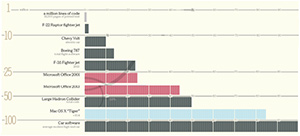
The embedded software necessary to do this is also incredibly complex; a modern EV now deploys upwards of 100 million lines of codeor 10x that of the F-35 stealth fighter – safe to say, the Inverter is definitely not a simple ‘commodity’ part!
 Supply Chain
Now, let us look at atypical Supply Chain for an Inverter from Supplier to Tier #1, OEM and the Final Customer.
Robust cybersecurity is essential to protect the highly sensitiveproprietary software that is embedded in the Inverter at multiple stages throughout this cycle, requiring the entire Supply Chain to beTISAX (Trusted Information Security Assessment eXchange) certified.
Electrical HW with embedded SW must be protected from theft or attempts to plagiarize the design and/or SWat the Inverter, EDU & vehicle levels, requiring SW ‘keys’ (immobilizers);suchmandatory precautions even extend to deploying tamper-proof Inverter packaging during transportation from Supplier to Customer – all of these new requirements carry added costs: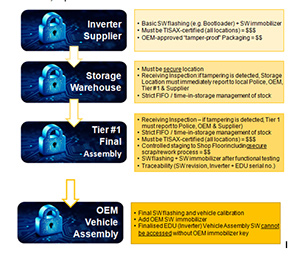
Clearly, the Inverter Supply Chain is highly complexwith exceptional steps required to manage cybersecurity (requiring 3rd Party industry certification).
In the event of 0km or field Warranty concern, normal expectation is to provide root causeanalysis & initial countermeasures within 20 working daysaftersuspect part receipt.
Therefore, special consideration must now be given to Tier #1s and their Supplier(s) to develop robust strategic approaches to Warranty &Service issues that deliver fast responseandeffective R-C analysis + Corrective Actions, with agreement between all Parties:
● What can / cannot be serviced or analysed in the field (Dealership)? What analytical field equipment is needed?
● Necessary field expertise (“Flying Engineer”) to support local and international markets, includingElectrical HW Supplier expertise if proprietary know-how is used
● Returns to the Tier #1: what can / cannot be analysed at that location? What additional Warranty resources are needed in terms of human and equipment / Test Bench?
● Returns to E/E HW Supplier: how quickly must parts be expedited? What are the transportation security requirements? (OEM to Tier #1, Tier #1 to Supplier, etc.)
● Cybersecurity must be maintained throughout the return + analysis process includingthe secure issue of SW ‘keys’ at the Dealer, Tier #1 & Supplier to unlockthe E/E HW & SW
● Budget & Costs (human + equipment): OEM + Market support, analysis at Tier #1 Warranty Return Center & Plant and/or Supplier, freight, scrap, return of NTF parts, etc.
The “Quality Protocol”
MPAs are a well-established to document OEM – Tier #1 – Supplier RACI for complex Supply Chain (e.g. Directed Tier #2), however the scenario for the Inverter goes far beyond a ‘typical’ MPA.
One way to address is through aproactive “Quality Protocol” focusing exclusively on concern management throughout the Supply Chain; early engagement of OEM & Supplier(s) is critically important to agree thescope:
● Ensure RACI constraints and responsibility“hand-shaking” interfaces are fully defined, including cybersecurity
● Develop robust Concern Management strategy for Warranty, Service & Support
● NTF strategy (rework & return vs. scrap) together with a transparent ‘pricing menu’ for Root Cause analysis charge-backs where appropriate
Predict, Prevent & Protect
This approachcan be tremendously helpful to foster collaborative, cross-functional relationships between OEM and Tier #1launch teams that can successfully:
Predict –accurate mapout a budget for the necessary support structures & resources throughout the Supply Chain, delivering a robust strategy that fits within the OEM 0km + Warranty Terms & Conditions.
Prevent –prevent ‘worst case’ scenarios created due to lack of process transparency& RACI interactions; if a field concern occurs, the “who does what and when” are pre-established including management of returns to maintain cybersecurity.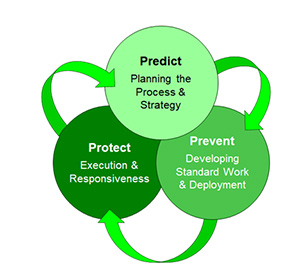
Protect –concerns do happen; the defined ‘pricing menu’ helps protect the OEM, Tier #1 & Supplier(s) from unexpected field complaint costs, and secondly facilitates expedited R-C + countermeasures to address field issues and protect the final Customer – which should be our ultimate mission.
The articles from these contributors are based on their personal expertise and viewpoints, and do not necessarily reflect the opinions of their employers or affiliated organizations.
EDITOR'S Choice

Fortune Brands Innovations [NYSE: FBIN]
By Juan Guerrero, Director, IT Audit & Data Analytics
The IT Audit Evolution: From Compliance to Strategic Intelligence
Broad River Retail
Wes Dudley, Senior Vice President, Customer Experience
Customer Experience in the Age of Amplified Complexity
Fortune Brands Innovations [NYSE: FBIN]
Scott Barnes, Sr. Director of Enterprise Cyber Security (CISO)
The X-Factor in Cybersecurity: AI and Automation at Work

LHarris Technologies [NYSE: LHX]
Brian Allred, Director of Business Intelligence and Analytics
The Shift from Rigid Dashboards to Conversational Analytics
Ivar's Restaurants
Patrick Yearout, Director of Innovation, Recruitment & Training
From Hiring to Development: Nurturing Teams that CareLatest Issues


