-
Technology
-
Industry
-
Solutions
-
- ASSET MANAGEMENT
- CUSTOMER EXPERIENCE MANAGEMENT
- CYBER SECURITY
- DATA CENTER
- DOCUMENT MANAGEMENT
- ELECTRONIC DATA INTERCHANGE
- ENTERPRISE DATA MANAGEMENT
- ENTERPRISE RESOURCE PLANNING
- ENTERPRISE RISK MANAGEMENT
- ENTERPRISE-GRADE WEB DATA SOLUTIONS
- FACILITY MANAGEMENT
- FIELD SERVICE
- IDENTITY AND ACCESS MANAGEMENT
- INFRASTRUCTURE
- IT SERVICE MANAGEMENT
- MANAGED IT SERVICES
- PAYMENT AND CARD
- PROJECT MANAGEMENT
- SOFTWARE TESTING
- STORAGE
- VIDEO SOLUTIONS
- WORKFLOW
-
-
Platforms
-
Functions
- Leadership Perspectives
- Innovation Insights
- Research
- Magazines
- News
- CXO Awards



 Colt McNealy, Founder & Managing Member
LittleHorse provides a powerful action layer that allows enterprises to codify and orchestrate business processes across the SaaS applications they already use. Its Business-as-Code platform allows organizations to define how work should move across applications, AI agents and people, along with the context they need to participate in those processes. Rather than relying on the insufficient automation capabilities in individual platforms, enterprises can define how their own processes should operate across those systems.
That control gives enterprises a way to move beyond the limitations imposed by their SaaS platforms. Companies that historically bought software can begin creating capabilities specific to the way they operate, without replacing their SaaS investments or maintaining a massive engineering organization. They can codify business logic around their own requirements, observe how processes perform and refine those capabilities as their needs evolve.
"For years, enterprises adapted their business processes to fit the software they bought. Business-as-code reverses that relationship by allowing software to adapt to the business," says Colt McNealy, founder and managing member.
Beyond Integration Toward Enterprise Orchestration
Business-as-Code emerged from McNealy's experience building enterprise software for the real estate industry. The platform he worked on grew to more than 150 microservices alongside external SaaS applications such as Salesforce and Rippling. Individual workflows could involve several dozen microservices, making it difficult to track a process or understand what went wrong when something failed.
Retries, circuit breakers, dead-letter queues and timeouts added further complexity. That experience led McNealy to develop the first part of the LittleHorse platform around reliable workflow execution across microservices and external integrations.
"Agents make the decision, and then the deterministic process is orchestrated by the system."
The same challenge appears for enterprises built around SaaS platforms. They may connect Salesforce to NetSuite or synchronize information between applications, yet those connections primarily govern data exchange, leaving the business process itself without a mechanism to manage its progression.
A fleet operation, for example, may need to respond to an external event, trigger activity across several applications and wait for information, actions or approvals before proceeding. Without process-level coordination, those dependencies can leave execution spread across individual systems, making it difficult to know when to move the process forward or step in when something goes wrong.
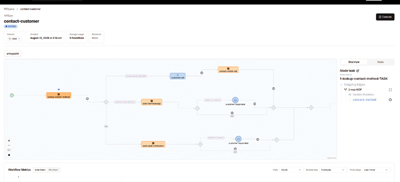 Process orchestration governs what happens around that exchange, defining how work progresses across connected systems, what happens in what order and how long-running activities are managed from beginning to end.
LittleHorse’s action layer coordinates those activities across enterprise systems while leaving each application in its role as a system of record. Organizations can define how work should move between those systems, while the workflow itself becomes an asset that can be developed independently of any single application.
That separation gives enterprises a way to change the logic connecting their systems without having to change the systems themselves. Business processes can evolve as operating requirements change while the underlying applications continue performing their established roles. Business-as-Code is more flexible and easier to adapt than the automation capabilities built into off-the-shelf SaaS applications.
Making AI Work Within Enterprise Operations
As enterprises introduce AI agents into these processes, the challenge is determining where they should exercise judgment and how their decisions should fit into the workflow. An agent may be capable of making a decision or completing a task, but that capability has to fit within the larger process around it. The key is separating the agent's decision from the actions that follow. That distinction matters because the ability to make a decision does not mean an agent should control everything that follows. Large language models are well-suited to interpreting information and reasoning through ambiguous situations. Enterprise operations, however, often depend on sequences that should remain consistent. A customer support agent may determine whether a customer wants a refund or a return, but the subsequent actions should follow established business logic.
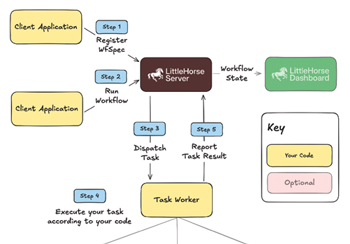 LittleHorse's Business-as-Code approach separates those functions. AI agents contribute where judgment is required. Once a decision is made, the workflow takes over and executes the defined sequence. Coding agents can produce Business-as-Code workflows, and business users can review them through the dashboard.The separation reduces unnecessary model usage while keeping repeatable process steps consistent. Workflow execution also creates a record of what the agent decided and what happened afterward, supporting traceability and compliance.
"Agents make the decision, and then the deterministic process is orchestrated by the system," says McNealy.
Human oversight can remain part of the same model. Business-as-Code allows organizations to define points where an agent can act independently and where a process must pause for human verification. This gives them a way to introduce AI into operational workflows while retaining accountability.
Turning Workflow Execution Into Operational Intelligence
Once those processes are running, their execution data can provide a view into how the business operates.
LittleHorse brings that visibility through Saddle Command Center, a centralized interface for managing and observing workflow execution. Teams can trace individual process instances from initiation to completion and see the systems involved, decisions made by agents, failures and retries. It also provides a single place to define the process template, process metadata and workflow itself, giving teams a consistent view of how a business process should operate across distributed systems. Because Business-as-Code codifies processes in code, they can be tested, version-controlled and validated.

For years, enterprises adapted their business processes to fit the software they bought. Business-as-code reverses that relationship by allowing software to adapt to the business.

Saddle Command Center can also push workflow events to Apache Kafka at meaningful points in a process, allowing execution data to flow into an organization's existing data infrastructure. This creates a stream of operational data that can be analyzed to identify inefficiencies and detect anomalies as processes run.
A vegetation management company shows how this approach can translate into measurable gains. It manages about 8,000 trucks and 100,000 pieces of equipment while coordinating field crews clearing vegetation around power lines. The operations previously depended on several SaaS platforms alongside spreadsheets and email. They lacked adequate visibility into truck locations, equipment availability and job progress.
LittleHorse helped the business build an end-to-end system for equipment purchases, maintenance, repairs, resource rerouting, job bidding and execution. It also built a command-center heat map showing the location of trucks in the field.
The new insights exposed idle capacity and inefficient routing. The business could fulfill more jobs with the same number of trucks, increase sales without expanding its fleet and scale without increasing its back-office operations. It also identified inefficiencies in how jobs were bid, helping reduce unnecessary costs.
Expanding the Business-as-Code Model
LittleHorse is now focused on reducing the implementation work enterprises need to undertake themselves. One upcoming capability will allow customers to create and configure AI agents declaratively, connecting them to MCP servers and integrating them directly into business workflows.
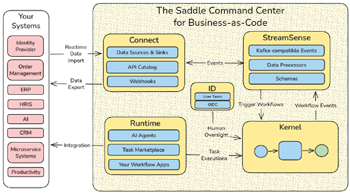 Industry-specific starter kits are also part of the roadmap. These packages will combine connectors, tasks and workflows around particular modernization and automation requirements, giving enterprises a more direct starting point for applying Business-as-Code to specific operational needs.
LittleHorse is also building stream processors that can turn execution events into business intelligence, bringing more of that analysis directly into the workflow environment as processes run. A combination of AI agent automation and workflow orchestration has earned LittleHorse recognition as a Top AI Agents Automation and Workflow Orchestration Platform 2026.
That combination gives enterprises greater control over how their existing technology works together and how business processes operate across it. As their needs evolve, LittleHorse provides a foundation for continuously refining those processes and building new capabilities around them.
Making AI Agents Accountable to Workflows
AI agents are exposing a problem that conventional workflow software has rarely solved. Many enterprises run essential work across SaaS platforms, integration tools, local scripts and shared spreadsheets. Agents are then expected to work across all of them, gather enough context and make safe decisions. The difficulty lies in the gap between what an agent can infer and what the business can actually control.
Point-to-point integrations move data but do not preserve the history of a process. iPaaS platforms connect systems, yet long-running work can still end up scattered across queues, callbacks, approvals and exceptions. For buyers, introducing agents is only part of the challenge. They also need a process that can show exactly what happened.
Workflow orchestration can provide that structure when it carries context along with the work instead of simply routing it from one system to another. Agents still need room to exercise judgment, but that judgment needs boundaries. A model might classify an email, interpret intent, retrieve missing context and recommend what should happen next. It should not have to work out the refund procedure or customer verification process from scratch every time a request comes in. Repeatable steps are less expensive to execute through deterministic logic and easier to audit. The agent can then handle the parts that require interpretation while established actions remain within versioned process logic.
“Agents can make decisions where judgment is required while the workflow handles repeatable actions.”
That separation is useful only if the business can see what happened in each workflow. Executives need a way to inspect the process template, runtime history, agent decision and failure path in one place. Once APIs, agents, human reviewers and external events are involved, ordinary system logs do not provide the whole picture. Buyers need to know which action ran, what data moved, what decision was made and what happened when a step timed out or had to be retried. Keeping that information with the process also makes automation easier to improve because performance data remains connected to the work that produced it.
The amount of engineering required to get there matters too. An orchestration platform has limited practical value if a company needs to build a large specialist team before it can put a useful process into production. Existing services and SaaS APIs should be composable into business logic that people can understand and change without rebuilding the entire integration map. A code-first approach is useful when software teams get version control, business reviewers can see the workflow as a visual graph, auditors can trace what happened and agents have a stable process map to work within.
The larger issue is ownership of the process, not simply how many tasks can be automated. Long-running workflows need to retain state, and agent decisions need to remain visible without requiring a model call at every step. Once the process is running, event-driven feedback can show where it needs improvement. The platform also has to work for organizations with different levels of software maturity. One team may be coordinating a large collection of microservices, while another needs custom workflow logic around ERP, CRM, field-service and workforce systems without having to wait for a vendor to add the functionality to its roadmap.
LittleHorse takes this approach with Saddle Command Center and its Business-as-Code model for building workflows across microservices, SaaS platforms, agents and human-in-the-loop steps. Agents can make decisions where judgment is required while the workflow handles repeatable actions. Individual instances remain traceable, and workflow event data can be published to Apache Kafka for analysis. Support for Java, Python, Go and C# also allows engineering teams to maintain the business logic without having to adopt a specialist workflow language. For enterprises working across disconnected SaaS environments or complex microservice estates, LittleHorse provides a practical way to give AI agents room to make decisions while keeping the surrounding process visible and controlled....Read more
AI Agent Automation and Workflow Orchestration Platforms Info
Q1
What Are AI Agents, Automation and Workflow Orchestration Platforms?
AI Agents Automation and Workflow Orchestration Platforms help organizations coordinate work across AI agents, software applications, events and people. Instead of treating every automation as an isolated task, these platforms manage how work progresses from one step to the next, including approvals, exceptions, delays and system responses. LittleHorse approaches this through its Business-as-Code model, which allows enterprises to define business processes across their existing SaaS applications, microservices and AI agents.
Q2
How Does LittleHorse Apply AI Agents, Automation and Workflow Orchestration Platforms to Enterprise Operations?
LittleHorse uses AI Agents Automation and Workflow Orchestration Platforms to separate judgment from execution. An AI agent can interpret information or make a decision, while the surrounding workflow carries out the repeatable steps that follow. Its Business-as-Code approach allows processes to be written, tested and version-controlled, while Saddle Command Center provides visibility into workflow execution, including decisions, failures and retries. This helps organizations introduce AI into operational processes without giving an agent uncontrolled responsibility for the entire workflow.
Q3
Why Is Workflow Orchestration Important When Organizations Deploy AI Agents?
AI Agents, Automation and Workflow Orchestration Platforms become important when an agent must operate within a larger business process rather than perform a single isolated task. AI can handle ambiguity, interpretation and judgment, but many operational steps need to follow established rules. Orchestration provides the structure around those decisions by determining what happens next, which system is involved and when a process should wait for an event or human review. This can make long-running processes more predictable, traceable and easier to manage.
Q4
What Should Organizations Look for in an AI Agent and Workflow Orchestration Platform?
When evaluating AI Agents, Automation and Workflow Orchestration Platforms, organizations should consider how well a platform handles complex processes across existing systems. Important capabilities include durable execution, exception handling, retries, timeouts, human approvals and visibility into individual workflow instances. The ability to retain process context also matters because teams need to understand what occurred before and after an agent made a decision. A platform should help organizations coordinate existing technology without requiring them to replace every system already in use.
Q5
How Can LittleHorse Improve Visibility Across Complex Workflows?
LittleHorse addresses a central challenge of AI Agents, Automation and Workflow Orchestration Platforms: understanding what is happening across distributed systems. Its Saddle Command Center allows teams to trace workflow instances from initiation through completion and examine the systems involved, agent decisions, failures and retries. Workflow events can also be sent to Apache Kafka, allowing execution data to become part of an organization's broader data environment. This can help reveal inefficiencies and operational patterns that are difficult to identify when work remains fragmented across applications.
Q6
Can Workflow Orchestration Help Organizations Build on Their Existing Software Investments?
AI Agents, Automation and Workflow Orchestration Platforms can help organizations create new process capabilities around the software they already use. Rather than replacing systems that serve as systems of record, orchestration can define how work moves between them. This approach is particularly useful when operating requirements change faster than packaged software can be adapted. By keeping process logic separate from individual applications, organizations can refine workflows while allowing their underlying technology investments to continue performing their established functions.

Company
LittleHorse
Management
Colt McNealy, Founder & Managing Member
Description
LittleHorse provides a Business-as-Code platform which acts as an action layer to enable enterprises to orchestrate AI agents, people and enterprise systems across complex workflows. Its unified execution framework helps organizations codify business processes, extend existing technology investments and transform fragmented software environments into coordinated, intelligent operations.