-
Technology
-
Industry
-
Solutions
-
- ASSET MANAGEMENT
- CUSTOMER EXPERIENCE MANAGEMENT
- CYBER SECURITY
- DATA CENTER
- DOCUMENT MANAGEMENT
- ELECTRONIC DATA INTERCHANGE
- ENTERPRISE DATA MANAGEMENT
- ENTERPRISE RESOURCE PLANNING
- ENTERPRISE RISK MANAGEMENT
- ENTERPRISE-GRADE WEB DATA SOLUTIONS
- FACILITY MANAGEMENT
- FIELD SERVICE
- IDENTITY AND ACCESS MANAGEMENT
- INFRASTRUCTURE
- IT SERVICE MANAGEMENT
- MANAGED IT SERVICES
- PAYMENT AND CARD
- PROJECT MANAGEMENT
- SOFTWARE TESTING
- STORAGE
- VIDEO SOLUTIONS
- WORKFLOW
-
-
Platforms
-
Functions
- Leadership Perspectives
- Innovation Insights
- Research
- Magazines
- News
- CXO Awards


Driving Digital Transformation: Our Key Takeaways from SAP Sapphire 2024
CIO Review
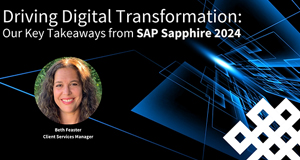
SAP Sapphire 2024, one of the most anticipated events in the enterprise software industry, was a resounding success, drawing thousands of professionals, executives, and thought leaders from around the globe. The event, held in Orlando, Florida, showcased the latest advancements in SAP technologies and provided a platform for networking, knowledge sharing, and innovation.
Keynote Highlights
The keynote sessions were the cornerstone of SAP Sapphire 2024, featuring insights from SAP's top executives and industry leaders. Christian Klein, CEO of SAP, kicked off the event with a visionary address focusing on the future of intelligent enterprises. He emphasized SAP's commitment to sustainability, digital transformation, and customer success. Klein also unveiled several new product enhancements and strategic partnerships aimed at accelerating business innovation.
BGSF's Key Takeaways
SAP S/4Hana
BGSF's own Beth Feaster, Client Services Manager, attended the event and noted that a majority of the sessions and her conversations related to SAP S/4HANA. According to Beth:
● SAP has extended the support deadline of ECC from 2027 to 2029.
● Organizations need to start with the migration by 2027, or they will be lacking ECC support, which will make it almost impossible for a successful transition.
● There is still a very large number of organizations on ECC.
The Rise of RISE with SAP
The RISE with SAP offering is a comprehensive, AI-powered cloud ERP solution managed and optimized by SAP. It provides a suite of services and tools built on SAP's clean core approach, enabling businesses to:
● Migrate on-premise systems to the cloud efficiently.
● Transform and modernize business processes.
● Drive continuous innovation.
● Unlock the agility and scalability of the cloud.
RISE with SAP represents a significant step forward in helping businesses transition to cloud environments while maintaining operational excellence and embracing innovative AI capabilities.
SAP Business Technology Platform (BTP)
SAP BTP is an integrated innovation platform optimized for SAP applications in the cloud. It brings together application development and automation, data and analytics, integration, and AI capabilities into a single, unified environment. This platform enables businesses to:
● Develop and automate applications seamlessly.
● Harness the power of data analytics to gain actionable insights.
● Integrate various processes and systems effortlessly.
● Leverage AI to enhance operational efficiency and decision-making.
BTP's unified environment ensures that all these capabilities work harmoniously, offering a robust foundation for digital transformation and innovation.
AI at the Forefront
Both RISE with SAP and SAP BTP heavily utilize AI, underscoring the pivotal role of artificial intelligence in modern enterprise solutions. At the conference, there were numerous discussions around the practical applications of AI, including the generation of ABAP code using AI, which demonstrates the growing sophistication and utility of AI in SAP's offerings.
Buzz and Insights from the Conference
This year's SAP Sapphire was buzzing with excitement and innovation. Beth's discussions with direct SAP representatives were particularly enlightening, providing deeper insights into the strategic direction and customer expectations. A significant emphasis was placed on RISE with SAP, with expectations of a major shift from customers towards adopting an SAP-managed cloud environment.
However, a recurring theme in these conversations was the challenge of resource availability. Multiple SAP account representatives highlighted a shortage of skilled resources required to kickstart new projects, indicating a potential bottleneck in the rapid adoption and implementation of these advanced solutions.
The Future of SAP
SAP Sapphire 2024 provided a comprehensive look into the future of enterprise technology, with a strong focus on AI-driven innovations and cloud solutions like RISE with SAP and SAP BTP. The event underscored SAP's commitment to driving digital transformation and continuous innovation, while also highlighting the challenges that lie ahead in terms of resource allocation and project initiation. As businesses continue to navigate the complexities of digital transformation, the insights and advancements showcased at SAP Sapphire 2024 will undoubtedly play a crucial role in shaping their journey.
BGSF is uniquely positioned to assist businesses in maximizing the value of their SAP solutions. With a deep understanding of SAP's comprehensive suite of products, BGSF offers expert consulting services to streamline implementation, optimize system performance, and drive digital transformation. Our team of seasoned SAP professionals provides end-to-end support, from strategic planning and system migration to ongoing management and innovation. By partnering with BGSF, businesses can leverage cutting-edge SAP technologies to enhance efficiency, achieve greater agility, and unlock new growth opportunities, ensuring they stay ahead in an increasingly competitive marketplace. Contact us today!
More in News
The creative production cycles are becoming faster and more adaptable as businesses increasingly turn to AI-driven video creation platforms to meet growing content demands. These platforms enable teams to produce high-quality visual content with minimal manual effort, reducing reliance on large production setups. Features like automated editing, script generation, and real-time customization allow brands to respond swiftly to market changes while maintaining consistent messaging across their campaigns.
Beyond efficiency, the impact extends into cost control and sustainability. Reduced need for physical shoots, travel, and equipment is lowering production expenses and minimizing the environmental footprint. Simultaneously, scalable content creation is helping organizations localize messaging across regions without duplicating resources. As adoption grows, these platforms are reshaping how businesses approach storytelling, making video production more accessible, flexible, and aligned with modern operational priorities.
Market Overview and Trends in AI Business Video Creation Platforms
Demand is expanding steadily as organizations across industries integrate AI-driven video tools into core communication strategies. Enterprises, startups, and even internal corporate teams are leveraging these platforms to support marketing, training, customer engagement, and social media outreach at scale. The market is witnessing broader adoption across sectors such as retail, education, healthcare, and finance, where the need for frequent, visually engaging content continues to grow. This widespread use is strengthening the platform ecosystem and encouraging continuous feature development.
Technology advancements are playing a central role in shaping current trends. Improvements in generative AI, voice synthesis, and multilingual capabilities are enabling more personalized and region-specific content delivery. Cloud-based deployment models are further enhancing accessibility, allowing teams to collaborate seamlessly without heavy infrastructure. In addition, integration with analytics tools is helping businesses measure content performance more effectively, creating a data-backed approach to video strategy and refinement.
Competitive dynamics are also evolving as platform providers focus on differentiation through customization, security, and enterprise-grade capabilities. Subscription-based models, flexible pricing tiers, and API integrations are making these solutions more adaptable to varying business needs. At the same time, concerns around data privacy, content authenticity, and intellectual property are prompting stricter governance and platform safeguards. Together, these developments are shaping a market that is not only growing rapidly but also maturing in terms of reliability, scalability, and trust.
Key Challenges and Solutions Shaping AI Business Video Creation Platforms
Maintaining content authenticity remains a pressing concern as AI-generated videos become more advanced. The risk of misrepresentation, deepfake misuse, and loss of brand credibility is pushing organizations to adopt stricter validation processes. In response, platform providers are introducing watermarking, traceability features, and verification layers that help distinguish original content from manipulated outputs, ensuring greater transparency across digital channels.
Another challenge lies in balancing creative control with automation. While AI accelerates production, it can sometimes limit originality or fail to capture nuanced brand identity. To address this, companies are enhancing customization capabilities, allowing users to fine-tune visual styles, tone, and narrative elements. Hybrid workflows that combine human oversight with AI assistance are emerging as a practical solution, preserving creativity while maintaining efficiency.
"Hybrid workflows that combine human oversight with AI assistance are emerging as a practical solution, preserving creativity while maintaining efficiency."
Data security and compliance requirements are also shaping platform development. Handling sensitive business data, scripts, and proprietary visuals requires robust protection measures, especially for enterprises operating across multiple regions. As a result, providers are strengthening encryption protocols, access controls, and compliance frameworks to align with evolving regulatory standards and enterprise expectations.
Integration challenges continue to surface as businesses seek seamless compatibility with existing digital ecosystems. Disconnected tools can disrupt workflows and reduce overall productivity. In response, developers are focusing on interoperability, enabling smoother connections with marketing platforms, content management systems, and enterprise software to create a more unified operational environment.
The pace of technological change itself presents both an opportunity and a hurdle. Rapid innovation can make it difficult for organizations to keep up with evolving features and capabilities. To counter this, vendors are investing in user education, intuitive interfaces, and ongoing support systems that simplify adoption. This approach is helping businesses stay aligned with advancements while maximizing the long-term value of AI-driven video solutions.
Future Outlook and Innovations in AI Video Creation Platforms
The next phase of growth is expected to be shaped by deeper intelligence and contextual understanding within video creation systems. Platforms are moving toward generating content that adapts not just to prompts, but to audience behavior, platform requirements, and real-time engagement signals. This shift is likely to support more dynamic storytelling, where videos evolve based on viewer interaction, enabling businesses to deliver more responsive and outcome-driven content experiences.
Innovation is also advancing in the area of hyper-personalization at scale. Future platforms are anticipated to create highly tailored video outputs for different audience segments without increasing production timelines. From individualized messaging to culturally adaptive visuals, this capability is set to redefine how brands communicate across diverse markets, making content feel more relevant and closely aligned with audience expectations.
Another emerging direction involves immersive and interactive formats that go beyond traditional video structures. The integration of augmented elements, interactive layers, and adaptive visual environments is opening new possibilities for engagement, particularly in training, marketing, and virtual experiences. These advancements are expected to blur the line between static content and interactive media, offering richer and more engaging user journeys. ...Read more
Gaming and hospitality software is increasingly a vital operational element of companies handling entertainment, guest service and customer engagement in connected surroundings. Today, software can do a lot more than just make reservations or deal with gaming administration. It can facilitate the coordination of guest interaction, the management of property operations, monitoring of transactions and the interconnection of various service areas via a common digital infrastructure. With a growing trend towards experience-driven customer expectations, gaming and hospitality software is evolving to make operations faster, while providing greater visibility of performance, preferences and service delivery for businesses.
Shifting Trends in Gaming and Hospitality Technology
The gaming and hospitality sectors have been joining forces in recent years, with a growing focus on efficient guest management. In recent years, the gaming and hospitality industries have been increasingly intertwined, with a particular emphasis on streamlined guest management. Software platforms can enable reservations, customer data, loyalty activity and operational workflows to be integrated into connected environments. More integration means that staff can retrieve all relevant information without having to switch between silo-based systems, enabling staff on service to meet guest needs better.
Hospitality technology is also slowly turning heads towards personalization. The days of providing a standard service are over as guests want to be treated according to their likes and dislikes. Software can help to learn customer booking patterns and provide insight into which services they prefer to book and how they engage with them. Staff are then able to make more relevant recommendations and ensure that controls exist around personal information.
Mobile access is transforming how guests interact with gaming and hospitality businesses. Use of digital booking, mobile check-in, access to accounts and requests for services can minimize the need for physical processes. Loyalty programs and information about properties can also be easily accessed from mobile platforms. A connected mobile experience can provide an extra touchpoint to operators, but may also eliminate repetitive admin tasks.
Cloud infrastructure is helping to facilitate flexibility throughout properties and environments. Centralized systems can control information from being available wherever it is approved, and minimize reliance on locally installed infrastructure. Cloud architecture can also help in software updates and provide uniformity in processes across different operational areas.
Strengthening Operations Through Practical Solutions
Multiple systems used to operate several functions can result in lost information and multiple duplicated systems. Integrated platforms enable the linking of reservations, customer records, loyalty activities and operational workflows in a synchronized environment. With the improved integration, there is a significant decrease in the amount of data that must be entered twice, and teams will have a clearer picture of how customers are using their services and what they need.
The operational demand fluctuates as well between the gaming and the hospitality environment, which makes it more complex to plan resources. Analytics can assist managers in knowing the pattern of bookings, customer activity, and service needs. With improved forecasting, it is also possible to modify the number of staff and operational resources available based on demand, thus avoiding a rigid resource schedule.
The provision of a consistent service at several properties can also be a challenge. Performance may be difficult to compare across different locations, as they may implement their own processes. Common software standards can create common workflows with sufficient flexibility for local requirements. Centralized reporting can also help management to know where their practices are working better.
The gaming and hospitality sectors are especially vulnerable to cybersecurity concerns, as they can store payment details, customer profiles, and account activity. Controlling permissions and continuously monitoring sensitive systems can help safeguard them through strong authentication. Routine security inspections may also discover spaces for enhancements and make sure that the working staff can continue to have access to the needed software with reliability.
New Capabilities Expanding Industry Opportunities
AI is opening up new avenues for understanding customer behavior and enhancing operational decision-making. AI-supported systems can detect patterns over bookings, service preferences and engagement activity. These insights are valuable for managers to optimize customer interactions and allocate resources efficiently. Machine recommendations are not an end-all and be-all, as human judgment is still necessary to take into account other operational factors and business priorities.
Another area where predictive analytics can help is demand management. Software can look at the past and present data to determine future needs for rooms, services and entertainment. Forecasting can be more accurate to help operators plan staffing, inventory and service capacity to their needs. The usefulness lies in the fact that such predictive information is used as a basis for decision-making, not as a foregone conclusion of the automated forecast.
Digital experiences are moving beyond recommendations to the personalized. Software can link customer preferences to loyalty programs, booking processes and service interactions. Any guest who has used specific facilities or services regularly may be provided with pertinent details via approved means of communication. Customer engagement through personalization can be more useful and provide better insight into customer interests for operators.
Another area that has a lot of scope for automation is property operations. Normal activities like notifications, booking confirmations, account updates and internal workflow alerts can be done digitally. Staff have more time to engage with guests and to make sound professional decisions as repetitive administrative tasks are reduced. ...Read more
Agricultural microalgae solutions are gaining significant attention as farmers and agribusinesses seek sustainable methods to improve crop productivity, soil health, and resource efficiency. Microalgae are microscopic photosynthetic organisms rich in nutrients, bioactive compounds, amino acids, and natural growth stimulants that can enhance agricultural performance while reducing dependence on conventional chemical inputs. As global agriculture faces increasing pressure from climate change, soil degradation, and growing food demand, microalgae-based technologies are emerging as valuable tools for supporting resilient and environmentally responsible farming systems.
How Do Agricultural Microalgae Solutions Improve Crop Performance and Soil Health?
Microalgae-based agricultural products provide multiple benefits that support both plant growth and long-term soil sustainability. These solutions are commonly used as biofertilizers, biostimulants, soil conditioners, and nutrient supplements that enhance crop development throughout various growth stages.
Microalgae are rich in essential nutrients, including nitrogen, phosphorus, potassium, trace minerals, vitamins, and compounds that enhance plant growth. When applied to crops, they can improve seed germination, root development, nutrient absorption, and overall plant vitality. Their natural bioactive compounds help strengthen plants against environmental stress factors, including drought, salinity, and temperature fluctuations. In addition to improving crop performance, microalgae contribute to healthier soils.
Promote microbial activity, improve soil structure, increase organic matter content, and enhance moisture retention. These benefits support sustainable soil management practices while helping farmers maintain productivity over the long term. As concerns about soil degradation continue to grow globally, microalgae solutions offer an environmentally friendly approach to restoring and maintaining agricultural ecosystems.
Why Are Microalgae Solutions Becoming Important in Sustainable Agriculture Strategies?
The increasing adoption of microalgae technologies reflects broader efforts to make agricultural production more sustainable, efficient, and climate-resilient. Farmers, agricultural cooperatives, and food producers are seeking alternatives that reduce environmental impacts while maintaining strong yields and profitability.
Microalgae cultivation can use relatively limited land resources and utilize carbon dioxide and wastewater streams, offering potential sustainability benefits compared with conventional agricultural inputs. Improving nutrient efficiency may also help reduce fertilizer losses and runoff that contributes to water pollution. Volt Technologies supports purchasing and inventory management through Microsoft Dynamics 365 Business Central, helping businesses coordinate operational processes and manage resources through integrated enterprise systems.
Cascades by Metamorphix connects student information, referrals, and interventions to improve coordination, resource allocation, and support planning across school districts.
Furthermore, growing regulatory emphasis on sustainable farming practices is encouraging the use of biological and natural agricultural inputs. Microalgae-based products align well with organic farming systems, regenerative agriculture initiatives, and environmental stewardship programs. Ongoing research continues to reveal new uses for microalgae in crop protection, carbon sequestration, and precision agriculture, further enhancing their role in modern farming operations. ...Read more
Organizations are increasingly adopting app deployment platforms to enable more systematic, reliable and efficient application delivery processes across their technology environments. These platforms help developers automate and manage application releases while coordinating deployment activities between development and operations teams, improving visibility across software delivery workflows. App deployment platforms enhance collaboration between teams, simplify application lifecycle management and provide organizations with greater control and insights into their software delivery processes.
Current Market Trends Shaping App Deployment Platforms
One of the most prominent trends influencing the future of app deployment platforms is the adoption of cloud-native and container-based application environments. Today, companies are heading towards flexible infrastructure architectures that will allow quick scalability of applications and improved resource management across a range of different technological platforms. This has enabled companies to implement deployment technologies that align with their modern architectural frameworks and changing digital requirements.
The DevOps approach and continuous delivery models have been changing the way in which companies develop, test, and deploy their applications through the development process. Technology teams are adopting more and more such automated testing systems, collaborative development tools and streamlined engineering practices, which are becoming an important part of software delivery processes. App deployment platforms are evolving alongside these practices by supporting broader tool integration and enabling more connected development ecosystems.
There is more emphasis being laid on security and compliance in view of the complexity of the application environment faced by organizations. Companies are concentrating on effective access control, deployment and governance solutions to ensure that their application environment remains secure. This trend is driving demand for app deployment platforms that support controlled software releases while helping organizations address evolving security expectations.
Key Challenges and Strategic Solutions in App Deployment Platforms
One of the biggest challenges for organizations continues to be managing complex application environments as software ecosystems proliferate across multiple platforms and operational environments. Differences in infrastructure configurations, application dependencies and technology stacks can create difficulties during deployment activities. Organizations are addressing these complexities through standardized deployment frameworks, improved environment management practices and structured processes that help maintain consistency throughout application operations.
Application reliability during regular updates is yet another crucial issue in the adoption of contemporary deployment methods by enterprises. There could be unintended interruptions, problems in configuration, or risks involved in release that can disrupt business operations and the end-user experience. Organizations are strengthening their deployment strategies through advanced testing practices, automated validation processes and controlled release mechanisms that help identify potential issues before applications reach production environments.
As organizations manage more integrated digital ecosystems, securing risks associated with software deployment will always be a huge focus. These vulnerabilities, unauthorized access risks and lack of protection may affect the integrity of applications. Organizations are raising the bar for security practices by embedding security assessments into development workflows, implementing stronger identity management controls, and proactively monitoring application environments.
Organizations may face difficulties in measuring operational efficiency when they lack comprehensive insights into application performance and deployment results. Without accurate insights into application behavior, identifying bottlenecks and resolving issues quickly becomes more difficult. Organizations are responding through enhanced observability tools, performance tracking capabilities and analytical solutions that provide a deeper understanding of application operations.
The difficulty faced by companies in acquiring experts who can manage modern deployment systems still poses a problem. Modern software environments have become more complex, necessitating companies to acquire specific skills relating to automation, cloud infrastructure and effective application management. This has been tackled by businesses through the process of employee training, gaining expertise and collaborating with technology firms that offer additional technical assistance.
Future Prospects and Innovations
The future of app deployment platforms will probably be a blend of higher intelligence, automation and adaptability in software management practices. Emerging capabilities such as artificial intelligence-driven operations, predictive analytics and automated decision-making are creating new possibilities for improving deployment strategies. These advancements are enabling organizations to anticipate operational requirements, optimize application handling and create more responsive technology environments that align with evolving business needs.
Innovations in low-code and no-code development ecosystems are also influencing the next phase of app deployment platforms by making application creation and management more accessible to a broader range of users. These methods are helping organizations speed up application development, encourage collaboration between technical and non-technical teams and enable quicker deployment of business solutions. The integration of these capabilities is expected to expand the role of deployment platforms beyond traditional software management functions.
However, the continued evolution of intelligent automation, advanced integration, and autonomous deployment technologies would redefine the ways organizations will manage software ecosystems in the future. The application deployment platforms would become more proactive and allow organizations to coordinate their resources more efficiently and resolve any issues automatically. These developments will also provide organizations with better digital capabilities in order to face future application challenges. ...Read more
