-
Technology
-
Industry
-
Solutions
-
- ASSET MANAGEMENT
- CUSTOMER EXPERIENCE MANAGEMENT
- CYBER SECURITY
- DATA CENTER
- DOCUMENT MANAGEMENT
- ELECTRONIC DATA INTERCHANGE
- ENTERPRISE DATA MANAGEMENT
- ENTERPRISE RESOURCE PLANNING
- ENTERPRISE RISK MANAGEMENT
- ENTERPRISE-GRADE WEB DATA SOLUTIONS
- FACILITY MANAGEMENT
- FIELD SERVICE
- IDENTITY AND ACCESS MANAGEMENT
- INFRASTRUCTURE
- IT SERVICE MANAGEMENT
- MANAGED IT SERVICES
- PAYMENT AND CARD
- PROJECT MANAGEMENT
- SOFTWARE TESTING
- STORAGE
- VIDEO SOLUTIONS
- WORKFLOW
-
-
Platforms
-
Functions
- Leadership Perspectives
- Innovation Insights
- Research
- Magazines
- News
- CXO Awards


The Changing of the Guard is Coming - Are you Future-Ready?
CIO Review

For years, the media, economists and labor experts have warned that our aging population – coupled with fewer young people entering the workforce – has the potential to cripple organizations across the globe. And although nearly every industry is likely to feel the pain of Baby Boomers entering retirement, facilities management is poised for significant labor shortages. According to the International Facilities Management Association, 40% of existing facilities managers are expected to retire by 20261 and it’s safe to say that those remaining aren’t too far behind – the average age of facilities management professionals is 49 years.2 Experts predict that by the end of the decade, the facilities management industry will have 150,000 open jobs.
Organizations increasingly turn to outsourcing as a solution to this problem – McKinsey & Company estimates that 50% of all facilities management is outsourced – with spending expected to reach a whopping $1.8 Billion this year.3 While outsourcing is a great option for companies seeking to quickly fill resource gaps, it’s ultimately a short-term solution that does not protect against the “institutional knowledge bleed” and scalability is lost as seasoned professionals exit the workforce. To be truly future-ready, organizations need to focus on building an infrastructure that can meet resource needs, preserve knowledge and ensure scalability across a “green” workforce.
For many businesses, developing this infrastructure starts with leveraging either a Computerized Maintenance Management System (CMMS) or an Enterprise Asset Management (EAM) solution. It’s important to point out that just having a CMMS/EAM solution in place might not be enough to achieve your objectives … you need to have the right software. CMMS/EAM solutions capable of mitigating the risks of an aging workforce include advanced features and capabilities that help balance resource deficits, maintain institutional knowledge, and ensure business continuity. Importantly, the right CMMS/EAM solution enables your organization to do more with less and make the most of the staff you do have – instead of feeling the pain of resource gaps.
Managing & mitigating resource deficits
There’s no getting around resource deficits these days – it’s inevitable. Not only is the average age of a facilities manager 49 years old2 , but the Bureau of Labor Statistics predicts a 7% job growth between 2021 and 2031, a number that may not sound high but equates to approximately 32,000 open jobs each year.5 Unfortunately, younger workers can’t be counted on to fill gaps; in a recent survey of new college graduates, less than 1% reported planning a career in facilities management and less than half even knew the profession exists.
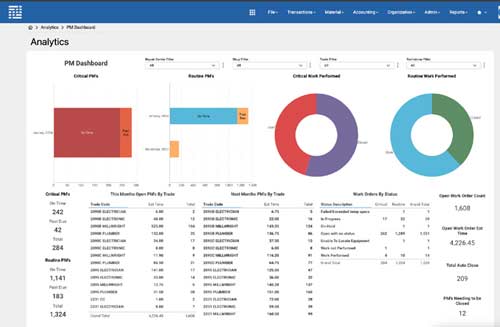
CMMS & EAM: What’s the difference?
CMMS
A component of EAM focusing on the automation of maintenance operations and strategies to improve asset performance and health. Typically used only by maintenance and operations teams, key capabilities of CMMS are dedicated to predictive, reactive, and preventative maintenance management.
EAM
Focuses on optimizing overall asset performance/use via asset lifecycle management. Includes a wide range of capabilities for facilities personnel and business leaders, like capital planning, asset procurement, workflow layouts, asset maintenance, compliance management, and asset risk management.
Top-tier CMMS/EAM solutions can help alleviate these challenges by streamlining processes and roles – ensuring that your organization is fully optimizing its resources. There are two notable ways a select group of software platforms accomplish this:
Automation
Under the skilled management of your facilities management staff, an advanced CMMS/EAM solution can automate several manual tasks that may seem small – like ordering parts and MRO inventory, scheduling, and aggregating information – but can add up when you’re tight on resources. By offloading tedious work onto a software platform, employees are available to work on higher value tasks that require time and focus. It’s also worth mentioning that when resources are thin, people tend to be overworked – and more prone to mistakes. Automating reduces – and can even eliminate – human error. On a macro level, automation functionalities within CMMS/EAM tools provide device and endpoint monitoring, alerting personnel when maintenance is required; ultimately this optimizes maintenance processes and reduces the time needed to keep the facility functioning in pristine condition.
Management
When optimized and well-implemented, CMMS/EAM solutions can serve as a single source of truth for facilities management; they can easily integrate with other platforms, like procurement software, for various maintenance, repair and overhaul needs. Importantly, CMMS/EAM solutions improve connectivity among internal and external field workforces across the enterprise, making personnel management – including things like scheduling and allocating tasks to the right people – easy to conduct from anywhere. By improving visibility into data and activities, less manual and person-to-person oversight is required to make sure operations run smoothly – ultimately improving efficiency and overall resource optimization.
Knowledge documentation and transfer
Even with a labor crisis looming, the majority of facility management employers don’t believe that they’re doing enough to adequately train their teams and future-proof knowledge transfer.5 In fact, 86% of facility managers admit to gaps between the skills their teams possess and what they actually need to succeed.5 With retirement on the horizon for the most seasoned folks in the industry, this knowledge bleed is likely to get worse unless organizations take necessary steps to invest in their people.
Implementing mentorship programs have proven successful in overcoming similar challenges in other professions, but – ultimately – they’re not enough. Companies need to prepare by storing institutional knowledge in centralized, easily accessible software platforms to ensure that historical information and data is available to future workers. Best-in-class CMMS/EAM solutions are deployed with this objective in mind, serving as a centralized database for everything from regulatory compliance to market knowledge to internal processes and proprietary information.
There are several ways that businesses can use a well-implemented CMMS/EAM solution to preserve knowledge for the next generation of workers, including:
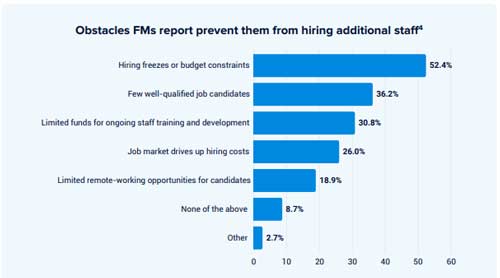
Onboarding and training
Facility managers increasingly use their software tools for more than just asset management – the top tier platforms serve as repositories for documentation, repair manuals, and internal policies and procedures. This 360-degree view into day-to-day operations and management provides new employees with a wealth of knowledge that they can access at any time. Whether your organization has a formal onboarding process or not, pointing new workers toward your CMMS/EAM solution to access institutional knowledge fosters education and hands-on learning critical to long-term success.
Business Intelligence preservation
In addition to providing the current state data for your facility’s assets and IoT devices, advanced CMMS/EAM solutions store a wealth of historical business intelligence that can help newer employers better understand how assets have operated for years. For example, it’s not uncommon for an employee to possess knowledge of the quirky nuances of a piece of equipment – and unless they pass this along to multiple stakeholders, the information will eventually get lost as people leave the organization; maintaining information in a centralized database reduces the dependence on other people to pass along critical information.
Business continuity, visibility and planning
To truly be “future ready” – beyond establishing mechanisms for knowledge transfer and training – organizations must implement technology-driven, “dynamic” facilities management strategies and processes. The introduction of smart technology – like IoT, AI and automation – further complicates facility operations and increases the risks of siloing systems. Unfortunately, many businesses aren’t equipped for this digital transformation: 40% of firms implementing smart tech admit that they lack the dedicated, knowledgeable staff critical to operating it.
But what if you could augment technical skills and resource gaps with software that could drive digital transformation and business continuity efforts? The leading CMMS/EAM vendors provide this “umbrella” over all aspects of facilities operations and serve as a “single source of truth” that ensures business continuity and transparency as management changes hands. The right platform will have many ways to accomplish this via advanced capabilities, with business outcomes including:
Ongoing worker accountability and resource assessment
Requiring that all staff use the same platform to pull information and log activities makes it easier not only to ensure that operations run smoothly, but also to quickly identify when critical tasks are falling through the cracks. Managers can then assess if these issues are due to resource constraints, skills gaps or both, and pivot by improving training programs, increasing resources, and/or outsourcing work.
Optimize day-to-day operations
Today’s most innovative CMMS/EAM solutions empower organizations to shift from preventative and reactive maintenance models to a predictive one. In doing so, facilities managers can better identify data trends, patterns and maintenance schedules for improved resource planning that ensures enough workers are assigned to projects during “push” periods. Leveraging the predictive maintenance capabilities of a cutting-edge CMMS/EAM platform automates most day-to-day asset monitoring, requiring fewer people on the floor to observe assets.
Conclusion
If current trends continue – and we have no reason to expect they won’t – facilities management is in danger of losing most of its most knowledgeable professionals with no real succession plan. Rather than scramble just to get bodies in the room, organizations are best served by taking a step back and evaluating how they might be able to optimize the people they do have by implementing a best-in-class CMMS/EAM solution that enables documentation management and process automation. Reputable CMMS/EAM vendors will be able to assist with implementation and ongoing support to ensure your organization is leveraging the platform to achieve the best outcomes.
For true future readiness, businesses need to work smarter, not harder – and positioning a software platform at the center of operations is the first step to scaling to meet ongoing needs.
More in News
The management of cloud environments involves the proper coordination of infrastructure, access rights and resource allocation as companies expand their operations digitally. In Latin America, organizations adopting cloud-based systems must account for regional data protection requirements, varying infrastructure capabilities and the complexity of overseeing multiple service providers.
Cloud management is an effective tool that enables the IT professionals to control the workloads, ensure the standard configuration, resource consumption and detect the possible disruption of services that could impact critical business operations. Clear governance policies, automated monitoring and well-defined access controls can help businesses maintain reliable cloud environments while managing operational complexity.
How Does Cloud Management Benefit Businesses?
Cloud management makes it possible for companies to have more options when dealing with varying loads without making significant investments in infrastructure. Organizations can scale computing capacity to match project demands, support remote teams and deploy digital services across different locations. For companies operating in Latin America, this flexibility can help accommodate expansion into new markets while allowing technology resources to evolve alongside business requirements.
The other significant benefit relates to visibility in finances. Centralized oversight helps organizations understand spending across cloud services, identify underused resources and select suitable service plans. These insights support more informed budgeting and reduce the likelihood of paying for capacity that delivers little practical value. Businesses can also evaluate service usage against departmental needs to allocate technology budgets more effectively.
Cloud management can be an important tool to improve the continuity and collaboration of business operations. Backup planning, recovery procedures and coordinated service administration help organizations prepare for unexpected outages and restore essential applications when disruptions occur. Shared digital workspaces and accessible business applications can further support collaboration among distributed teams. For businesses in Latin America, these capabilities can help maintain consistent operations across regional offices while supporting day-to-day productivity.
What Are the Emerging Trends in Cloud Management?
Artificial intelligence is reshaping cloud management through intelligent analytics, predictive monitoring and automated decision-making. These tools can help IT teams identify unusual performance patterns, anticipate capacity demands and investigate potential technical issues before they escalate. In Latin America, growing interest in AI-enabled infrastructure management is creating opportunities for businesses to simplify complex technology environments while improving the speed and precision of routine IT operations.
The other emerging trend is the increasing adoption of hybrid and multi-cloud solutions, which combine private infrastructure with public clouds and services offered by several different providers. FinOps approaches are another area where enterprises are increasingly focusing, which involves financial decision-making around cloud usage, along with security methods that keep a check on the risks to which access is exposed.
For businesses in Latin America, these developments highlight the need for cloud strategies that balance technical flexibility, cost transparency, regulatory requirements and evolving cybersecurity risks. Together, these approaches are shaping a more intelligent and adaptable future for cloud management. ...Read more
Businesses are increasingly looking to enhance efficiency and make data-driven decisions, and in this context, AI technology is emerging as a practical option for organizations in Latin America. AI technology is a viable solution for businesses and organizations in Latin America seeking to enhance efficiency and make data-driven decisions. Businesses are transitioning from single-use cases to the potential of AI for everyday use, such as customer service and financial forecasting. The challenge is not just about introducing new technology. Organizations need to find issues that can be solved and train their workers to be confident using AI.
An effective AI transformation solution is able to link AI capabilities with a clear business objective. Instead of loading onto the tools without a specific purpose, organizations can concentrate on specific needs like decreasing repetitive work, better demand anticipation and assisting staff in getting the details they need. This method allows easier evaluation of the return on investment of the technology.
How Is AI Changing Business Operations across Latin America?
One of the most apparent changes is automation. AI systems can handle repetitive administrative tasks and classify documents to help employees. Conversational tools can manage routine inquiries and pass on more complex requests to customer representatives in support. This means that employees will have more time to deal with situations that need some judgment, empathy, and detailed knowledge.
The analysis of data is also getting easier. Machine learning can be utilized to differentiate buying patterns, forecast demand and recognize abnormal transactions, making it possible for enterprises to be better prepared. Retailers can enhance the improvement of inventory planning, and financial service providers can reinforce the strengthening of fraud monitoring. Predictive maintenance can be used by manufacturers to detect issues with their equipment before they can cause production to be interrupted.
What Helps Organizations Scale AI beyond Initial Projects?
Companies need to establish reliable data governance as they expand their use of artificial intelligence. Lack of records can lead to misinformation, and unclear access rules may lead to the disclosure of sensitive information. Strict accountability within businesses for data quality, privacy and security. They should also evaluate systems periodically to find out what errors have been made and whether outputs will continue to be relevant to business needs.
It is important to make steady progress to successful adoption, not necessarily making a big investment at the beginning. Businesses can transform AI experiments into sustainable improvements by aligning projects with measurable objectives, empowering employees and providing responsible oversight. A thoughtful AI transformation solution can enable organizations to optimize their operations while retaining human oversight, participation, accountability, and understanding. ...Read more
Agentic AI-powered customer service automation is reshaping how businesses across Latin America manage high-volume interactions, multilingual support and service operations. Unlike traditional chatbots that follow fixed scripts, agentic systems can interpret requests, plan actions, access approved business systems and complete tasks with limited human intervention.
This creates opportunities to reduce response times, improve consistency and extend service availability across diverse customer markets. For enterprises, the challenge is moving beyond simple automation toward controlled, accountable digital agents that can operate across channels while respecting local language, cultural expectations, data governance and operational rules within complex customer service environments and regulatory requirements.
Customer Service Is Moving from Answers to Action
Customer service automation is moving from question answering toward task completion. Agentic systems can identify what a customer needs, determine which systems or knowledge sources are relevant and carry out approved steps such as checking an order, updating an address, scheduling an appointment or initiating a service request. This changes the role of automation from a conversational layer into an operational participant.
For Latin American businesses, this shift is significant because customer service often spans multiple channels. Consumers may move between messaging applications, voice, email, web chat and social platforms during the same issue. Agentic AI can help maintain context across these interactions, reducing the need for customers to repeat information each time they change channels.
Language handling is equally important. Spanish varies considerably across the region, while Portuguese is essential in Brazil, and other local language preferences may influence customer expectations. Effective systems need more than direct translation. They must recognize tone, local expressions and the intent behind a request without creating awkward or misleading responses.
Human escalation remains critical. Not every case should be completed automatically. Billing disputes, vulnerable customers, sensitive complaints or exceptions to policy may require judgment. Strong platforms define when an AI agent can act, when approval is needed and when the interaction should move to a trained employee.
The strongest deployments, therefore, combine autonomy with clear operating boundaries. Businesses that begin with well-defined service journeys can automate repetitive tasks while preserving human attention for cases that require empathy, negotiation or complex decision-making.
Integration and Governance Determine Operational Reliability
Integration determines whether agentic AI can deliver meaningful service improvements. A digital agent may understand a customer request accurately. Still, it cannot complete the task unless it can securely interact with customer relationship systems, order platforms, payment tools, scheduling applications and knowledge bases.
This is encouraging enterprises to redesign customer service architecture around governed access rather than isolated bots. Permissions can restrict which actions an agent may perform, while approval steps can be introduced for transactions carrying higher financial or customer risk. Detailed activity logs can show what information was accessed, which action was taken and why the workflow moved to a particular outcome.
Data quality is another major issue. Customer records may be incomplete, duplicated or spread across different systems. Agentic AI can expose these weaknesses quickly because automated decisions depend on reliable information. Companies, therefore, need stronger data management alongside automation, including clear ownership of customer information and consistent processes for updating records.
Security becomes more important as AI agents gain the ability to take action. Authentication, role-based access, transaction limits and monitoring need to be designed into the service environment. Businesses also need protection against malicious prompts, unauthorized requests and attempts to manipulate automated workflows.
Governance should extend beyond technical controls. Customer service leaders, compliance teams, legal functions and operations managers need shared rules covering acceptable automation, customer disclosure, complaint handling and escalation. Clear responsibility helps prevent situations where a system completes an action, but no team owns the consequences.
Business Value Will Depend on Scalable Service Design
The business case for agentic AI is expanding from labor efficiency toward service quality and operating flexibility. Automated agents can handle repetitive interactions continuously, allowing human teams to focus on more complex cases. This can help enterprises manage seasonal peaks, rapid growth or demand across multiple countries without expanding service capacity at the same rate.
However, measuring success requires more than counting automated conversations. Companies need to examine whether issues are actually resolved, whether customers return with the same problem and whether automation creates additional work elsewhere. First-contact resolution, escalation quality, transaction accuracy and customer effort can provide a clearer picture of operational value.
Workforce design is also changing. Customer service employees may spend less time retrieving information and more time reviewing exceptions, handling sensitive cases and improving automated workflows. This creates demand for skills in quality assurance, conversation design, process analysis and AI supervision alongside traditional service capabilities.
Regional scalability will depend on adaptability. A workflow that performs well in one market may need different language, payment options, regulatory controls or escalation rules elsewhere. Platforms that support local configuration without requiring a complete rebuild can make regional expansion easier.
That balance will be especially important for organizations serving customers with different digital habits, service expectations and levels of comfort with automated decision making across the region.
For Latin American enterprises, agentic AI-powered customer service automation offers a path toward faster, more consistent and more scalable service. The strongest results will come from treating AI agents as governed operational components rather than standalone chat tools. ...Read more
Cloud-based solutions will have numerous benefits to offer, such as flexibility, scalability, accessibility, and faster deployments. But cloud infrastructure requires expert knowledge, ongoing monitoring, security management, performance optimization, and compliance checks. Having the necessary in-house resources and skills to carry out the business functions effectively is difficult for many organizations.
To plug these gaps, managed cloud service providers bring their expertise, technical support, infrastructure management, and strategic advice to the table. They offer businesses the support needed to keep their cloud environments secure, efficient, and cost-effective, and to facilitate long-term digital transformation.
Optimizing Cloud Infrastructure Performance through Proactive Management Strategies
One of the main things to be optimized is application performance. Managed providers monitor application performance, computing resources, databases, network performance, and user experiences, which will help them detect any potential constraints. Technical teams may analyze this to fine-tune system configurations and resources, increasing system performance and application responsiveness.
Managed cloud environments also enable hybrid and multi-cloud approaches. An organization can choose to utilize one or more cloud platforms in addition to on-premises infrastructure for various applications, compliance, performance or business needs. These environments are managed and have uniform monitoring, security, governance and management practices, regardless of platform.
Providers are able to evaluate the current infrastructure and suggest a modernization plan, such as containers, microservices, serverless, and cloud-native architecture. These technologies can enhance application flexibility and speed up development. Cost optimization is one of the other significant duties that managed cloud providers are responsible for. Costs of cloud expenditure can escalate if an organization has unused resources, sub-optimal configurations, over-provisioned storage, or unnecessary services.
Providers review usage and suggest resource changes to help increase efficiency and keep a close check on operating costs. Managed cloud services can then offer a holistic solution for infrastructure performance for organizations. Through proactive monitoring, automation, optimization, and expertise, service providers ensure seamless cloud operations and sustainability amidst evolving business needs.
Advancing Cloud Security Compliance with Advanced Protection Strategies
Security is considered to be one of the primary concerns of businesses that are taking advantage of cloud services. Data that is sensitive, such as financial data, customer records, intellectual property, operational data and business applications, is increasingly being stored and processed in the cloud. These resources must be continually monitored, and a risk management plan must be developed.
Threat detection and monitoring deliver increased visibility in the cloud. Security technologies can be used to watch users, system activity, access patterns, unusual activity and system events and determine if there is a threat on the network. The early detection provides security teams the opportunity to investigate suspicious activity and respond in time before the situation escalates.
A key component of cloud security is identity and access management. Managed providers have the option to configure authentication controls, user permissions, role policies, and multi-factor authentication.
These are designed to ensure that only authorized individuals can access the sensitive resources and reduce the risk of bad credentials. Managed cloud providers can implement encryption, secure storage settings, backups, and data protection features. These measures help to ensure greater data protection and assurance of integrity.
" A key component of cloud security is identity and access management. Managed providers have the option to configure authentication controls, user permissions, role policies, and multi-factor authentication. "
Managed security professionals can investigate, contain, support remediation and help with recovery. A coordinated response can limit the disruption of operations and limit the potential impact of a security incident. Backup and disaster recovery are equally crucial.
Businesses need backups of sensitive information to safeguard against accidental deletion, infrastructure failures, cyberattacks, and ransomware attacks. To improve business continuity, managed providers can set up backup schedules and procedures, redundancy, and testing methods.
Network security provides yet another layer of security. Cloud environments are protected from external and internal threats by firewalls, intrusion detection, traffic monitoring, segmentation and secure connectivity. Organizations that use continuous security monitoring can stay more aware of potential security threats.
Security management is, therefore, a continuous process and not a one-time activity. Managed cloud providers can provide ongoing expertise, monitoring, and support to help organizations bolster their security defenses, meet compliance mandates, and enhance their operational resilience.
Enabling Sustainable Business Growth through Strategic Cloud Expertise
Managed cloud service providers are becoming more than just infrastructure operators and are becoming strategic technology partners. Their expertise empowers organizations to leverage cloud technologies for improved innovation, operational efficiency, customer experience, and growth.
Cloud-native development is one of the key areas of innovation. The use of containers, microservices, serverless computing and new development platforms allows companies to create and release apps more efficiently.
Business continuity planning continues to be vital even as businesses are increasingly reliant on digital services. Cloud service providers can build redundant infrastructure, automate recovery, implement backups, and monitor automatically. These features enable organizations to continue serving their critical functions in case of infrastructure failures, cyber incidents, or unexpected disruptions.
Managed providers can assess the current infrastructure, potential for modernization, new technologies, and cloud solutions based on business goals. This proactive approach enables companies to anticipate future needs and not be hampered by technology limitations. ...Read more
