-
Technology
-
Industry
-
Solutions
-
- ASSET MANAGEMENT
- CUSTOMER EXPERIENCE MANAGEMENT
- CYBER SECURITY
- DATA CENTER
- DOCUMENT MANAGEMENT
- ELECTRONIC DATA INTERCHANGE
- ENTERPRISE DATA MANAGEMENT
- ENTERPRISE RESOURCE PLANNING
- ENTERPRISE RISK MANAGEMENT
- ENTERPRISE-GRADE WEB DATA SOLUTIONS
- FACILITY MANAGEMENT
- FIELD SERVICE
- IDENTITY AND ACCESS MANAGEMENT
- INFRASTRUCTURE
- IT SERVICE MANAGEMENT
- MANAGED IT SERVICES
- PAYMENT AND CARD
- PROJECT MANAGEMENT
- SOFTWARE TESTING
- STORAGE
- VIDEO SOLUTIONS
- WORKFLOW
-
-
Platforms
-
Functions
- Leadership Perspectives
- Innovation Insights
- Research
- Magazines
- News
- CXO Awards


KLST's Annotate101 3.0 app Introduced on Windows Store for Download
CIO Review
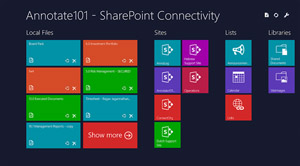 NEW YORK: KL Software Technologies, creator of Annoate 101—the PDF Annotation and SharePoint connectivity app for Windows 8, introduced its Annotate 101 version 3.0 to the Windows Store for users to download.
The Annotate101 3.0 follows the Windows 8.1 design philosophy and can be executed on Microsoft Surface Pro 2 and Windows Tablets. Documents are of utmost importance to the app, however all the tools and functions required to annotate PDF, connect to SharePoint, Sync with Dropbox/Box or Simply Share documents with friends or colleagues via email is easy. Due to its layout following the Windows 8.1 design, it makes customers feel familiar.
Stay ahead of the industry with exclusive feature stories on the top companies, expert insights and the latest news delivered straight to your inbox. Subscribe today.
Annotate101 3.0’s newly designed File Management features works with PDF files that are stored on a Windows tablet or PC. A single tap allows users to add a folder and move files to their favorite folders. A gentle tap syncs files and folders with Dropbox or share a zip archive of the folder via email with friends and colleagues. “Refreshing Folders” enables users to quickly access recently modified files with a single tap without the need to open the folder to view files.
According to Ragav Jagannathan, “Founder, KLST President & Group CEO, KL Software Technologies, “Despite the fact that Windows Tablet adoption in business skyrocketed during the last 12 months, it is still sometimes challenging for employees on the go to access corporate content when and where they want to get the job done. With Microsoft Office 365 SharePoint and OneDrive integration, Annotate101 3.0 makes collaborative work on your Windows Tablet truly possible. Annotate101 3.0 is the ONLY app on Windows Store that allows users to experience rich collaboration capabilities of SharePoint right within our app while offering world class rich PDF reading and annotation capabilities. You can connect to your corporate SharePoint Intranet or Extranet and get full offline access to corporate SharePoint content on the go, including the ability to sync back your changes to SharePoint next time you are online. You can even read, annotate and sync PDF documents anywhere: PC desktop, OneDrive, Dropbox, Box, Google Drive, Evernote, SugarSync and many more Windows apps."
Some of the features of Annotate101 3.0 are its ease of use, free hand writing, free text, highlight, sticky note, view document outline and easily navigage PDF, bookmark favorite pages for faster access, secure encrypted local file/folder storage option for users to organize and access recently used documents, access corporate SharePoint content, Save annotated documents to SharePoint, enhanced Security. The documents can even be accessed offline. The automated save/sync and automated crash recovery, helps save documents safely. PDF’s can also be protected with passwords.
Aditi Jagannathan, Global Chief Operating Officer, KL Software Technology, concluded stating, “Even though Annotate101 is exclusively designed for Windows devices, we understand users work in multiple locations and access content via multiple mobile devices. Hence we introduced features such as "Flatten PDF" in Annotate101 3.0 that allows users to annotate PDF on Windows and then sync with SharePoint, OneDrive, Box, Dropbox, SugarSync, Google Drive or just share via email to read at a later stage on a different mobile device such as iPhone/iPad/Android/Blackberry devices. Cross mobile platform compliant PDF Annotations is just one of several innovations that define Annotate101 3.0.”
More in News
Across the digital landscape, the Zero-code platform industry is experiencing rapid innovation as organizations seek faster and more adaptable ways to build applications without lengthy development cycles. Modern platforms are introducing AI-driven automation, intuitive visual design environments, and stronger integration capabilities that enable teams to create and modify solutions with greater agility.
This momentum is helping businesses reduce development bottlenecks while responding quickly to operational demands. As adoption expands, providers are strengthening governance frameworks, security controls, and scalability features, ensuring that simplicity and speed remain aligned with long-term reliability and enterprise requirements.
How Do Zero-Code Platforms Benefit Modern Businesses?
Zero-code platforms are helping businesses translate ideas into working digital solutions with less complexity. Using visual interfaces, teams can design internal tools, automate routine operations and build customer-facing applications without lengthy development cycles. Inktel Contact Center Solutions applies automation within customer-facing applications and operational workflows, combining digital tools with human expertise to support execution. This flexibility supports faster experimentation and innovation, enabling organizations to refine workflows and respond to changing operational needs with greater confidence.
Another major advantage lies in improving collaboration between technical teams and business departments. Operations, marketing, finance, and customer service teams can actively participate in building the tools they rely on every day. This closer alignment reduces communication gaps and ensures that digital solutions reflect real operational needs. As a result, organizations often see stronger productivity, better workflow transparency, and faster problem resolution across departments.
Cost efficiency and scalability also make these platforms valuable in modern business environments. By minimizing the need for large development resources, organizations can manage technology investments more effectively while still expanding digital capabilities. Many platforms also support integration with existing enterprise systems, enabling businesses to extend functionality without replacing established infrastructure. With stronger oversight features and adaptable architectures, zero-code platforms are becoming a practical foundation for companies seeking sustainable digital growth.
Which Trends Are Shaping the Zero-Code Platform Market?
The Zero-code platform market is being shaped by a wave of technological and organizational shifts that are redefining how digital solutions are created and managed. One notable trend is the increasing use of intelligent features that simplify application design while improving decision-making within workflows.
Platforms are gradually incorporating advanced analytics, built-in logic engines, and adaptive tools that help organizations design more responsive systems. This evolution is enabling businesses to move beyond simple task automation toward building smarter, data-driven operational environments.
Mastery Coding uses project-based learning and digital tools to develop technology skills through structured, adaptable learning experiences.
Another important development is the growing emphasis on enterprise readiness. As adoption expands across larger organizations, platform providers are investing in stronger compliance frameworks, identity management capabilities, and centralized governance tools. These enhancements allow companies to maintain control over applications developed across different departments while ensuring regulatory standards and internal policies are consistently followed. Connectivity across different platforms is also improving, making it easier for organizations to integrate applications with cloud services, existing legacy systems, and wider data environments.
The market is also witnessing greater specialization, with platforms evolving to support industry-specific use cases in sectors such as healthcare, finance, retail, and logistics. Tailored templates, pre-configured modules, and sector-focused integrations are helping organizations deploy solutions that address unique operational challenges. As digital transformation accelerates across industries, zero-code platforms are emerging as a flexible foundation for developing adaptable and future-ready technological environments. ...Read more
The increasing cyber risk situation is forcing organizations to re-evaluate vulnerabilities originating from applications, networks, cloud environments and connected devices. Moreover, weak access controls, outdated configurations and gaps in security practices can represent a more favorable attack surface for malicious activity; whereas fragmented security processes may lead to increased difficulty in identifying and containing isolated incidents.
Cybersecurity consulting services assist organizations with these concerns through risk assessments, vulnerability reviews, security audits and incident response planning based on the operating environment of the organization. Clear security policies, employee awareness measures and defined response procedures can further strengthen preparedness and support a more coordinated approach to managing cyber threats.
How Can Cybersecurity Consulting Services Strengthen Business Security?
One of the major results of such cybersecurity consultancy includes increased protection of sensitive information from possible threats. The consultants can help organizations set up appropriate security measures for protecting the confidentiality of client information, financial information, intellectual property and other critical data. This helps minimize the likelihood of expensive data breaches while strengthening trust and confidence among customers, business partners and other stakeholders.
Cybersecurity consulting services can guide businesses to align their security practices with relevant regulatory and sectoral requirements. A better understanding of compliance obligations may also help to mitigate the risk penalties, legal issues and delays that can arise from non-compliance. External expertise can further provide an objective view of security gaps that may be overlooked during internal reviews, helping decision-makers prioritize security investments according to business needs.
An improved level of resilience in cybersecurity can help ensure smoother business operations in case of a security incident. A well-prepared organization is able to minimize the disruption, keep its key functions safe and restore itself quickly following a security incident. Availability of specialized knowledge can also alleviate the burden on internal IT teams, especially for those organizations that do not have any specific experts in the area of cybersecurity.
What Trends Are Shaping Cybersecurity Consulting Services?
The rising trend of adopting cloud native operations is also having an impact on the realm of cybersecurity consulting, especially as organizations manage increasingly distributed digital environments. Zero trust frameworks have become popular as firms begin to shift their paradigm from implicit access controls and begin to adopt continuous verification for users, devices and resources.
Consulting engagements are also becoming more focused on identity security, third-party risk and security considerations across software supply chains as organizations rely on a wider network of external platforms and providers.
Another key factor is the impact of artificial intelligence, especially as organizations look for ways to speed up their analyses of security events and detect threats in a more proactive manner. Consultants are being engaged for security needs tied to the AI systems themselves, such as data exposure, model misuse and unauthorized access.
Demand is also shifting direction towards continuous security monitoring and managed consulting models, allowing organizations to have access to ongoing guidance instead of one-off assessments. These shifts are broadening the role of cybersecurity consulting services as digital operations become more distributed, interconnected and dependent on emerging technologies. ...Read more
Organizations are increasingly looking to upgrade their applications and expand their digital capabilities, making cloud computing essential for improving business performance. Effective management of a cloud environment demands specific skills, constant monitoring, and careful cost control. Managed cloud service providers are crucial in assisting companies to operate efficiently.
Current trends show a shift from traditional infrastructure management to integrated services that emphasize security, automation, optimization, and achieving positive business outcomes.
What Are the Best Practices for Hybrid and Multicloud Management?
Businesses are also increasingly embracing the hybrid and multicloud approach in addressing application needs, compliance issues, resiliency, and flexibility. As such, there is an increased need for organizations to embrace providers that will handle workloads in public cloud, private cloud, and multicloud through unified processes.
Rather than having separate approaches for each cloud environment, organizations have been developing capabilities for monitoring, governance, identity management, and performance management on a centralized basis. There has also been significant investment in automation in such areas as provisioning, configuration management, patching, scaling of workloads, and incident response.
AI and machine learning continue to play a role in the management of cloud services. Intelligent monitoring may be able to detect odd behavior, predict future capacity needs, and assist with problem-solving efforts. Predictive analysis can also help service providers detect any possible future problems that would negatively impact performance. With the advancement of such technology, companies will be provided with more flexible cloud services without building their own competencies.
How Are Providers Improving Cloud Cost And Security?
Optimization of costs in cloud computing has emerged as a key corporate concern as more value needs to be derived from technology investments. In response, managed cloud service providers have begun adopting approaches that involve resource analysis, identification of unused capacity, configuration recommendations, and efficient workload management.
The FinOps framework has also begun to gain relevance as it involves collaborative efforts from finance, technology, and business stakeholders to align cloud expenses with tangible results. This would help corporations understand their resource consumption and make better technology investments.
Security is still closely tied to the emphasis on efficiency. There are growing expectations for managed service providers to incorporate such security capabilities as identity and access management, monitoring, vulnerability management, data protection, and compliance support into daily cloud activities. The traditional approach of viewing security as a distinct function is now being replaced by integrating security controls into the infrastructure and application environment.
Other trends include the shift towards an outcome-oriented approach to delivering services. Companies are not only assessing the availability of their infrastructure but have shifted their assessment towards application performance, user experience, resiliency, scalability, and cost effectiveness. Service level agreements are now geared more towards operational outcomes, while dashboarding and analysis provide visibility of performance and utilization. ...Read more
A software engineering and AI analytics purchase can fail long before model accuracy becomes a concern. The bigger challenge is often the handoff between existing infrastructure and new analytics, especially when camera networks and edge devices were never designed to share context. Replacing everything may simplify architecture on paper, but it can strain capital requirements and stretch deployment timelines. Buyers need to know whether a platform can work across existing technology boundaries without turning modernization into a wholesale infrastructure project.
Integration depth is therefore more revealing than the number of AI features on a product sheet. A useful platform should accept heterogeneous inputs and expose their data through a common control layer without forcing every piece of existing hardware to conform to one technical standard. It should also preserve the usefulness of legacy assets while making their information accessible to newer analytics. That matters in distributed environments where hardware replacement may be slow or economically unjustified. The real question is whether modernization can proceed around installed infrastructure rather than requiring a clean slate.
Real-time analytics creates an attention problem of its own. Video feeds and sensor events can overwhelm staff when every detection is treated as equally important. Buyers should examine how a platform separates routine activity from events that merit human review, and then look at how quickly those events reach the people responsible for validation. The difference between raw monitoring and useful analytics lies in this filtering step. A system that produces more alerts without improving prioritization merely transfers workload from observation to triage.
Architecture becomes more consequential as data volumes rise. Sending every high-definition stream to a centralized cloud environment can create avoidable bandwidth costs and response delays. Edge processing can reduce that burden when analytics are performed close to the source and only selected information moves upstream. Yet edge deployment introduces management demands. Devices and application services still need a coherent way to exchange information and support later investigation. Buyers should also examine how much infrastructure complexity is added when analytics move closer to the source.
“ CFBD ’s hybrid architecture connects legacy environments to newer computing infrastructure through hyperconvergence and virtualization.”
Searchability deserves equal importance. Once video or sensor data has been transformed into structured metadata, teams should be able to move from live detection to later investigation without manually reviewing hours of footage. Useful systems retain descriptive attributes and behavioral context in forms that can be queried quickly. The buying question is whether that context survives across live monitoring and retrospective analysis rather than being trapped in separate workflows. Fast retrieval matters because delayed investigation can erase much of the advantage gained from real-time detection.
CFBD merits consideration for buyers facing this mix of integration pressure and analytics workload. Its AZOR Ecosystem, a real-time data orchestration platform, centralizes video and sensor information. AZOR Panel, a centralized monitoring interface, receives AI-filtered events for human validation. AZOR Analytics, a video analytics component, supports real-time and forensic analysis, while edge gateways can process video near the source and pass lighter event data upstream. Its hybrid architecture connects legacy environments to newer computing infrastructure through hyperconvergence and virtualization. The fit is strongest where replacement costs and operator overload are material constraints. For organizations that need AI analytics without discarding usable infrastructure, CFBD is a practical choice. ...Read more
