-
Technology
-
Industry
-
Solutions
-
- ASSET MANAGEMENT
- AUGMENTED & VIRTUAL REALITY
- COLLABORATION
- CONVERSATIONAL
- CUSTOMER EXPERIENCE MANAGEMENT
- CUSTOMER RELATIONSHIP MANAGEMENT
- CYBER SECURITY
- DATA CENTER
- DIGITAL CUSTOMER EXPERIENCE
- DOCUMENT MANAGEMENT
- EHS SOFTWARE
- ELECTRONIC DATA INTERCHANGE
- ENTERPRISE DATA MANAGEMENT
- ENTERPRISE DATA QUALITY MONITORING
- ENTERPRISE RESOURCE PLANNING
- ENTERPRISE RISK MANAGEMENT
- ENTERPRISE-GRADE WEB DATA SOLUTIONS
- FACILITY MANAGEMENT
- FIELD SERVICE
- GAMIFICATION
- IDENTITY AND ACCESS MANAGEMENT
- INFRASTRUCTURE
- IT SERVICE MANAGEMENT
- MANAGED IT SERVICES
- PAYMENT AND CARD
- PROJECT MANAGEMENT
- SOFTWARE TESTING
- STORAGE
- VIDEO SOLUTIONS
- WORKFLOW
-
-
Platforms
-
Functions
- Leadership Perspectives
- Innovation Insights
- Research
- Magazines
- News
- CXO Awards


Robotmaster Software To Create An Automated Way Of Producing Custom Orthoticsusing Milling Robots
CIO Review
FREMONT, CA: In 2008, ORTHOPEDIE BONTOUX, a company that has specialised in the manufacture and adaptation of orthopedic and prosthetic apparatus (orthoses and prostheses) since 1982, created its subsidiary OSIC-CARBONE “We decided to transform our organisation to address the challenges we perceived to be facing our profession. We were widely recognized for the superior performance of our apparatus, manufactured of composite materials, but our business vision had identified revolutionary changes we considered necessary to the entire delivery process, from the precise measurements made of the patient through the rapid production of molds and apparatus.
Stay ahead of the industry with exclusive feature stories on the top companies, expert insights and the latest news delivered straight to your inbox. Subscribe today.
In the traditional process, a cast of plaster strips was taken of the patient’s body part to permit the creation of a plaster model. The model was then refined using files and other specialised tools. Modelling and milling of molds for orthoses on computer numerical control (CNC) machines, was not new to the industry. Our innovation was to extend this process to a full range of 3D forms by developing a custom computer-aided design (CAD) modelling solution that offered unprecedented design freedom and was able to process input data from a wide variety of sources: scans, measurements, photographs, X-ray images, etc. As a result, today we can create models of parts with dimensions ranging from just centimetres up to two metres to create even the largest posture-correcting orthoses.
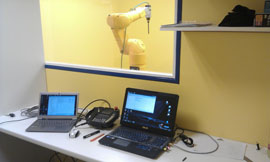
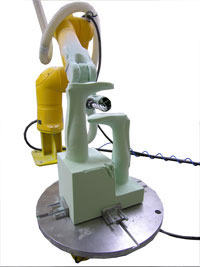
This logically led us to consider a robotic solution for our milling needs. With increased degrees of freedom and reduced physical constraints, the range of movement of the milling robot was an excellent match to the wide variety of size of parts on which we needed to work.
Finally, we had to find a rapid and efficient robot programming solution, a high-performance computer-aided manufacturing (CAM) tool that would provide the necessary versatility and ease-of-use. The criteria and constraints of our application were challenging:
-‐ Production lot size of one: Each product was unique, customized to a unique patient, hence requiring a unique milling program for every unit produced
-‐ Wide range of part dimensions: Ranging from a few centimetres to two metres
-‐ Materials to be milled: Both rigid and flexible polyurethane foam
-‐ Output requirements: Production of up to ten parts in eight hours at a material removal speed
of 300 mm/sec, in three-dimensions
-‐ Product delivery cycle: Maximum of 12 hours, from design through delivery, and a maximum of
20 minutes from modelling to program transfer to the robot
-‐ Stability and reliability: Accurate robot trajectory control in all positions – the robot program and
its milled product must be right on the first try!
After extensive research and trial of potential solutions, we settled on ROBOTMASTER® as the solution best suited to our stringent requirements.
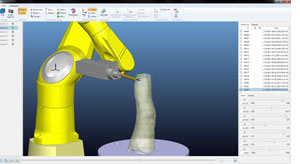
 Using ROBOTMASTER, we developed a systematic approach to address our “made-to-measure” production requirements. Our simplified working procedure imports the unique patient 3D model into a preprogrammed production design strategy that takes account of all the pertinent milling and robot articulation data. This methodology has reduced our programming time to less than one minute for the complete range of our parts portfolio. ROBOTMASTER manages all the robot parameters and trajectories with ultimate precision. The mastery we developed of ROBOTMASTER’s capabilities, combined with our expertise in orthoses and prostheses, permitted us to develop proprietary, patented milling strategies, conceived specifically for, and ideally suited to, our highly specialised business. Our continued optimization research has now taken us to even greater material removal speeds, reaching 800 mm/sec – three times faster than conventional milling methods.
In less than two years, we have delivered over 3000 unique products using this high performance solution. Our know-how has been widely recognised in the orthopedic sector, and, since the beginning of 2012, we have been offering our turnkey robotic orthopedics milling solution to others in the industry.”
More in News
AI agents are exposing a problem that conventional workflow software has rarely solved. Many enterprises run essential work across SaaS platforms, integration tools, local scripts and shared spreadsheets. Agents are then expected to work across all of them, gather enough context and make safe decisions. The difficulty lies in the gap between what an agent can infer and what the business can actually control.
Point-to-point integrations move data but do not preserve the history of a process. iPaaS platforms connect systems, yet long-running work can still end up scattered across queues, callbacks, approvals and exceptions. For buyers, introducing agents is only part of the challenge. They also need a process that can show exactly what happened.
Workflow orchestration can provide that structure when it carries context along with the work instead of simply routing it from one system to another. Agents still need room to exercise judgment, but that judgment needs boundaries. A model might classify an email, interpret intent, retrieve missing context and recommend what should happen next. It should not have to work out the refund procedure or customer verification process from scratch every time a request comes in. Repeatable steps are less expensive to execute through deterministic logic and easier to audit. The agent can then handle the parts that require interpretation while established actions remain within versioned process logic.
“Agents can make decisions where judgment is required while the workflow handles repeatable actions.”
That separation is useful only if the business can see what happened in each workflow. Executives need a way to inspect the process template, runtime history, agent decision and failure path in one place. Once APIs, agents, human reviewers and external events are involved, ordinary system logs do not provide the whole picture. Buyers need to know which action ran, what data moved, what decision was made and what happened when a step timed out or had to be retried. Keeping that information with the process also makes automation easier to improve because performance data remains connected to the work that produced it.
The amount of engineering required to get there matters too. An orchestration platform has limited practical value if a company needs to build a large specialist team before it can put a useful process into production. Existing services and SaaS APIs should be composable into business logic that people can understand and change without rebuilding the entire integration map. A code-first approach is useful when software teams get version control, business reviewers can see the workflow as a visual graph, auditors can trace what happened and agents have a stable process map to work within.
The larger issue is ownership of the process, not simply how many tasks can be automated. Long-running workflows need to retain state, and agent decisions need to remain visible without requiring a model call at every step. Once the process is running, event-driven feedback can show where it needs improvement. The platform also has to work for organizations with different levels of software maturity. One team may be coordinating a large collection of microservices, while another needs custom workflow logic around ERP, CRM, field-service and workforce systems without having to wait for a vendor to add the functionality to its roadmap.
LittleHorse takes this approach with Saddle Command Center and its Business-as-Code model for building workflows across microservices, SaaS platforms, agents and human-in-the-loop steps. Agents can make decisions where judgment is required while the workflow handles repeatable actions. Individual instances remain traceable, and workflow event data can be published to Apache Kafka for analysis. Support for Java, Python, Go and C# also allows engineering teams to maintain the business logic without having to adopt a specialist workflow language. For enterprises working across disconnected SaaS environments or complex microservice estates, LittleHorse provides a practical way to give AI agents room to make decisions while keeping the surrounding process visible and controlled. ...Read more
Sage migration decisions often begin with a contradiction. Finance and IT teams want the subscription feel of SaaS, yet the applications they rely on still carry custom workflows, connected databases, reporting routines and partner-managed changes. A generic cloud host can move the server, but it may leave the business managing every handoff when access breaks or latency appears during a critical task. Month-end close, warehouse workflows, payroll access and reporting cycles leave little room for cloud experiments that behave well only under ideal conditions.
The weak point is usually not migration itself. It is the support chain that follows. Servers sit somewhere, a hosting provider manages the platform, the software publisher owns the application, a Sage consultant handles business logic and the internal team is left to coordinate the room. A single interruption then becomes a routing problem. Executives should favor a hosting model that reduces escalation layers without stripping away control over the ERP.
Control matters because Sage environments rarely behave like standard SaaS tenants. Updates, integrations, VPN links, reporting tools and adjacent applications may need business-specific treatment. Shared resources can look efficient until they limit troubleshooting or change windows. Dedicated virtual environments, network isolation, clear backup design and documented availability standards give leadership a firmer basis for risk decisions. The point is not more infrastructure for its own sake. It is a service model that keeps customization possible while making ownership clearer.
Ransomware risk and phishing exposure have changed the due diligence standard for hosted ERP. Sage access cannot be separated from identity controls, recovery routines, monitoring practices and response authority. A provider that only hosts the application may still leave security teams stitching together evidence after an incident. Before renewal terms are signed, buyers should test how backup frequency, network segmentation, disaster recovery design and incident escalation work in practice.
Cloud economics create a second trap. Public cloud flexibility can turn into variable outlay when workloads are poorly matched to the platform. Licensing shifts and Microsoft choices make architecture a finance issue as much as an IT issue. Lowest monthly price can be misleading when internal staff must manage exceptions or pull multiple suppliers into every problem. A stronger decision weighs contract predictability, application performance, recovery posture and the cost of internal coordination. Sage projects also require a provider that can work alongside ERP partners rather than displace them.
Against that buying logic, Cloud at Work is a premier choice for Sage cloud hosting. It model is built around Sage end users and fewer support handoffs, then extended that base into Azure and managed technology services where the customer environment demands it. Its portfolio spans Virtual Private Cloud, Infrastructure as a Service, Desktop as a Service, Managed Services and Managed Cybersecurity, giving buyers a path from hosted Sage to broader cloud management without changing accountability every time the environment expands. Dedicated resources, virtual firewalls, backup design and Sage-aware support match the pressures that matter most. For leaders who want Sage to feel closer to a managed service while preserving customization, Cloud at Work warrants serious consideration. ...Read more
Digital transformation remains a priority for organizations across Canada, but for many leaders, the challenge is no longer deciding whether to modernize. It is figuring out how to do it without disrupting the systems the business relies on every day.
Many organizations are operating in a mixed environment where old and new technologies must work side by side. Core applications that were implemented years ago still support critical operations. ERP and commercial off-the-shelf platforms have been customized over time to fit unique business processes. Data often lives in multiple systems and cybersecurity concerns continue to grow as organizations expand their use of cloud services, mobile applications and external partners. The result is a level of complexity that can make modernization feel risky, even when change is clearly needed.
This is why successful digital transformation rarely starts with technology. It starts with understanding the business. Leaders need a clear picture of which systems continue to deliver value, where inefficiencies exist and which investments will have the greatest impact. Organizations often spend too much money replacing systems that still serve an important purpose or implementing new solutions before fully understanding the long-term costs. The most effective transformation partners help organizations make informed decisions rather than pushing change for its own sake.
The same practical approach applies to emerging technologies such as artificial intelligence. While AI continues to attract attention, its success depends heavily on the quality of the data behind it. Organizations that struggle with fragmented information, inconsistent processes or weak governance often find it difficult to unlock meaningful value from AI investments. Data modernization, cybersecurity and system modernization are closely connected. Progress in one area often depends on getting the others right.
Security has become another defining factor in successful transformation initiatives. Whether operating in healthcare, education, municipal government or the private sector, Canadian organizations face increasing expectations around privacy, access management and accountability. Security cannot be treated as a separate project that follows modernization efforts. It needs to be built into planning and decision-making from the beginning. Strong governance, clear documentation and defined responsibilities help organizations reduce risk while giving leadership teams confidence that projects remain on track.
Execution is equally important. Many transformation initiatives struggle not because the strategy is wrong but because employees are left behind during the process. New systems, workflows and technologies only create value when people understand how to use them and why the changes matter. Clear communication, realistic timelines and strong change management are often the difference between a successful implementation and an expensive disappointment. For organizations operating across different regions of Canada, bilingual communication and local stakeholder engagement can further influence outcomes.
For organizations looking to modernize in a practical and manageable way, IPSG Technology offers an approach grounded in business realities rather than technology trends. The company combines custom application development, website modernization, cloud services, cybersecurity, data optimization and change enablement to help organizations navigate complex transformation initiatives with confidence.
Its strength lies in helping clients modernize ERP and COTS environments without unnecessary replacement, align AI initiatives with data readiness and incorporate security from the outset. By focusing on clarity, governance and measurable outcomes, IPSG Technology helps organizations move forward without losing sight of operational continuity, budget control and long-term business value. ...Read more
Mid-sized companies often reach a point where data volume has outgrown the reporting habits built around it. Sales systems, finance platforms, customer records and workforce tools accumulate information, yet decision-makers still wait for manually assembled reports or rely on partial views. The buying problem is rarely a shortage of software. It is the cost and coordination burden of connecting systems, preparing reliable data and turning it into useful action without building a large specialist team.
Platform selection should begin with the data foundation. Dashboards and AI models cannot compensate for inconsistent definitions, missing records or poorly governed pipelines. Executives need to know how a platform profiles and cleans data while preserving traceability from source to output. Integration also matters beyond the initial connection. A workable platform must support existing databases and business applications while reducing the amount of custom code required to keep those links current. Migration demands, refresh frequency and access controls deserve scrutiny before implementation begins.
The next pressure is time to proof. Many firms cannot justify a large upfront investment in engineers and data scientists before a use case has shown credible returns. A platform should let a business test a narrow problem and measure model accuracy before committing to broader deployment. Low-code workflow design can shorten that cycle, but ease of configuration must not remove oversight. Buyers should examine how knowledge bases and semantic layers are managed when model outputs affect staff decisions or customer-facing processes.
Access to insight presents a separate test. Static reports remain useful for recurring review, yet business leaders increasingly need answers that were not anticipated when a dashboard was built. Natural-language querying can reduce dependence on report backlogs, provided the platform grounds responses in governed company data and shows enough context for users to judge the result. Predictive functions should be assessed in the same manner. Forecasts are valuable only when teams can understand the inputs and monitor performance before connecting a prediction to a defined next step.
The final buying concern is service depth. Mid-sized firms may adopt a capable platform and still lack the people to design data models or maintain AI workflows. A provider should be able to supply targeted support without turning every change into a consulting project. Subscription or usage-based pricing can lower the entry barrier, though buyers should compare consumption controls and support terms carefully. The strongest fit will combine self-service tools with practical help around implementation and model tuning, backed by ongoing maintenance when internal capacity is limited.
Aidas Technologies is a premier choice for firms that need this combination without assembling separate platforms and specialist teams. Its AI-powered data and analytics platform brings data preparation, reporting, predictive modeling and workflow automation into one environment through low-code tools. The company also offers professional services for setup and custom development, plus model support and continued maintenance, allowing buyers to test focused use cases before scaling. A usage-based subscription model further suits mid-sized organizations that need tighter control over upfront cost. For executives prioritizing faster proof and guided adoption, Aidas Technologies merits serious consideration. ...Read more
