-
Technology
-
Industry
-
Solutions
-
- ASSET MANAGEMENT
- CUSTOMER EXPERIENCE MANAGEMENT
- CYBER SECURITY
- DATA CENTER
- DOCUMENT MANAGEMENT
- ELECTRONIC DATA INTERCHANGE
- ENTERPRISE DATA MANAGEMENT
- ENTERPRISE RESOURCE PLANNING
- ENTERPRISE RISK MANAGEMENT
- ENTERPRISE-GRADE WEB DATA SOLUTIONS
- FACILITY MANAGEMENT
- FIELD SERVICE
- IDENTITY AND ACCESS MANAGEMENT
- INFRASTRUCTURE
- IT SERVICE MANAGEMENT
- MANAGED IT SERVICES
- PAYMENT AND CARD
- PROJECT MANAGEMENT
- SOFTWARE TESTING
- STORAGE
- VIDEO SOLUTIONS
- WORKFLOW
-
-
Platforms
-
Functions
- Leadership Perspectives
- Innovation Insights
- Research
- Magazines
- News
- CXO Awards



Why do traditional enterprise systems fail to support complex field operations effectively? For CIOs and C-level executives in midsized to large enterprises, the most complex operational challenges begin once work moves beyond the office and into the field. Managing distributed teams requires precise location data, efficient dispatching, optimized routes and consistent execution across every job site. Without the right systems in place, small inefficiencies compound quickly, eroding margins, service quality and operational visibility. MobiWork was built to help field-centric enterprises bring structure, accuracy and control to field operations at scale. Traditional enterprise software was never designed for field execution. Platforms such as Salesforce and HubSpot organize customer records, while financial systems like Sage Intacct and NetSuite safeguard transactions. These systems answer critical business questions: what was sold? What was billed? What was recognized? They manage records and transactions, but not execution discipline in the field. In the field, an address functions very differently than it does in a database. For instance, 4974 Garden Drive, 33496 is technically accurate, it is operationally ambiguous. On a hospital or university campus, construction site or industrial park, that single address can represent multiple buildings, entrances or restricted access points. The physical reality rarely aligns with the simplicity of the record. “Where you send someone in the field makes a tremendous difference,” says Hervé Rivere, CEO. “If you arrive at the wrong place, you can easily lose 20 or 30 minutes before any work even begins.” The Power of the Leverage Effect How does the leverage effect amplify productivity gains across distributed field teams? That kind of lost time does not appear directly on a financial statement. It surfaces indirectly through increased fuel usage, compressed schedules, missed service windows and incremental overtime. The true value of field execution lies in what Rivere calls the “leverage effect.” While saving an hour a day for a back-office employee is valuable, the impact is multiplied exponentially in the field. If an organization has 5 office staff and 100 field technicians, saving each field worker just one hour a day recovers 500 hours of productivity per week. This transition from manual to digital execution is a primary driver of EBITDA improvement. Within MobiWork, location becomes structured operational data. Addresses are validated, converted into precise latitude and longitude coordinates and displayed visually. Dispatchers can anchor work to exact service entrances or job sites and refine those coordinates over time. Each visit strengthens the accuracy of the next, turning field experience into institutional knowledge. Built to Support Enterprise Scale and Growth Why is enterprise-grade architecture critical for scaling field operations across acquisitions? MobiWork was built on the belief that field execution is not an extension of office software but a discipline of its own, with its own set of problems to solve. Over the past 16 years, that philosophy has matured into an enterprise-grade architecture capable of supporting organizations ranging in size from small teams to those with more than 6,500 users. Unlike many competitors who began as small-business tools and struggle to scale up, MobiWork was engineered with a “top-down” philosophy, solving the most complex enterprise use cases first. This provides a seamless upgrade path that is often impossible for lower-end solutions. This structural durability makes MobiWork a platform of choice for Private Equity (PE) and Growth Equity (GE) firms. MobiWork is a platform of choice for investors who rely on operational visibility and rapid scalability to drive portfolio success. It enables PE-backed companies to deploy standardized processes across new locations almost instantly; in one instance, a firm quadrupled its user base seamlessly in less than three months following a single acquisition.
Digital Magazine
Durable Execution Platform Company of the Year 2026
What problem does Durable Execution solve in distributed systems? Temporal Technologies did not emerge to participate in an existing software category. It created one with Durable Execution, a programming model that preserves application state and guarantees workflow completion even in the face of infrastructure failures. Decades of operating experience at Amazon, Microsoft and Uber shaped the founding team’s approach to Durable Execution. The result is a platform built to keep business-critical processes, such as payments, onboarding and automation, running consistently in production. "My co-founder Samar and I developed durable execution over years of operating distributed systems," says Maxim Fateev, co-founder and CTO. "It's the concept of code that fundamentally cannot crash. We've been building it for a very long time.” The model emerged in response to a fundamental shift in how software is built and operated. As organizations moved from monolithic systems to distributed cloud architectures, execution became harder to manage. Application developers were increasingly required to coordinate incomplete processes, stalled transactions and unpredictable system behavior across services. This reflected a deeper structural imbalance. While infrastructure evolved rapidly, from virtual machines and containers to serverless platforms and intelligent agents, programming models changed far more slowly. Developers continued to rely on low-level abstractions such as queues, databases, and handlers that were never designed to guarantee end-to-end execution, placing the burden of consistency directly on application teams. From Operational Experience to Category Creation How did prior distributed systems experience shape Temporal’s creation? Maxim Fateev, co-founder and CEO of Temporal encountered these limitations firsthand while operating some of the world’s largest distributed systems. As a technical lead on Amazon’s messaging platforms, including those behind Simple Queue Service, he observed how queues and pub/sub systems were deployed at scale across complex organizations. While these architectures enabled communication between services, they pushed reliability concerns into application logic. Developers were forced to manage retries, partial execution and inconsistent state, making it clear that event-driven messaging alone was insufficient for coordinating complex, long-running processes. Existing orchestration frameworks offered little improvement, lacking the scalability and flexibility required for modern workloads. Seeking a higher-level alternative, Fateev and his collaborators began rethinking how execution itself should be modeled. Early work took shape in Amazon Simple Workflow Service, where Fateev served as technical lead. After a brief time at Google, Fateev moved to Uber while his co-founder, Samar Abbas, went to Microsoft, where Abbas created the Durable Task Framework that later became Azure Durable Functions. At Uber, Fateev and Abbas reunited to build Cadence, validating the approach under extreme scale and operational pressure. Each stage reinforced a central principle: developers should be able to write normal application code while the system preserves execution state and manages recovery automatically. This accumulated experience ultimately led to the creation of Temporal, which opened this lineage to a broader audience and established Durable Execution as a distinct execution paradigm.

Top Enterprise Zero Code Platform 2026

Karolium was built to solve a specific enterprise problem: how to extend existing ERP systems with new, best-of-breed capabilities without rebuilding them, accumulating integration debt, or losing governance. As enterprises push beyond the functional limits of core ERP platforms like SAP and Oracle, they increasingly encounter gaps in areas such as asset intelligence, supplier collaboration, and multi-enterprise orchestration. Traditional custom development fills these gaps at the cost of rising complexity, brittle integrations, and long upgrade cycles. Most low-code/no-code (LCNC) platforms ease workflow automation but fall short when applied to ERP-scale systems that demand deep data consistency, extensibility, and long-term architectural integrity. To address this, Karolium positions itself as an enterprise zero-code platform designed explicitly for ontology-driven extension of existing ERPs. Rather than replacing core systems, the platform introduces pre-composed, enterprise-grade models that plug into existing technology stacks, allowing organizations to add missing capabilities while preserving their foundational infrastructure. At the core of Karolium’s approach are AI-driven, ontology-based data models that abstract and normalize enterprise data across source and target systems. Unlike rigid schemas, these models allow global and vendor-specific structures to coexist, enabling enterprises to adapt processes without creating downstream integration friction. In Karolium’s view, this architecture eliminates much of the technical debt traditionally associated with customization and point integrations. “Our scalable, fully secured, plug-and-play LCNC PaaS platform understands your data, context, machines, processes, and disruptions across your business ecosystem to deliver proven, enterprise-grade, re-composable solutions that accelerate your IT and OT transformation,” says Shan Muthuvelu, president and CEO. “It also reduces total cost of ownership and technical debt from high-cost licenses, integrations, and customizations by up to 35% within 2 to 5 years.”
Top Communications and IT Design Firm 2026
Owners and technology teams are often tasked with identifying what they need regarding technology and security systems during a building construction project. Sometimes they understand the entire process but often they have spent their time with their silo’d system and do not have a complete building and technology infrastructure mindset. Without a clear picture of how information should be gathered, distributed, and used inside and outside a facility poor drawings can leave room for interpretation, contractors are forced to make assumptions, and clarity comes too late—after walls are closed and budgets are committed. For more than 20 years, Commtech Design has helped organizations avoid those outcomes by bringing clarity to technology and security design early in the process. Now in its 21st year, it operates as a complete technology and security consulting company specializing in detailed, buildable drawings that guide projects from concept through installation. Rather than approaching systems in isolation, it treats infrastructure, networks, wireless, audiovisual, and security systems as a single cohesive plan. “We translate our clients’ operational goals and security philosophy into drawings that can be clearly understood, accurately priced, and built correctly,” says Bret Emerson, president and owner. Commtech serves a diverse client base, including K–12 school districts, higher education campuses, corporate facilities, municipal and state projects, and correctional institutions. Each environment presents different operational needs and security considerations, and that exposure gives the company a broad understanding of various technologies, security approaches and end-user requirements. Those insights allow it to create designs that work across new construction, renovations, and phased projects alike.

Best Connected Access Network Platform 2026
CIOs face a familiar problem in the less familiar domain of physical security: Digital identity management has long benefited from interoperability and open standards while physical security continues to operate in proprietary silos. This has created the same fragmentation, compliance gaps, and operational inefficiencies that IT worked hard to eliminate, making physical access a significant gap in digital transformation strategies for organizations tasked with enabling hybrid work and extending zero-trust principles across the enterprise. As a result, physical security is finally at the crossroads that IT faced years ago, where the rip-and-replace approach to standardize on a single vendor is expensive, disruptive, and often infeasible. Organizations are now seeking a different solution that unifies physical identity and access management across existing infrastructures without requiring costly replacement, the same approach that succeeded in digital transformation. SwiftConnect’s Network Approach SwiftConnect's connected access network platform represents a fundamental shift in how organizations approach physical access management and governance. Rather than managing building access systems in isolation, the platform creates a unified identity layer that orchestrates access permissions, credential management, and policy enforcement across existing systems and infrastructure from multiple vendors and buildings. This means organizations can now manage one identity that works seamlessly across every building and access point without ripping out and replacing fully functional systems. Since this mirrors the shift that CIOs have widely adopted with cloud-based single sign-on (SSO) for IT security and compliance, it is also the next logical step to enabling connected access across physical domains. To accomplish this, the SwiftConnect connected access network platform integrates physical access credentials (traditional cards, fobs, and mobile credentials) with access control systems, identity providers, and other systems that govern physical security. This enables fully centralized, automated identity and access management and governance that accelerates mobile access deployments in NFC wallets, meeting the demand to provide users with effortless physical access experiences via their smartphones and other mobile devices. SwiftConnect’s growing momentum around delivering these user experiences and automated capabilities is at the crux of why its platform was named the “Best Connected Access Network Platform 2026” by CIO Review.
CXO INSIGHTS

Financial Services Leveraging Technology To Enhance Physical Security
Mark Brown, Chief Security Officer (CSO),SouthState Bank

Streamlining Efficiency: Document Management in Oil Field Construction Companies
Jeff Green, Chief Information Officer,STRIKE

Zero Trust: The Ultimate Guide To Modern Cybersecurity
Leo Rajapakse, Global Head of Cloud & Advanced Technologies, Bimbo Bakeries, USA

From Firefighter to HSE Leader Driving Safety Excellence
Britt Howard, Vice President, Worley

Self Service at Scale: Why the Best Customer Experiences Start Before a Conversation
Zach Harris, Director of Customer Experience, Big Ass Fans

Executive Brief: AI-Driven Physical Security Engineering
Bill Davis, Sr. Director Physical Security, Ally

Effective Communications between Cisos and Key Stakeholders
Kevin P. Gowen, Chief Security Officer, Synovus


IN FOCUS
EDITORIAL
Building Resilient Digital Foundations for the Enterprise
As enterprises accelerate digital transformation, the reliability and adaptability of core technology systems have become central to business performance. This edition of CIOReview examines how organizations are strengthening execution platforms, simplifying enterprise development and designing technology infrastructures that support complex operational environments.
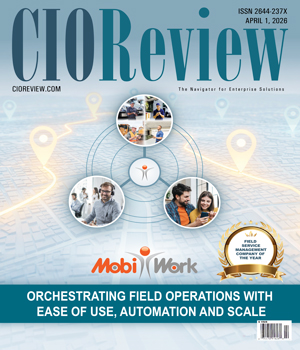
Continue ReadingOur cover story, MobiWork, recognized as the Field Service Management Company of the Year, reflects a disciplined approach to field operations management. The company has built a platform that enables real-time visibility, workforce coordination, and task execution across complex service networks.
Temporal Technologies, recognized as Durable Execution Platform Company of the Year, is redefining reliability in distributed systems through its Durable Execution platform. By ensuring workflows persist despite infrastructure failures, it enables organizations to build fault tolerant, long running services with reduced complexity.
SwiftConnect, recognized as the Best Connected Access Network Platform 2026, unifies physical and digital identity management through a centralized identity layer. Its platform integrates access systems, credentials, and governance workflows without infrastructure replacement, enabling zero trust extension into physical environments while improving compliance and user experience.
This edition also highlights organizations advancing enterprise technology in complementary areas. Karolium, recognized as Top Enterprise Zero Code Platform 2026, provides organizations with a way to extend and evolve enterprise systems without heavy development overhead.
Meanwhile, Commtech Design, named Top Communications and IT Design Firm 2026, focuses on the physical and digital infrastructure that supports modern organizations. By integrating communications, IT systems and security architecture early in project planning, the firm enables technology ecosystems that function seamlessly within complex facilities.
Leadership insights reinforce the discussion. Britt Howard, Vice President at Worley, emphasizes leadership accountability in safety systems, while Bill Davis, Sr. Director Physical Security at Ally, focuses on engineering-driven physical security strategies.
Together, these perspectives reflect a shared priority across industries: building dependable systems that support growth, safety and operational excellence.
