-
Technology
-
Industry
-
Solutions
-
- ASSET MANAGEMENT
- CUSTOMER EXPERIENCE MANAGEMENT
- CYBER SECURITY
- DATA CENTER
- DOCUMENT MANAGEMENT
- ELECTRONIC DATA INTERCHANGE
- ENTERPRISE DATA MANAGEMENT
- ENTERPRISE RESOURCE PLANNING
- ENTERPRISE RISK MANAGEMENT
- ENTERPRISE-GRADE WEB DATA SOLUTIONS
- FACILITY MANAGEMENT
- FIELD SERVICE
- IDENTITY AND ACCESS MANAGEMENT
- INFRASTRUCTURE
- IT SERVICE MANAGEMENT
- MANAGED IT SERVICES
- PAYMENT AND CARD
- PROJECT MANAGEMENT
- SOFTWARE TESTING
- STORAGE
- VIDEO SOLUTIONS
- WORKFLOW
-
-
Platforms
-
Functions
- Leadership Perspectives
- Innovation Insights
- Research
- Magazines
- News
- CXO Awards












Digital Innovation Energizes Global Compliance Management
Daniel Hughes, CIO, ELEMENTIS GLOBAL LLC

Daniel Hughes, CIO, ELEMENTIS GLOBAL LLC
Bi-Modal IT has grabbed the IT headlines urging CIOs to drive up the business value proposition and promote digital innovation to accelerate business growth. Traditionally, the chemical industry has been a slow adopter of computing technology but that landscape is rapidly changing, driven by margin erosion.
Specialty Chemical companies are challenged to remain competitive in a market whereby supply chain complexity, reduced raw material supply and global trade compliance continue to consume resources while driving operational costs up.
Governments, environmental bodies and consumers demand transparency in chemical formulations, production and transportation networks to monitor the impact these activities might have on human health and the environment. In the last decade, governments have taken a leading role in this journey to transparency introducing legislations to drive substance registration. The most publicized legislation is the European initiative known as REACH.
REACH is the acronym for Registration, Evaluation, Authorization and Restriction of Chemicals.
Described as one of the European Union’s major pieces of legislation in the last 20 years, REACH was adopted to improve the protection of human health and the environment from the risks that can be posed by chemicals, while enhancing the competitiveness of the EU chemicals industry. China, Taiwan, Malaysia and South Korea have since adopted similar programs and we expect Brazil, India and Mexico to implement REACH-like regulations in the coming years.
"Compliance is a daunting subject but nevertheless essential for the success of chemical companies in today’s highly regulated world."
The EU REACH initiative is a long-term roadmap taking place over the course of a decade incorporating different registration thresholds for substance registration which will culminate in 2018 with the registration of chemicals in excess of 1 metric tonne per year.
The initial two phases necessitated Specialty Chemical companies registering moderate numbers of substances relying on manual document filling, spreadsheet and email-based tools. Typically, each substance registration involved multiple complex spreadsheets containing dozens of worksheets and demanding the cooperation of numerous stakeholders from various departments within a company.
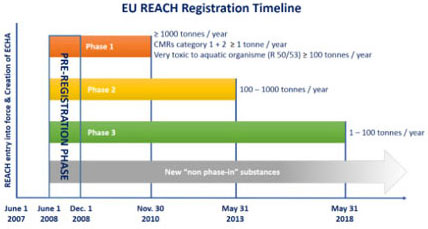 Such manual approaches result in labor-intensive and disparate processes generating higher margin for error and greater risks for missed activities throughout the registration process. This approach also affects the quality and availability of data, hampering future audit obligations. The lack of traceability, automation and monitoring can lead to incomplete and unsuccessful registrations which put companies at risk in securing their position within international markets. Businesses cannot afford poor registration management resulting in registration dossier rejections signifying a direct business loss. The European Chemical Agency (ECHA) has a mantra “No Data – No Market”, meaning that companies failing to properly register by 2018 will lose or delay their access into the EU market.
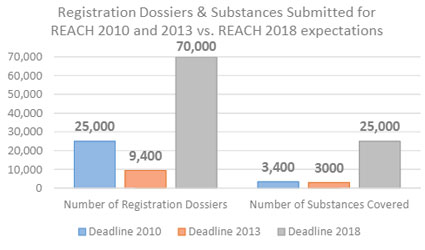
The scope of REACH 2018 is significantly larger than the previous two phases (2010 and 2013) combined. ECHA expects that up to 70,000 registration dossiers will be prepared, covering up to 25,000 substances. This represents three to seven times more dossiers than the amount registered in 2010 and 2013 . In addition, the proportion of small to medium enterprises (SMEs) affected by the 2018 deadline will be much higher than for either of the previous phases and many of these SMEs will have little to no experience of registering under the REACH initiative.
For phase 3, Elementis expects to register four times more substances at lower volume thresholds than for prior deadlines, multiplying the amount of resources necessary to complete registration projects. Each substance demands a thorough dossier including product descriptions, test methods, study reports and certifications, forcing the necessity of automation for project definition, process management, automated workflow and documentation repository. Companies like Elementis are quickly coming to the realization that the former approach to managing registrations is inappropriate and inefficient for the 2018 deadline which requires 21st century digital techniques.
Although there is a plethora of project management tools available, software developer xTensegrity identified through chemical company and contract research benchmarking, a clear deficiency in applications tailored to address this compliance challenge. xTensegrity approached Elementis to be an early adopter of their new application, EUPHOR, which combines our chemical industry knowledge with their software expertise. Although this application was primarily designed to meet the immediate REACH challenge, it can be applied to other regional compliance initiatives that global businesses will face in the coming years.
EUPHOR is a comprehensive Registration Management System (RMS) which is designed to enhance the capability of project and process management in one easy-to-use web-based platform available on either cloud or premise with SharePoint integration.
The application allows our internal and external REACH registration teams to confidently manage, collaborate and track the registration workflow from start to finish. It has become our primary workbench to ensure that REACH activities are managed, error-free and completed on-time and on-budget.
 By implementing such digital application, our registration process is now simplified and straightforward thanks to four elements that we find essential for successful compliance:
- Workflow Generation: automated workflow generation allows our teams to proactively plan the different steps involved in the registration process;
- Automatic Alerts: activity alert system reminds collaborators of upcoming or missed tasks and ensures all activities are completed on time;
- Monitoring: dashboard component allows our Compliance Project Managers to quickly review the status of each registration at BU and enterprise levels;
- Traceability: document repository functionality permits sharing and accessing documents throughout the registration process.
Over time, Elementis anticipates using EUPHOR as a source for useful compiled data to be cross-utilized in other compliance programs, as well as to facilitate future audits and business analysis.
Compliance is a daunting subject but nevertheless essential for the success of chemical companies in today’s highly regulated world. By implementing an innovative software application, we have turned the REACH challenge into a digital opportunity for business process and project management improvement across our organization. Our registration teams can prepare for the 2018 deadline with a higher level of confidence that all dossiers will be accurately and successfully completed, ensuring Elementis’ brand is enhanced in the markets we serve.
Latest Issues