-
Technology
-
Industry
-
Solutions
-
- ASSET MANAGEMENT
- CUSTOMER EXPERIENCE MANAGEMENT
- CYBER SECURITY
- DATA CENTER
- DOCUMENT MANAGEMENT
- ELECTRONIC DATA INTERCHANGE
- ENTERPRISE DATA MANAGEMENT
- ENTERPRISE RESOURCE PLANNING
- ENTERPRISE RISK MANAGEMENT
- ENTERPRISE-GRADE WEB DATA SOLUTIONS
- FACILITY MANAGEMENT
- FIELD SERVICE
- IDENTITY AND ACCESS MANAGEMENT
- INFRASTRUCTURE
- IT SERVICE MANAGEMENT
- MANAGED IT SERVICES
- PAYMENT AND CARD
- PROJECT MANAGEMENT
- SOFTWARE TESTING
- STORAGE
- VIDEO SOLUTIONS
- WORKFLOW
-
-
Platforms
-
Functions
- Leadership Perspectives
- Innovation Insights
- Research
- Magazines
- News
- CXO Awards



Why has verifying who signed a document become critical in modern digital workflows? In boardrooms and compliance offices, the question is shifting from, “Was this document signed?” to “Can we verify who signed the document with defensible proof that will withstand legal, regulatory and audit scrutiny?” As artificial intelligence makes identity replication increasingly accessible, the act of e-signing a document carries new exposure. Signature workflows must prioritize structure and traceability over speed alone. Knowing who reviewed a document, who approved it and who ultimately signed it has become central to establishing accountability. By embedding verifiable identity and audit-grade traceability into the e-signing process, Intellisign has earned recognition as CIOReview’s Top E-Signature Solution for 2026. Rather than treating digital signatures as a standalone action, the platform replicates how authority operates in regulated enterprise environments. Each step of review, approval and execution is distinctly captured with its own context, so accountabilities are never flattened into a single click. “We call it a trust-tech platform. Trust isn’t an abstract idea in our space; it’s something you can measure,” says Eddie Lourenço Jr., Head of Product and Expansion. “When identity, process and regulation align, a digital signature carries the same weight and defensibility as it would on paper.” Designed to Withstand Regulatory Scrutiny How does Intellisign design e-signature architecture to withstand regulatory and audit scrutiny? Across many jurisdictions, electronic signatures are defined by levels of assurance. Simple signatures rely on basic authentication. Advanced signatures introduce additional layers of verification such as tokens, biometrics or multi-factor authentication. Qualified signatures, backed by digital certificates issued within a regulated public-key infrastructure (PKI), carry the highest legal standing. Designing qualified signature workflows for regulated environments requires a different architecture from the outset. Audit trails must be complete, identity verification must be layered and evidence must be defensible by default. For Intellisign, that long-term defensibility stems from its origins within Soluti, an 18-year-old Brazilian technology group recognized for its leadership in PKI and regulated digital identity. With more than 400 professionals and its own Tier 3 data center, Soluti operates in markets where digital certificates and private keys are governed by strict legal and technical frameworks. The rigor required in those environments shapes Intellisign’s architecture, where each signature is treated as an identity-backed decision designed to endure examination over time. For that reason, Intellisign has also become a preferred platform for complex enterprise environments in banking, infrastructure, mining and other compliance-intensive sectors, where contracts, financial commitments and supplier agreements must stand up to review years after they are formalized. Recreating Real-World Authority in Digital Form How does Intellisign replicate real-world approval authority within digital signature workflows? In the physical world, the signature workflow is intuitive. A document first goes to legal for review. If approved, it goes to an executive who needs to understand the exposure and confirm the direction. Only after those steps is the authorized person allowed to sign. That sequence is natural when the document is carried from office to office. Everyone understands their role. Digital systems remove that clarity. Many platforms reduce the entire process to a link and a click. You sign, or you do nothing.
Digital Magazine
Top ODOO ERP Implementation Solutions in Latin America 2026
Why do many Brazilian SMEs struggle with structured operational data and reporting? In Brazil’s SME economy, most companies still operate without structured operational data. That gap is more structural than it is analytical. According to SEBRAE, SMEs represent 97 percent of Brazil’s active companies. Yet many still rely on fragmented spreadsheets, informal controls, and disconnected financial processes. For 4SME Consulting, this is not simply inefficiency. It is operational risk. Founded in 2024, the firm did not begin as an ERP implementation company. It began in data analytics. Leadership repeatedly encountered the same barrier: companies could not analyze what they could not measure. Forecasting models failed because underlying workflows lacked structure. Reports conflicted because data entry followed no unified logic. “Analytics without structured systems is illusionary. If the process is unstable, the data will be unstable,” says Leandro Santos, Founder. Why did 4SME shift from analytics toward ERP implementation and system structure? ERP, then, was not a product expansion. It was a prerequisite. A disciplined system backbone became essential before analytics could deliver value. That realization led to a formal partnership with Odoo and collaboration agreements with certified ecosystem partners operating under defined governance, security, and intellectual property controls. Alignment before Customization How does 4SME approach ERP implementation without excessive customization or technical debt? In a market where ERP projects often escalate into heavy customization, 4SME operates from deliberate restraint. Its implementation model is anchored in the alignment of people, process, and technology. Technology is configured only after workflows are mapped and operational responsibilities clarified. The firm follows Odoo’s structured methodology with discipline, anchoring each engagement in a rigorous ROI analysis. Objectives are clarified upfront, risks are addressed before configuration, and proofs of concept are built using real client data. Even requirements are stress-tested before a single line of code is written.

Top SMS Traffic and Communication Automation Marketing Platform in Latin America 2026

Why has enterprise messaging become mission-critical infrastructure for transactions, security, and customer trust? In today’s digital economy, customer experience can hinge on a single message. One-time passwords, payment alerts, onboarding notices, and service updates are now central to revenue protection and user trust. When they are delayed or fail, transactions stall, support demand rises, and confidence drops. The risk is measurable: users begin abandoning logins within seconds, and about 62 percent quit entirely if an OTP takes more than 30 seconds. At scale, routing inefficiencies or carrier congestion can create latency that leads to failed payments and lost conversions. Even with global SMS authentication spending exceeding $1.6 billion, delivery performance still varies widely, prompting enterprises to treat messaging as mission-critical infrastructure. Against this backdrop, BestUse positions itself as a communications infrastructure partner. Founded in 2009, the Brazilian company supports banks, fintechs, retail enterprises, healthcare networks, logistics operators, and high-volume digital platforms across Latin America. “Our mission is to ensure enterprise messages do not just get sent, but perform,” says João Generoso, president. How does BestUse’s multi-layer routing architecture maintain delivery reliability during congestion and spikes? BestUse differentiates itself at the infrastructure layer. Its platform is built on a multi-layer routing architecture that combines direct operator connections, intelligent fallback mechanisms, and real-time route monitoring. This design maintains consistent delivery even during traffic spikes or carrier instability. Distributed high-availability servers, redundant routing, adaptive load balancing, and real-time queue management support secure, low-latency delivery at enterprise scale. Security and compliance are embedded through encrypted APIs, traffic validation, fraud detection, and frameworks aligned with regional regulations such as Brazil’s LGPD.
CXO INSIGHTS

BRF Bets on Digital Transformation to Become Simpler and More Efficient
Antonio Cesco, Global Director of Technology and Digital Transformation, BRF

Streamlining Efficiency: Document Management in Oil Field Construction Companies
Jeff Green, Chief Information Officer,STRIKE

The Changing Marketing World
Mariangela Duarte Soares Albuquerque, Marketing Director,ATTO Seeds

Innovation as the Engine of Growth
Rodrigo Cantelli, CEO, Domo Inovação and VP Sucesu/SP

Data Products: The Catalyst for Agentic AI
Alejandro Poloz, Head of Data & Analytics, Xepelin

Leading Across Cultures and Beyond Technology
Guilhermo Fragelli, Plant Manager, Union Agener and Victor Fetter, CIO and Managing Director, LPL Fi

Architecting Growth in Latin America's Payments Ecosystem
Gonzalo Esquitino, Business Performance & Data Science Director,Kushki


IN FOCUS
Scaling Smarter: Acceleration of Odoo ERP Implementation in Latin America
Odoo ERP adoption in Latin America accelerates digital transformation, operational efficiency, and scalable growth across midmarket enterprises and expanding regional industries.
The Growing Demand for E-Signature Solutions in Latin America
In the current digital era, the demand for secure, efficient, and environmentally sustainable solutions has become increasingly pronounced.
EDITORIAL
Building Trust in Latin America’s Digital Ecosystem
Across Latin America, organizations are moving beyond basic digital adoption toward building structured, secure, and scalable technology infrastructures. In this edition of CIOReview Latin America, we explore how enterprises are strengthening digital workflows, data governance, and communication systems to support sustainable digital transformation across the region.
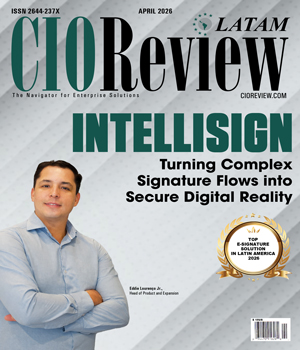
Continue ReadingOur cover story recognizes Intellisign as the Top E-Signature Solution in Latin America 2026. The platform addresses a key challenge in digital transactions: ensuring electronic signatures provide verifiable identity and legally defensible proof. Instead of treating signing as a simple click, Intellisign structures digital workflows that replicate real-world approval chains, capturing each stage of review, authorization, and execution. Built on Soluti's digital identity expertise, the platform integrates layered authentication and PKI-backed verification to support compliance-driven industries that require traceable documentation.
This edition also features 4SME Consulting, recognized as the Top Odoo ERP Implementation Solutions in Latin America 2026. The firm approaches ERP adoption as operational infrastructure rather than software deployment. By aligning processes, governance, and system configuration before customization, 4SME enables small and mid-sized businesses to replace fragmented systems with structured operational data that supports financial transparency and reliable analytics.
BestUse is awarded the Top SMS Traffic and Communication Automation Marketing Platform in Latin America 2026. Through its routing architecture and real-time monitoring capabilities, the platform ensures the reliable delivery of time-sensitive communications, such as authentication codes, payment alerts, and service notifications, while enabling measurable customer engagement.
This issue also includes perspectives from Gonzalo Esquitino, Business Performance & Data Science Director at Kushki, who emphasizes the role of standardized data infrastructure in strengthening decision-making within the payments ecosystem, and Esteban Elia, Head of AI and Data Science at MODO, who examines how organizations can evolve into AI-native enterprises by embedding artificial intelligence into everyday workflows.
Together, the companies and leaders featured in this edition illustrate how disciplined technology infrastructure is shaping the next phase of digital transformation in Latin America.
