-
Technology
-
Industry
-
Solutions
-
- ASSET MANAGEMENT
- CUSTOMER EXPERIENCE MANAGEMENT
- CYBER SECURITY
- DATA CENTER
- DOCUMENT MANAGEMENT
- ELECTRONIC DATA INTERCHANGE
- ENTERPRISE DATA MANAGEMENT
- ENTERPRISE RESOURCE PLANNING
- ENTERPRISE RISK MANAGEMENT
- ENTERPRISE-GRADE WEB DATA SOLUTIONS
- FACILITY MANAGEMENT
- FIELD SERVICE
- IDENTITY AND ACCESS MANAGEMENT
- INFRASTRUCTURE
- IT SERVICE MANAGEMENT
- MANAGED IT SERVICES
- PAYMENT AND CARD
- PROJECT MANAGEMENT
- SOFTWARE TESTING
- STORAGE
- VIDEO SOLUTIONS
- WORKFLOW
-
-
Platforms
-
Functions
- Leadership Perspectives
- Innovation Insights
- Research
- Magazines
- News
- CXO Awards


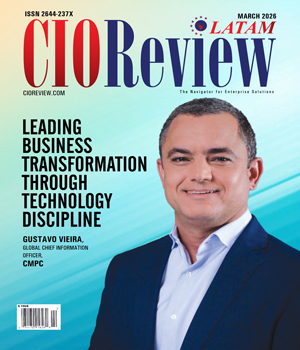
CMPC
Leading Business Transformation Through Technology Discipline
With nearly 30 years of experience in information technology, Gustavo has worked across multiple disciplines, including IT services management, architecture, business partnership, and project management. His leadership approach focuses on managing IT as a business unit, aligning technology investments directly with business drivers, value creation, and long-term operational resilience. A Career Built Across Disciplines I currently serve as the Global CIO for CMPC, a pulp and paper company headquartered in Chile with operations throughout Latin America and beyond. My professional journey in technology spans close to three decades, during which I have worked across many areas of IT, like analyst roles, global IT services, architecture, business partnering, and project management. Moving through different disciplines helped me build empathy for how technology teams operate and how decisions made in one area affect others. More importantly, it shaped my belief that technology must always be connected to business drivers. That idea may sound simple, but in practice it is not easy to achieve. From early in my career, I have viewed IT not as a support function, but as a business unit. Every dollar invested in technology must return value to the organization, ideally two or more dollars in business impact. We are not here to implement technology for its own sake. We are here to create measurable value. That is also why I prefer to talk about business transformation enabled by digital technology, rather than digital transformation alone. Technology is the means, not the objective. Aligning Global Strategy with Local Reality Operating as a global CIO in Latin America brings its own complexity, with varying regulations, varying infrastructure maturity, and local business needs. To manage this effectively, we rely on a strong global architectural foundation that allows consistency, while still respecting local requirements. Technology only matters when it clearly returns value to the business. Digital transformation without business transformation is just activity, not progress. One of the most important mechanisms we use is structured governance with the business. I currently run eight steering committees across CMPC, each aligned to a specific line of business. These committees meet quarterly and serve as a shared forum where IT and business leaders discuss priorities, pain points, and value creation. This approach ensures technology initiatives are directly connected to business goals. It also allows us to reprioritize throughout the year when conditions change. Strategy cannot be static. The ability to adjust direction, while staying aligned with business objectives, is critical in today’s environment. Transformation Starts with Mindset, Not Tools One of the most common mistakes companies make is assuming technology is the hardest part of transformation. In reality, technology is often the easiest component. The real challenge is mindset. It is very common to see major platforms or tools implemented successfully, only to be underutilized or unable to deliver the expected value. This usually points to a lack of change management and to a lack of leadership alignment. Transformation must start with preparing the organization, especially the leadership and the board, to think differently about how the business operates. Digital initiatives only succeed when people understand why change is necessary and how it connects to business outcomes. Without that shared understanding, even the best technology will fail to deliver impact.
Digital Magazine
Microsoft
Confitec Tecnologia
Empowering Businesses through Tailored Microsoft Solutions
João Rafael Girão, Owner
For many organizations, Microsoft environments grow organically. Tools are added, licenses expand, and integrations accumulate, often without a clear operating logic. Over time, this creates complexity that slows decision-making and weakens governance. Confitec Tecnologia exists to take responsibility for that complexity. Confitec’s model is built on embedding itself into clients’ day-to-day operations to manage Microsoft as a single operating environment, not a collection of standalone tools. Rather than focusing on licenses or isolated implementations, the company assumes end-to-end responsibility for how Microsoft platforms are governed, sequenced, and evolved inside the organization. Founded in 2013 and headquartered in São Paulo, Confitec operates with a single guiding principle: Microsoft should function as a stable, governed backbone for business operations. Every engagement is structured around outcomes, continuity, and operational clarity, not short-term deployments. End-To-End Responsibility As A Differentiator Unlike many Microsoft partners, Confitec does not position itself as a project-based implementer. It embeds deeply into client workflows, managing planning, deployment, governance, and ongoing optimization as a continuous operating responsibility. This approach allows clients to move from fragmented tool usage to a coherent, standardized environment that still adapts to their specific needs. Microsoft services such as Office 365, Azure, CRM, and Copilot form the execution layer of this model, but they are never the starting point. Decisions begin with governance structure, operational priorities, and sequencing. Only then are platforms configured to support how the business actually works. “Today, we operate 100 percent with Microsoft solutions for our clients, starting with Office 365 and evolving according to their internal demands,” says João Rafael Girão, Owner of Confitec Tecnologia.
Retail

Why does fragmented customer engagement undermine enterprise service performance? NeoAssist addresses fragmented customer engagement by unifying all service channels into a single platform. This challenge is operational, technical and structural, particularly in enterprise environments where multiple systems, strict governance requirements, and high interaction volumes are the norm. By removing traditional silos, NeoAssist enables service teams to operate from one continuous view of the consumer across messaging apps, social platforms, voice channels, and digital touchpoints. Strong customer relationships depend on full visibility supported by resilient, scalable architecture. As consumers move fluidly between WhatsApp, Instagram, email, telephone, and LinkedIn, disconnected systems erode context, slow decision-making, and weaken service quality. NeoAssist was designed to perform reliably in complex, high-volume enterprise environments, supporting continuous growth without compromising data governance, performance, or operational control. “At NeoAssist, we consolidate consumer interactions across diverse platforms into one unified layer, allowing companies to understand individual touchpoints and the entire customer journey,” says Oswaldo Garcia, CEO. AI as an Integrated Operating Layer How does Nub.ia leverage unified data for contextual engagement? NeoAssist embeds AI as a core operating layer built on a unified data foundation. Its proprietary AI, Nub.ia, draws from a centralized data lake that integrates customer conversations, profiles, orders, ticket values, and internal systems to support human and AI interactions. This foundation enables context-aware, timely, and hyper-personalized engagement across the customer lifecycle.
Data Analytics

Challenges in the role of a Global and Multi-Market IT Executive
Ygor Silva Cezar, Head of IT, and Ronaldo Andrade, Head of Business Technology and CISO, Horiens Ris
Supply Chain

Navigating the Technological Wave for Supply Chain Resilience and Efficiency
Arnaldo Ortona, Chief Procurement Officer, USIMINAS
Supply Chain

Leadership and Skills
Cristhian Gordillo, Supply Chain & Procurement Director, Indorama Ventures
Agile

Supply Chain Professionals Matters
Carlos Felipe García, Head of Procurement and Finacial Control, Mineros S.A
SAP

Connecting the Dots: Harnessing Technology and Curiosity to Transform Supply Chain and Procurement
Francisco Rovira, Head Supply Chain, Nestlé
Digital Transformation

Turning Technology into a Maritime Growth Engine
Jürgen Dahl-Skog S., Chief Information Officer, Empresas Taylor

From Conception to Critical Infrastructure
Rodrigo Takao, IT Director, Gokei Tecnologia

IN MY OPINION
Salesforce
Supply Chain: Turning Motion into Progress
Francisco Bravo Gomez, Supply Chain Director, Audi México

LAST WORD
Cloud
Web Dev's Secret Weapon: Sustainable Copilots & AI
Everton Molina, Technology and Product Director, Luizalabs
IN FOCUS
Unlocking Potential: Microsoft Services and Their Influence on Latin America's Growth
Microsoft’s cloud, data analytics, and productivity services are driving business transformation and efficiency in Latin America.
Rise of Omnichannel Customer Service Platforms in Latin America
Customer expectations in Latin America have shifted dramatically over the past decade. Consumers now interact with brands through websites, mobile apps, social media, messaging platforms, call centers, and physical touchpoints, often switching channels within a single journey. They expect fast responses, consistent information, and personalized service regardless of how or where they engage. The change has pushed businesses to rethink traditional, siloed customer support models. Omnichannel customer service platforms have emerged as a strategic solution, allowing organizations to unify customer interactions across channels into a single, seamless experience.
EDITORIAL
Architecting Business Value across Latin America’s Digital Economy
Technology leadership in Latin America is shifting from implementation to accountability. CIOs are expected to deliver measurable returns, enforce governance and build systems that withstand volatility. This edition of CIOReview Latin America examines how disciplined execution is defining competitive advantage across the region.
Continue ReadingAt the center of the issue, CMPC, recognized as one of the Top CIO in Latin America 2026, reflects this shift. Gustavo Vieira manages IT as a business unit, aligning every investment to value creation through structured steering committees and outcome-based governance. Technology is positioned as a lever for business transformation, not an isolated function.
Confitec Tecnologia, recognized as Top Microsoft Service in Latin America 2026, embeds itself into client operations to manage Microsoft as a governed operating backbone rather than a collection of tools. Empresas Taylor, also recognized as one of the Top CIO in Latin America 2026, has elevated IT into a maritime growth engine. Through cloud-first architecture, SAP in the cloud, Salesforce CRM and advanced BI, the company strengthened automation and governance while enabling Smartflux, its automated cargo release platform, which is recognized globally for digital port innovation.
Gokeitecnologia, recognized as Top CIO in Latin America 2026, operates at the intersection of architecture, regulation and systemic responsibility. Its Central Bank regulated payment infrastructure demonstrates that strict compliance and scalability can coexist when governance is embedded at design level. NeoAssist, recognized as Top Omnichannel Customer Service Platform 2026, unifies enterprise engagement into a single AI-powered layer. By consolidating channels and embedding proprietary AI across a centralized data foundation, it enables automation rates above 50 percent while maintaining high satisfaction in high-growth environments.
Francisco Bravo Gomez of Audi México emphasizes predictive KPIs and matrix structures to anticipate disruption early. Francisco Rovira of Nestlé highlights curiosity, analytics, and generative AI as the foundations for resilient, adaptive supply networks.
The message across these narratives is consistent. Sustainable impact is built on architecture, governance and clarity of leadership. We invite readers to engage with the insights shaping the next chapter of CIO leadership in Latin America.
