-
Technology
-
Industry
-
Solutions
-
- ASSET MANAGEMENT
- CUSTOMER EXPERIENCE MANAGEMENT
- CYBER SECURITY
- DATA CENTER
- DOCUMENT MANAGEMENT
- ELECTRONIC DATA INTERCHANGE
- ENTERPRISE DATA MANAGEMENT
- ENTERPRISE RESOURCE PLANNING
- ENTERPRISE RISK MANAGEMENT
- ENTERPRISE-GRADE WEB DATA SOLUTIONS
- FACILITY MANAGEMENT
- FIELD SERVICE
- IDENTITY AND ACCESS MANAGEMENT
- INFRASTRUCTURE
- IT SERVICE MANAGEMENT
- MANAGED IT SERVICES
- PAYMENT AND CARD
- PROJECT MANAGEMENT
- SOFTWARE TESTING
- STORAGE
- VIDEO SOLUTIONS
- WORKFLOW
-
-
Platforms
-
Functions
- Leadership Perspectives
- Innovation Insights
- Research
- Magazines
- News
- CXO Awards


Contributory Virtus Investment Partners on the invitation from our Editorial

Indorama Ventures
Cristhian Gordillo, Supply Chain & Procurement DirectorLeadership and Skills
Cristhian Gordillo, Supply Chain & Procurement Director
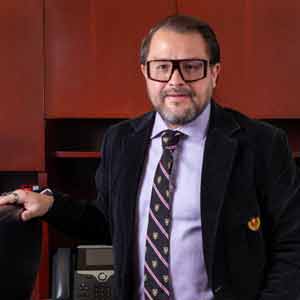
Cristhian Gordillo is the supply chain & procurement director at IVL Mexico. IVL (Indorama Ventures Public Company Limited), a global sustainable chemical company, is one of the world's leading petrochemical producers, with a global manufacturing footprint across Africa, Asia, Europe, and the Americas. The company's portfolio comprises Integrated PET, olefins, fibers, packaging, and specialty chemicals. Indorama Ventures products serve major FMCG and automotive sectors, i.e., beverages, hygiene, personal care, tire, and safety segments.
Cristhian has five years of experience in the automotive sector plus 19 years in procurement, energy & supply chain management in the polyester/ petrochemical sector.
Graduated with on Industrial Engineering Bachelor's degree from Universidad Iberoamericana in Mexico.
New generations are looking for mentors. That’s very millennial, but it is genuine. That’s the way they see it. The subordinate & the boss is no longer used. It is no longer well perceived for them.
It is said that we all want to be leaders. I don't think so. Rather not all of us want to be leaders, or not all of us can be leaders. And the reason is because it has a high degree of personal sacrifice.
Today the main problem is that there is no one teaching how to lead. We don't even know how to explain the characteristics and abilities that a leader must have; nobody has taught us anywhere. Then how do you decide who to follow?
Hard vs. Soft Skills
Competencies are knowledge, know-how, attitudes, and values.
Hard skill is being an engineer, lawyer, or doctor and/or having a master's, specialty, or doctorate.
Soft skills are knowing problem-solving, storytelling, collaboration, communication, and creativity.
A hard skill should be considered as a technical competence as well. However, there are 114 skills as basic competencies, for life (40), for leadership (50), and for management (24).
For so many years, hard skills have been privileged over others. If the hard skills are thoselearned in university formation, where do we learn basic competencies? The answer is probably at your own job, where the school is. Mentoring and moral authorities are the perfect machinery for success in an organization.
 If my career had turned out like the fantasy I had of what it was going to be, it would never have made me happy.
Is being a manager or director synonymous with being a leader? Probably a high percentage of managers and directors are bad leaders. Knowledge is useless if it doesn't change our behavior.
During the last three years, I have seen several resignations. I'm really surprised how many people are leaving their jobs, tenting to say there is a lack of opportunities. We better fix that because this is the kind of an environment we are making. It's an opportunity to practice providing a culture where people like to go to work. They want to be seen, where they feel heard, that they contribute to the business.
Attention replaces money as a new currency. Attention includes mentoring!
New generations are all in a hurry to know what to do. Being successful fast! We were all practically born under the same paradigm of being born, studying, working, getting married, raising a family, educating our children, buying a house, and dying. Plus leaving a legacy! However, there is a problem here. It is increasingly difficult to meet that life expectancy that was planned for us.
It is less and less viable, it is more and more difficult to find a stable job for us, it is more and more difficult to have a house (not impossible) or aspire to have goods and properties and establish the plan that has been programmed for you since you were born and now what are you going to do? Whenever we look for culprits for the economic conditions in which we find ourselves, and even despite reviewing our environment, we end up realizing that we are also suspected of all the conditions that affect not having a better way of life, so it is preferable never to point anyone responsible until we are completely sure that we are not included in the origin of the problem. Conclusion: You have to prepare to be able to transcend in your organization.
Nothing I did go fast, nothing I did was easy, but it was all worth it. I believe strongly that it is today's thought model and process.
Make money fast. Fast promotions.Speedy career.Anything, all fast, all in all.
And trust me; nothing is that fast. Therefore, all that I did so far did not happen fast. Nothing that I did was easy.
But everything is certainly worthwhile.
If my career had turned out like the fantasy I had of what it was going to be. It would never have made me happy.
But I couldn’t have known that until it didn’t happen. I found a success that is so much bigger and deeper and better, and it’s because it happened later.
If any of what I’m having happen now – the successes – would have happened to me when I was younger, I would have been ruined.
Because when you're young, and things come super easily to you, and you have success right out the gate, you're liable to think that's how it works.
You start to think you don’t need to be fully prepared or committed to have these things meet you.
The articles from these contributors are based on their personal expertise and viewpoints, and do not necessarily reflect the opinions of their employers or affiliated organizations.
EDITOR'S Choice

Fortune Brands Innovations [NYSE: FBIN]
By Juan Guerrero, Director, IT Audit & Data Analytics
The IT Audit Evolution: From Compliance to Strategic Intelligence
Broad River Retail
Wes Dudley, Senior Vice President, Customer Experience
Customer Experience in the Age of Amplified Complexity
Fortune Brands Innovations [NYSE: FBIN]
Scott Barnes, Sr. Director of Enterprise Cyber Security (CISO)
The X-Factor in Cybersecurity: AI and Automation at Work

LHarris Technologies [NYSE: LHX]
Brian Allred, Director of Business Intelligence and Analytics
The Shift from Rigid Dashboards to Conversational Analytics
Ivar's Restaurants
Patrick Yearout, Director of Innovation, Recruitment & Training
From Hiring to Development: Nurturing Teams that CareLatest Issues