-
Technology
-
Industry
-
Solutions
-
- ASSET MANAGEMENT
- CUSTOMER EXPERIENCE MANAGEMENT
- CYBER SECURITY
- DATA CENTER
- DOCUMENT MANAGEMENT
- ELECTRONIC DATA INTERCHANGE
- ENTERPRISE DATA MANAGEMENT
- ENTERPRISE RESOURCE PLANNING
- ENTERPRISE RISK MANAGEMENT
- ENTERPRISE-GRADE WEB DATA SOLUTIONS
- FACILITY MANAGEMENT
- FIELD SERVICE
- IDENTITY AND ACCESS MANAGEMENT
- INFRASTRUCTURE
- IT SERVICE MANAGEMENT
- MANAGED IT SERVICES
- PAYMENT AND CARD
- PROJECT MANAGEMENT
- SOFTWARE TESTING
- STORAGE
- VIDEO SOLUTIONS
- WORKFLOW
-
-
Platforms
-
Functions
- Leadership Perspectives
- Innovation Insights
- Research
- Magazines
- News
- CXO Awards


WRITER
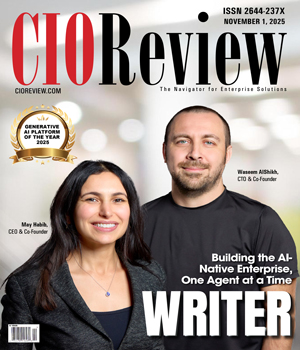
Building the AI-Native Enterprise, One Agent at a Time
In the expanding world of generative AI, only a few companies have carved out a place as unique and resolute as WRITER. Positioned at the forefront of enterprise AI transformation, WRITER has gone beyond building technology for large organizations—they’ve built it with them. Through thousands of hours working side by side with customers, a deep understanding of enterprise complexity, and a refusal to settle for retrofitted solutions, it created a platform purpose-built for the nuanced demands of modern businesses. WRITER emerged in 2020 prior to the generative AI boom. At that time, the field was still largely academic and experimental, with major players targeting consumers or hobbyist developers. But Waseem AlShikh, CTO and Co-founder, and May Habib, CEO and Co-founder, saw a different path forward. Initially working in machine translation, the two were convinced that language models would do more than just generate text—they would redefine the very fabric of work. “We saw firsthand how transformer models changed the way language and, eventually, work happened,” says AlShikh. “From the beginning, we were building toward a future that was enterprise-first, not consumer-led.”
Digital Magazine
Digital Transformation
Vortex Consulting
Delivering Digital Transformation Excellence through Decades of Expertise and AI
Matt Wendroff, CPA, President and Founding Partner
2030 is the looming deadline for companies running on SAP, as it marks the end of extended support for SAP ECC systems. By then, every enterprise must be operating in SAP’s ERP cloud environment. For most companies, the challenge is not a lack of intent but a lack of clarity and expert resources to execute the move. Many SAP environments are highly customized, often spanning decades and multiple geographies, making any change complex and risky without proper execution. With this cloud migration deadline on the horizon, enterprises hesitate because they are unsure how to proceed without disrupting their core operations. Adding to the complexity is a shortage of internal SAP expertise, which makes critical decision-making and the management of large-scale transformations difficult. The risk of scope creep and misaligned execution only heightens this hesitation. In this high-stakes environment, SAP clients need more than just a vendor. They need a trusted partner with proven experience who can navigate these challenges and deliver clarity and confidence throughout the transformation journey. That is the role Vortex Consulting has come to play.

Enterprise Data Management

Edge Total Intelligence
Transforming Data Silos into Actionable Enterprise Insights
Jacques Jarman, Chief Growth and Federal Operations Officer
Paradoxically, technology experts are turning to AI for positive disruptions while ignoring the low-hanging fruit of AI-assisted data integration. Every time they seek new data-driven insights, it’s a rinse and repeat of the often ineffective and inefficient building of new data warehouses, lakes or the “rip and replace” of enterprise systems. edgeTI™ has devised a different approach. edgeTI challenges enterprises to look at data and data architecture, in a new and more effective way. edgeTI's performative data mesh/fabric solution, edgeCore™, disrupts the status quo by leaving data in its authoritative source, accessing and transforming data in real-time when and how it's needed by the user. The result is the proverbial and storied single-pane-of-glass, in a dynamic, low-code UI that comprehensively delivers the actionable insights you need at the speed of relevance. It’s not a rip and replace, but rather an AI-enabled, COTS software platform that provides results in weeks rather than months or years. By integrating existing legacy systems, edgeCore delivers unprecedented situational awareness and a higher ROI on existing enterprise solutions.
Storage
2025 has been the year enterprise storage was forced to evolve. Artificial intelligence, immersive media, and scientific research generated data at unprecedented levels. Ransomware incidents became more sophisticated, cloud costs less predictable, and vendor lock-in more punishing. CIOs and IT leaders discovered that adding capacity wasn’t enough. The real challenge was control—managing an organization’s data estate with confidence, clarity, and resilience in the face of volatility. That context explains why TrueNAS was named Data Storage Company of the Year 2025. The recognition is not just about technology or revenue growth. It reflects a model built around giving enterprises mastery over their data: control, transparency, predictability, and peace of mind. As Mike Lauth, CEO of TrueNAS, put it: “Storage isn’t just about where you put data anymore. It’s about whether you’re in control of it. In 2025, that became the defining issue for every CIO we spoke with.” This year, TrueNAS reached new milestones. With over 40% annual growth since 2021, TrueNAS has reached an all-time revenue high, while the number of multi-petabyte customer deployments continues to rise across government, media, and AI workloads. Additionally, the release of TrueNAS 25.10 introduced the company’s most intelligent and resilient software to date. TrueNAS 25.10 simplified operations while strengthening ransomware protection, ensuring organizations could operate with confidence in high-risk environments.

Artificial Intelligence

Ujigami, a trailblazer in the AI space, has redefined what it means to leverage machine intelligence in business operations. While many AI systems focus on mimicking human self-learning models, Ujigami offers a deterministic, rules-based logic solution that streamlines decision-making and replaces significant human labor. Under the leadership of CEO Edward Dickson, Ujigami has carved a unique niche by integrating its AI capabilities into industries that typically require heavy human intervention, demonstrating the power of predictable, efficient, and intelligent automation. “At the core of Ujigami’s innovation is a distinct approach to AI. AI is a computer system that can perform tasks that typically require human intelligence,” says Dickson. This broad definition sets the stage for how Ujigami differentiates itself from conventional AI systems. While most AI engines today are striving to mimick human self-learning, the Ujigami system thrives on applying precise business logic to drive outcomes. It doesn’t rely on vast data to continuously evolve its decision-making processes. Instead, Ujigami provides a solid, predetermined framework where human knowledge is directly translated into machine action. This makes it ideal for environments where consistent, repeatable results are necessary.
Artificial Intelligence

Self-Managed Storage Units With Embedded Artificial Intelligence
Federico Masias, Innovation Officer, Baird & Warner
Artificial Intelligence

Transforming Building Solutions, the Power of Data and Innovation
Christos Ruci, SVP, Chief Information Officer, Limbach
Artificial Intelligence

Unlocking the Value of AI
Louie Celiberti, MD, Head of Software Engineering - Shared Services, Guggenheim Partners
Artificial Intelligence

AI in Enterprise Applications: Unleashing new Possibilities
Joe Zirilli, Vice President, Artificial Intelligence Solutions Architecture, Parsons Corporation
Artificial Intelligence

From Human Change to Digital Transformation Success
Scott Blake, SVP & CIO, Bangor Savings Bank

IN MY OPINION
Artificial Intelligence
The art of predicting the price of collectibles: how machine learning is revolutionizing valuation
Dan Van Tran, Chief Technology Officer, Collectors

LAST WORD
Artificial Intelligence
An Approach To Strategic Cyber Resilience
Ray M, Sr. Director, IT Security and Infrastructure, Jacuzzi Group
IN FOCUS

Shaping the Future: The Expanding Role of Generative AI Platforms
Generative AI platforms have evolved from experimental tools to transformative technologies that are shaping industries, workflows, and customer experiences worldwide. By enabling machines to create original content, ranging from text and images to code, designs, and synthetic data, these platforms are redefining the boundaries of creativity, automation, and productivity.

Data Storage Strategies: Aligning Technology with Organizational Goals
In today’s rapidly evolving digital economy, businesses generate and process unprecedented volumes of data each day. From customer transactions and operational metrics to real-time analytics, the ability to store and manage data efficiently has become central to sustaining growth and maintaining competitiveness.
EDITORIAL
Upgrading Storage, Consulting, and Culture for AI Reality
Data is no longer a byproduct of digital life. It is the fuel that makes modern businesses defensible, efficient, and scalable. Because data holds that role, every layer of the enterprise stack is in motion.
Continue ReadingStorage companies are not selling static hardware anymore. They compete on intelligent optimization, on energy use, and on how precisely they place the right data in the right tier for analytics and AI workloads. This matters because the usefulness of AI depends on fast and reliable access to data.
Consulting firms are also changing. They are not digitizing back offices in isolation. They are redesigning operating models around cloud, software, and AI so that enterprises realize measurable gains in margin and growth.
Artificial intelligence is not a novelty. Boards treat it as a lever on profit and as a surface of risk that requires governance with the same seriousness applied to finance or safety. Once AI sits at the board level, the data foundation beneath it must mature in parallel.
That pressure is driving the shift toward data mesh. Central data lakes often stall decision-making. By giving business domains ownership of their data products under shared governance, organizations recover speed and accountability.
Generative AI platforms are accelerating this shift. They are embedding into drafting, coding, discovery, support, and design work. They shorten production cycles and expose the cultural resistance inside firms that do not update how people work.
All these moves reinforce one another. Better storage lowers the cost of inference. Cheaper inference makes AI useful. Useful AI forces new operating models. New operating models require new data architecture. New data architecture creates new platforms and new winners.
In this edition, we feature insights from leaders like Christos Ruci, SVP, Chief Information Officer at Limbach, and Federico Masias, innovation officer at Baird & Warner, whose perspectives reflect how organizations are adapting strategy, technology, and culture to compete in an AI-driven economy.
