-
Technology
-
Industry
-
Solutions
-
- ASSET MANAGEMENT
- CUSTOMER EXPERIENCE MANAGEMENT
- CYBER SECURITY
- DATA CENTER
- DOCUMENT MANAGEMENT
- ELECTRONIC DATA INTERCHANGE
- ENTERPRISE DATA MANAGEMENT
- ENTERPRISE RESOURCE PLANNING
- ENTERPRISE RISK MANAGEMENT
- ENTERPRISE-GRADE WEB DATA SOLUTIONS
- FACILITY MANAGEMENT
- FIELD SERVICE
- IDENTITY AND ACCESS MANAGEMENT
- INFRASTRUCTURE
- IT SERVICE MANAGEMENT
- MANAGED IT SERVICES
- PAYMENT AND CARD
- PROJECT MANAGEMENT
- SOFTWARE TESTING
- STORAGE
- VIDEO SOLUTIONS
- WORKFLOW
-
-
Platforms
-
Functions
- Leadership Perspectives
- Innovation Insights
- Research
- Magazines
- News
- CXO Awards


Capacity planning has long been the unsung function of contact centers, tucked behind the flashier parts of workforce management. Even as operations grew more complex, volumes more volatile, and expectations more demanding, one critical task remained in a spreadsheet. Datanitiv was created to fix that. Its platform, Capability, was purpose-built for contact centers. Whether managing an outsourcing environment supporting multiple clients or a Captive organization with in-house centers and outsource partners, Capability gives teams a faster, smarter and more grounded way to plan. Instead of manually stitching together forecasts, onboarding curves, rosters and shrinkage assumptions, the platform unifies it all into one connected system. It reflects actual people, not placeholders, and empowers planners to model scenarios, test assumptions, and course-correct before problems arise. It integrates with HR, scheduling and telephony systems to ensure plans align with how a business runs. Most importantly, it gives back time. In many cases, up to 40 percent, gleaned from the hours spent wrestling spreadsheets and chasing updates. Today, Capability powers workforce planning for hundreds of thousands of agents across some of the world’s largest BPOs and Fortune 500 companies. Datanitiv is already expanding into highly manual, contact center-dependent industries such as banking, telecom, healthcare, aviation and FinTech, where smarter planning is now more than an upgrade. It’s a necessity. Living the Problem Capability works the way it does because the people behind it knew precisely what was broken. In 2019, industry veterans Sunil Varyani and Mohit Shah asked, ‘What if there was a smarter way to plan?’ With more than 40 years of combined experience— Varyani in operations and partnerships, Shah in workforce transformation for global BPOs—they weren’t outsiders looking in. They had spent their careers inside the system, navigating the delays, inefficiencies and spreadsheet sprawl that made capacity planning a recurring pain point. The time for incremental fixes had passed. It was time to entirely rethink the function. Out of that shared vision, Datanitiv was born. The team at Datanitiv did not jump into a generic solution. They focused on one of the most mission-critical and underserved parts of contact center operations. At the time, capacity planning had no dedicated enterprise tool, despite its importance. Every organization, from the largest global outsourcers to in-house teams, still used spreadsheets to make staffing decisions across regions, vendors and channels. It was a fragile, error-prone process that simply could not keep up with the pace of change. So they got to work. They quietly built, tested, refined, and reimagined for the next few years. Then, in late 2022, Datanitiv’s flagship product, Capability, went to market. Currently, it -is already planning capacity for over 225,000 agents across some of the most prominent BPO players in the world. “What sets Capability apart is the level of detail and agility,” says Sunil Varyani, Co-Founder & Chief Client Officer. “The solution natively addresses 95 percent of an organization's use cases and, in contrast to other workforce platforms, offers additional customization capabilities.” The New Standard for Smarter Planning Capability is compelling because it redefines what capacity planning should look like in a modern enterprise.
Digital Magazine
Cloud Migration Services of The Year 2025
When most companies hear “cloud migration,” they think of sky-high costs, long-term contracts, and tech support teams that feel more like strangers than partners. It’s often a high-stakes process handled under tight timelines, where one wrong move can lead to downtime, lost data, or frustrated teams. That’s why many businesses hesitate to make the shift, even when they know their current systems are outdated or no longer secure. The complexity, cost, and risk of migration can feel overwhelming—especially when most providers treat it as a billable service rather than a step toward transformation. This is where RyanTech enters the picture—not just as a service provider, but as a partner built on trust, flexibility, and long-term relationships. For 25 years, the company has understood these challenges, continually refining its processes to simplify cloud transformations. Businesses turn to RyanTech because it brings both urgency and care to the table. Focused solely on Microsoft Cloud, it offers free migrations, no lock-in contracts, and a single dedicated agent who guides each client through every step—from planning and cutover to adoption. Whether migrating a single user or consolidating five newly acquired companies into one Microsoft tenant, RyanTech has the team, the process, and the trust to make it seamless. Its client-centered approach has earned the company multiple accolades, including being named Microsoft Partner of the Year three times and ranking on the Inc. 5000 list for two consecutive years. “Our belief is simple: migration and adoption should be part of the software. We don’t charge for migration. We invest in the relationship, and our success grows when our customers succeed,” says McMillen, CEO. Adapting to Every Environment RyanTech consistently serves a wide range of customers, from single-user operations to enterprises with thousands of seats. The company supports all major Microsoft licensing environments, including nonprofit, GCC, GCC High, and commercial— removing barriers for specialized sectors that often face limited vendor support. Its services fall under three key stages of cloud transformation within the Microsoft ecosystem: migrate, adopt, and protect. Migrate covers the movement of email, files, and applications into Office 365 or Azure. Clients may be migrating from Google Workspace, AWS, or on-premises systems. RyanTech manages these transitions at no additional cost. To minimize disruptions and protect data, the migration is completed in multiple stages, allowing original and target systems to run in parallel. Each client is guided by a dedicated agent who helps them adjust to their new platforms. Even after the migration, clients continue working with the same agent—someone who is familiar with their needs and understands the full context of the migration. These personal specialists oversee planning, adjust strategies as needed, and respond to questions in real time. It’s a model built on continuity, not call tickets. Protect is RyanTech’s cybersecurity service group. The company has built a robust security solution that prevents breaches and enables teams to collaborate securely at both the endpoint and user level. It also offers an AI-powered email security system that detects and blocks malicious messages before they reach users. These capabilities guard against a growing range of cyber threats, providing clients with peace of mind.

Top Incident Management Platform 2025

While Silicon Valley chases unicorns and IPOs, 911Cellular is chasing something far less glamorous but infinitely more important: peace of mind. Since its inception, the company has remained self-funded and organically grown, guided not by investors but by a deep commitment to public safety. It has specialized in providing fully integrated incident management solutions—panic buttons, response management software, and mass notification systems—that empower organizations to respond to emergencies more effectively. At the heart of it all is Chad Salahshour, a former law enforcement professional turned tech entrepreneur, whose personal mission to protect people has defined every decision the company makes. “Because we’ve never taken outside funding, our only stakeholders are our customers,” says Salahshour, founder and CEO. “That’s why everything we build is centered on their safety, needs and environments.”
CXO INSIGHTS

Leveraging the Cloud for Data and Analytics
Bryan Goodman, Director of Artificial Intelligence, Ford Motor Company

Beating the ERP Implementation Odds: Leveraging Appropriate Paranoia
Liam Durbin, CIO, and Kimberly Frey, VP, Business Transformation, T. Marzetti

ITSM Article – Why ITIL?
Fred Geerken, Chief of Information Security (C-CISO/CISSP), Leprino Foods

Migrating to Containers using Could Vendor Offerings
Hiram Amador, Manager of Data and Cloud Operations, Fragrance.com

Driving Innovation and Modernization
Brian Shultz, Chief Information Officer, Cruise Planners

Leadership Strategies Powered By Communication and Technology
Michael Crowley, Chief Information Officer, Shorr Packaging Corp

Mastering the Balance Between Innovation and Stability in Media
Paul Capizzi, Chief Information Officer, SVP Enterprise Technology, Fox Corporation


IN FOCUS

Scaling Smart: Rise of Enterprise Capacity Planning Solutions
The enterprise capacity planning solutions market is expanding rapidly, driven by the rising complexity of business operations, evolving consumer demands, and the need for real-time decision-making. In an era of digital transformation, enterprises must balance resources, workforce, infrastructure, and production capabilities with demand fluctuations and strategic goals. One of the fundamental factors driving demand for capacity planning tools is operational unpredictability.

Reimagining Enterprise IT: The Transformative Role of Cloud Migration Services
Businesses increasingly use the cloud to enhance scalability, agility, and operational efficiency. Large and small organizations recognize that maintaining traditional IT infrastructure is costly, inflexible, and often incapable of supporting the demands of modern applications, remote workforces, and real-time analytics.
EDITORIAL
Shaping the Future of Enterprise Technology
The enterprise technology landscape is soaring, fueled by rapid digital transformation and the race to deliver always-on services. Organizations are scaling faster than ever. But with growth comes a wave of new challenges. Rising service expectations, complex multicloud environments and unpredictable demand patterns are pushing IT teams to rethink how they manage incidents, move workloads to the cloud and plan capacity across the enterprise.
Continue ReadingThe latest incident management platforms are evolving beyond ticketing systems into intelligent ecosystems that integrate monitoring, analytics and automated remediation, reducing mean time to resolution and strengthening service resilience. New-age cloud migration services are shifting focus from simple workload transfers to complex, hybrid strategies that prioritize security, compliance and interoperability across diverse environments. Cutting-edge enterprise capacity planning solutions are increasingly data-driven, using predictive modeling and AI to align infrastructure investment with business demand while mitigating the risks of over- or under-provisioning.
This edition of CIOReview brings recent developments in incident management platforms, cloud migration services and enterprise capacity planning solutions into focus, highlighting the technologies, strategies and innovations driving the next wave of enterprise transformation.
It features thought leadership articles from industry experts, including David Almeida, MBA, VP, devOps and BI, at Fathom Realty, who outlines how business intelligence, reporting and dashboarding enable organizations to transform raw data into actionable insights. Adel Bekhiet, senior director of infrastructure & cloud services at Northwestern Mutual, examines how rapid technological change demands that IT professionals stay current and adaptable, with edge computing emerging as a defining trend.
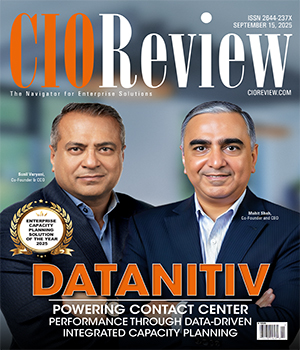
The edition also features Datanitiv, a workforce planning company that helps contact centers move beyond error-prone spreadsheets with Capability, its purpose-built capacity planning platform.
We hope this edition helps you gather valuable insights into the innovations and best practices shaping the future of enterprise technology and empowering organizations to operate with greater agility, resilience and intelligence.
