-
Technology
-
Industry
-
Solutions
-
- ASSET MANAGEMENT
- CUSTOMER EXPERIENCE MANAGEMENT
- CYBER SECURITY
- DATA CENTER
- DOCUMENT MANAGEMENT
- ELECTRONIC DATA INTERCHANGE
- ENTERPRISE DATA MANAGEMENT
- ENTERPRISE RESOURCE PLANNING
- ENTERPRISE RISK MANAGEMENT
- ENTERPRISE-GRADE WEB DATA SOLUTIONS
- FACILITY MANAGEMENT
- FIELD SERVICE
- IDENTITY AND ACCESS MANAGEMENT
- INFRASTRUCTURE
- IT SERVICE MANAGEMENT
- MANAGED IT SERVICES
- PAYMENT AND CARD
- PROJECT MANAGEMENT
- SOFTWARE TESTING
- STORAGE
- VIDEO SOLUTIONS
- WORKFLOW
-
-
Platforms
-
Functions
- Leadership Perspectives
- Innovation Insights
- Research
- Magazines
- News
- CXO Awards











Contributory Virtus Investment Partners on the invitation from our Editorial

VOZIQ
Kalyan Banga, Director Research and AnalyticsHow Predictive Analytics In Contact Centers Can Improve Your Customer Retention?
Kalyan Banga, Director Research and Analytics

So, how can companies ensure that their customers feel valued and keep using their product or service?
A Contact Center is Critical in Shaping Customer Experience
What drives the customer sentiments towards a business? Our research using sentiment analysis of social media mentions how different brands confirmed that overall positive mentions of a company show a strong correlation to the positive mentions of “customer service” of that company. The following graph shows this correlation for various industries.
“Applying predictive analytics to mining contact center interactions uncovers new opportunities to approach customer retention effectively”
How to Ensure that Contact Centers Drive Customer Retention
The answer to this question lies in the interactions that happen at the contact center. The contact center is the most visible and approachable part of any business for a customer. Over the course of the customer’s journey, he or she approaches the contact center multiple times, for multiple reasons, and via a multitude of channels like emails, website chats, customer service calls and so on. Through all these interactions, customers voice their concerns, share their experiences, give their feedback or register complaints. Further, the customers also expect to get a satisfactory response when they contact the business.
All these interactions are a treasure trove of data about the needs and wants of the customers, their behaviors, pain points and expectations. If mined properly, these interactions reveal very crucial insights about the intention and behavior pattern of customers.
Typical Retention Approach – Performance Management
The typical retention program companies deploy are reactive in nature. When encountered with a customer who wants to cancel their services, the call is typically routed to a ‘save desk’ which creates an offer for the customer and tries to win them back. By managing the performance of the save desk agents with various training and coaching tools, contact centers aim to keep customer retention numbers high. However a segment of customers can never be saved with this approach if they already signed up with a competitor before the save desk attempts to retain them.
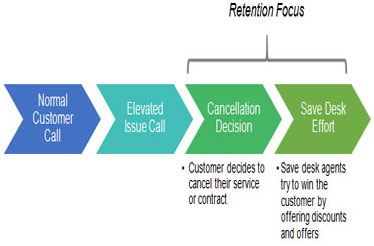 If we inspect typical activities that happen prior to a customer deciding to cancel, typically a customer calls to get their issue resolved from the service side of the contact center. Over a period of time, some issues are still left unresolved, resulting in dissatisfied customers. Often even these disgruntled customers give the company a chance, and express their dissatisfaction in their calls and expect quick resolution to their issue. However, if the issues this customer is facing are unresolved after a few calls, he or she finally decides to cancel the services and switch to a competitor. Until this point, call centers make no differentiation between this customer and others. When an actual cancellation request surfaces, the customer is then routed to the save desk. This team is responsible for convincing the customer to stay with the company by offering special discounts and deals, which is often a very expensive way to retain customers.
Besides the cost of retention issues, it might also be too late to ensure that the customer is retained at the time the save desk makes an offer. The focus here is on trying to minimize the customer churn, which is a reactive and less effective approach because the customer has already decided to cancel prior to this, and in some cases, they might’ve already signed up with another service provider.
A Better Approach –Predictive Customer Retention
Applying predictive analytics to mining contact center interactions uncovers new opportunities to approach customer retention effectively.
Identifying a dissatisfied customer
All the interactions a customer has with a contact center have enough clues about their satisfaction or dissatisfaction. Typically businesses fail to leverage these interactions as a source of customer intelligence. Predictive analytics enables identifying these clues and categorizes the customer as ‘satisfied’ or ‘dissatisfied’ based on the their previous interactions, and then assigns a propensity to churn score. Typically,the following are the indicators of an at-risk customer:
• Large number of calls
• Expression of dissatisfaction
• Competitor mentions and comparisons
• Enquiry of alternative price plans
• Customer experience issues
Using interaction analytics and predictive churn modelling, a churn score can be created for each customer based on dissatisfaction identifiers like the ones mentioned above. When the churn score is above a pre-defined value, the customer is tagged and then various recovery efforts can be made either within the contact center as part of future interactions or, even better, a proactive outreach to the customer to resolve their issue.
Proactive customer retention strategy
The next time a customer calls, the call is automatically routed to expert agents with higher skills and empowerment on the basis of churn scores. With their skills in empowerment, empathy, resolution abilities and communication skills, the agent stands a better chance of offering a satisfactory solution to the customer. Note that this effort takes place even before the customer decides to cancel the service.
As you can see, the customer retention approach becomes proactive instead of reactive with the application of predictive analytics. The proactive retention efforts aim at identifying a dissatisfied customer and offering a timely solution to his or her concerns before it is too late. These programs can be implemented with very little additional cost, with intelligent segmentation and routing within the call centers based on risk scores.
Improving customer experience
Big data analysis of the customer interactions has another benefit – fine tuning operations to enhance customer experience. With the approaches discussed above, not only do customer churn scores go down, but other contact center KPIs such as satisfaction scores, first contact resolution scores, etc., typically increase as well resulting in a good return on investment (ROI).
In addition to improving contact center specific KPIs, this same intelligence from contact centers can identify the drivers of customer experience and the root causes behind them, as most customer experience issues lead to a contact center interaction. These insights into the customer experience help the contact centers to collaborate with other business units with clear action plans to enhance the overall customer experience across many other touch points without involving contact centers.
Takeaway
Even a small reduction in customer churn leads to a considerable impact on the bottom-line by helping companies retain their valuable customers. Further, proactive engagement also leads to increased customer satisfaction levels. Dynamic and proactive customer retention strategies based on predictive analysis go a long way to increase the effectiveness of your customer retention drive by enabling enterprise-wide actions.
The articles from these contributors are based on their personal expertise and viewpoints, and do not necessarily reflect the opinions of their employers or affiliated organizations.
EDITOR'S Choice

Fortune Brands Innovations [NYSE: FBIN]
By Juan Guerrero, Director, IT Audit & Data Analytics
The IT Audit Evolution: From Compliance to Strategic Intelligence
Broad River Retail
Wes Dudley, Senior Vice President, Customer Experience
Customer Experience in the Age of Amplified Complexity
Fortune Brands Innovations [NYSE: FBIN]
Scott Barnes, Sr. Director of Enterprise Cyber Security (CISO)
The X-Factor in Cybersecurity: AI and Automation at Work

LHarris Technologies [NYSE: LHX]
Brian Allred, Director of Business Intelligence and Analytics
The Shift from Rigid Dashboards to Conversational Analytics
Ivar's Restaurants
Patrick Yearout, Director of Innovation, Recruitment & Training
From Hiring to Development: Nurturing Teams that CareLatest Issues


