-
Technology
-
Industry
-
Solutions
-
- ASSET MANAGEMENT
- CUSTOMER EXPERIENCE MANAGEMENT
- CYBER SECURITY
- DATA CENTER
- DOCUMENT MANAGEMENT
- ELECTRONIC DATA INTERCHANGE
- ENTERPRISE DATA MANAGEMENT
- ENTERPRISE RESOURCE PLANNING
- ENTERPRISE RISK MANAGEMENT
- ENTERPRISE-GRADE WEB DATA SOLUTIONS
- FACILITY MANAGEMENT
- FIELD SERVICE
- IDENTITY AND ACCESS MANAGEMENT
- INFRASTRUCTURE
- IT SERVICE MANAGEMENT
- MANAGED IT SERVICES
- PAYMENT AND CARD
- PROJECT MANAGEMENT
- SOFTWARE TESTING
- STORAGE
- VIDEO SOLUTIONS
- WORKFLOW
-
-
Platforms
-
Functions
- Leadership Perspectives
- Innovation Insights
- Research
- Magazines
- News
- CXO Awards











Contributory Virtus Investment Partners on the invitation from our Editorial

Harte Hanks
Shirish Lal, COO and CTOMarketing Disruption: Role of the CIO
Shirish Lal, COO and CTO

The last 5 years has seen a dramatic change in CMO’s engagement in technology decisions. From Gartner declaring the CMO will make more IT purchasing decisions than the CIO; to Accenture becoming the world’s largest digital agency; to a growth in the number of MarTech vendors from less than 500 to over 4,000—there has been a paradigm shift for CMOs.
We work with more than 50 marketing departments at Harte Hanks, and we have come to believe that the companies with a strong partnership between the CIO and CMO will be most successful in managing this disruption in the marketing function.
The Evolution of CRM
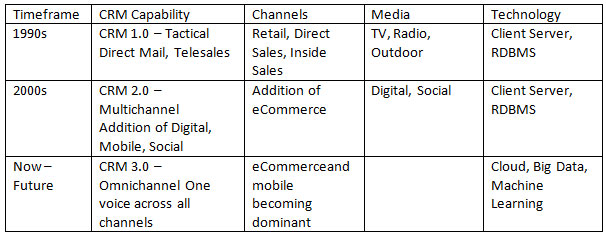
This table shows our view of the evolution of marketing and what we believe will emerge as CRM 3.0 in next few years.
The traditional marketing model in which big brands relied on branding and control of “shelf space” is changing rapidly. An example is Nike’s decision to begin selling their products on Amazon despite not being able to display their product the way they wanted the Nike brand presented. We are working with many companies that are facing the realization that the retailer or dealer is not going to be the customer going forward. Brands need to have a one to one relationship directly with the customer. Even companies selling via direct sales to enterprise clients tell us most customers have done their research on the web prior to any discussion with a sales representative.
 The challenge for marketers is that prospects are directing their own individual purchasing journeys, often leveraging digital and social for research and other influencers, even if they do not buy online. While brands will always be important, there will be no putting the “genie back in the bottle.” Customers are driving the purchasing process, and marketers are at the mercy of a free-for-all environment in digital and social. This puts the marketer in the position of having to understand individual customers and their stage of buying process and be able to deliver compelling content and offers at the right time, in the right outlet. Very few companies we have worked with have the technical and data infrastructure to deliver on this challenge.
 The traditional marketing model in which big brands relied on branding and control of “shelf space” is changing rapidly.
A Partnership is Required for Success
We believe the journey to CRM 3.0 is best undertaken with a partnership between the CIO and CMO. CRM 3.0 immediately resonates with most CMOs we have spoken to, but they do not have the technical knowledge to lay out a roadmap for how to build systems and data architecture (which they must do while also delivering value at each step along the way). Most CMOs are under pressure to achieve short-term results and cannot make a long-term investment that does not have near-term returns.
CIOs will need to take on the challenge of marketing disruption with the following approaches:
• Partner with the CMO—It is critical for the CIO and CMO to develop a common view of the direction of the marketing function and the type of architecture required to support the function. We believe this should include the CIO helping the CMO envision what is possible with new technologies, such as Hadoop, Spark, Cloud, etc.
• Focus on Marchitecture and Integration—The one certainty in the market is that there will continue to be tremendous innovation and change in martech space. We believe the ability to rapidly integrate and take advantage of new martech can be a core advantage for a company. But, the company must build a flexible marketing architecture that allows for ongoing integration of new technology. It also means the focus should be on building the right marchitecture and leveraging market innovation, rather than building custom solutions.
• Help CMOs Evaluate MarTech Options—With over 3,000 martech providers in the latest Lumascape, it is very difficult for most CMOs to keep up with the latest technologies available to accelerate the marketing function. During my time as CMO of CenturyLink, my marketing department identified and deployed several marketing technologies that had significant impact on our go-to-market performance. The best model is for the CIO to be an adviser to CMO on the latest technology trends in martech and which of those would help the marketing organization accelerate performance, while moving the company to its longer term marchitecture vision.
Key Investments for CRM 3.0
As the CIO/CMO partnership works toward achieving CRM 3.0 from a systems perspective, it will be critical to include the following investments:
• Business Intelligence Engine–The key foundation for CRM 3.0 is having a database and analytics engine that allows marketers to collect, analyze, and act upon large quantities of data about customers and prospects. This data should include both first party and third party structured and unstructured data. There are several key aspects to an architecture to allow for CRM 3.0:
• Supports Real-time Processing—Timely business Intelligence should drive point of sale interactions, as well as marketing tactics.
• Flexibility to Ingest New Data Sources— Sources of third party data, and potentially first party data, can change rapidly. It is important not to be tied into an inflexible data schema.
• Scalability—The ability to scale up and down quickly is an important part of giving marketing the flexibility necessary for testing and adding new sources of data.
• Data Prep and Analytics Automation— One of the challenges we see with many marketing departments is that they are spending 80 percent of their time on data prep and running core analytics and only 20 percent in real analysis. We believe the BI platform has to do more of the data preparation so 80 percent of time can be spent on real analysis.
• AI/Machine Learning—With the amount of potential data, including both structured and unstructured, AI and machine learning will be a necessary tool for finding valuable insights—rather than just relying on human driven analytics.
At Harte Hanks, we have partnered with Opera Systems, which has built a BI platform on top of cloud, Hadoop/ Spark, and major analytics engines such as SAS and R, to provide customers the capabilities outlined above.
• Front Office Middleware and Engagement Engine—This element integrates across all channel systems and provides an abstraction layer for orchestrating cross-system customer journeys. With centralized logic and unified data from all channels and systems, companies can both understand and rapidly optimize the customer experience. And by moving business logic out of point solutions and into an integrated layer for orchestration, companies can easily adopt new technologies as they emerge.
Harte Hanks has partnered with Usermind to provide this functionality for our customers.
• Legacy Systems—To provide coordination with legacy go to market systems, it is critical that IT makes the investment to build a services layer into legacy systems that allows interaction with a front office middleware capability, rather than trying to build additional business logic into legacy systems.
Harte Hanks has partnered with Wipro to provide a broad set of capabilities to maintain and support Legacy Systems across a wide variety of environments.
The End Result
The ultimate goal of evolving toward CRM 3.0 is that marketers will be able to use these more advanced and connected technologies and data to bring the human touch back to marketing. By optimizing customer experience and building toward the right vision and architecture, the CIO/ CMO partnership can have the best of both worlds: delivering short-term improvements and returns while making a more profound impact as the company journeys closer to the ideal.
The articles from these contributors are based on their personal expertise and viewpoints, and do not necessarily reflect the opinions of their employers or affiliated organizations.
EDITOR'S Choice

Fortune Brands Innovations [NYSE: FBIN]
By Juan Guerrero, Director, IT Audit & Data Analytics
The IT Audit Evolution: From Compliance to Strategic Intelligence
Broad River Retail
Wes Dudley, Senior Vice President, Customer Experience
Customer Experience in the Age of Amplified Complexity
Fortune Brands Innovations [NYSE: FBIN]
Scott Barnes, Sr. Director of Enterprise Cyber Security (CISO)
The X-Factor in Cybersecurity: AI and Automation at Work

LHarris Technologies [NYSE: LHX]
Brian Allred, Director of Business Intelligence and Analytics
The Shift from Rigid Dashboards to Conversational Analytics
Ivar's Restaurants
Patrick Yearout, Director of Innovation, Recruitment & Training
From Hiring to Development: Nurturing Teams that CareLatest Issues


