-
Technology
-
Industry
-
Solutions
-
- ASSET MANAGEMENT
- CUSTOMER EXPERIENCE MANAGEMENT
- CYBER SECURITY
- DATA CENTER
- DOCUMENT MANAGEMENT
- ELECTRONIC DATA INTERCHANGE
- ENTERPRISE DATA MANAGEMENT
- ENTERPRISE RESOURCE PLANNING
- ENTERPRISE RISK MANAGEMENT
- ENTERPRISE-GRADE WEB DATA SOLUTIONS
- FACILITY MANAGEMENT
- FIELD SERVICE
- IDENTITY AND ACCESS MANAGEMENT
- INFRASTRUCTURE
- IT SERVICE MANAGEMENT
- MANAGED IT SERVICES
- PAYMENT AND CARD
- PROJECT MANAGEMENT
- SOFTWARE TESTING
- STORAGE
- VIDEO SOLUTIONS
- WORKFLOW
-
-
Platforms
-
Functions
- Leadership Perspectives
- Innovation Insights
- Research
- Magazines
- News
- CXO Awards











Contributory Virtus Investment Partners on the invitation from our Editorial

and Board Member Ashling Partners
Daniel Mahlebashian, Retired General Motors, Global Senior Executive (Executive Director, GBS and Chief Contracting Officer IT & BPO), Board Member World Commerce and ContractingThe CIO's role has evolved, stimulating a transformation of the CPO organization, including Sourcing, Procurement, Supply Chain, and Commercial Management
Daniel Mahlebashian, Retired General Motors, Global Senior Executive (Executive Director, GBS and Chief Contracting Officer IT & BPO), Board Member World Commerce and Contracting

In this second section of our two-part article, we continue to examine how the evolving role of the CIO is stimulating a transformational change in the role of the CPO and their organization. Let's continue our discussion around the transformation of the CPO organization, starting with using Global Business Services as a lever.
Global Business Services (GBS)
GBS at GM (used as an example) encompasses all Back and Middle Office work activities across Purchasing, Supply Chain, Manufacturing, Finance, and HR. It is global and in place for 6+ years. Typical of GBS operations, it delivers cost savings via consolidation, standardization, and labor arbitrage. The capability of the operation starts to deliver further value via digitalization. Starting with single task RPA applications, these bots automated manual work in terms of "what" and "how" work was done. The capability was further matured via end-to-end automation. Request to Pay, Invest to Divest, Record to Report, Hire to Exit, etc. This Intelligent Automation further evolved to Smart Manufacturing automations. Consolidated together, the goal was the optimization of operational effectiveness and cost-efficiency. The vision looking ahead is to expand the digital footprint to include Cognitive and AI capabilities. This evolving environment is depicted in figure 7.
 Transition to the transformed new world of Sourcing, Purchasing, Supply Chain, and Commercial Management requires our people to make appropriate adjustments to skill sets and focus
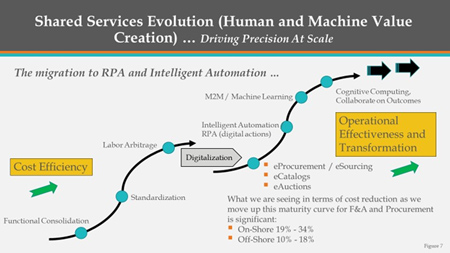 The key is GBS, and its automation was leveraged to transform the underlying operating functions, e.g., Purchasing, Supply Chain, Finance, etc. The cost take-out delivered was significant. Next up, automation across Strategic Sourcing, Procurement, and Commercial Management.
Procurement, Supply Chain, Commercial Management Digitalization / RPA / Intelligent Automation Use Cases
The next area of automation looks at examples across the end-to-end Strategic Sourcing. A process where at GM Digitalization, RPA and Intelligent Automation solutions were deployed to automate manual work activities. Figure 8 shows this. Done mostly inside GBS, every component of these processes had elements of automation applied. If the work was rules-based, process-oriented, and manual, it became an automation candidate. Examples include Category Management, Supplier Selection (e.g., "Scoutbee" software), Contract Management, Placing and Receipting Orders, SRM, Item Master, Request-PO-AP Processing, etc. This digitalization drove improvements in cost efficiency and operational effectiveness. Resources “mined” by the digitalization actions, becoming available capacity, were for the most part re- skilled / re-prioritized to more value-added work (SRM, Strategic Sourcing, Data Analytics, etc.). However, in some cases, the excess capacity was exited from the organization.
 These actions helped transform the Commercial Management, Sourcing, Procurement, Finance functions. Remember transformation across three impact areas – what works, how performed, and how consumed. Our next area of transformation is Supplier Innovation and Collaboration.
Supplier Collaboration and Innovation
Next up, in transforming the CPO role and associated organization, including Commercial Management, Sourcing, and Procurement, our focus is on Supplier Collaboration and Innovation. 5 elements to focus in on as reflected in Figure 9.
1. Supplier Account Management – Fostering strategic Supplier partnerships aligned with company objectives is critical. Suppliers must be aligned with your company's strategic objectives and areas of focus. Think also about data transparency. Your data and information access transparency should align with what you are charging your Suppliers to deliver.
2. Innovation Management – Working closely with strategic Suppliers to identify a sustained level of innovation opportunities, including rapid deployment. As more work is “sourced," innovation coming out of that external environment becomes a bigger, more impactful portion of overall innovation capability. Important you and your Suppliers are aligned on this.
3. Innovation Sourcing – You are not buying a commodity-based on an input-focused contracting model. Rather, you are sourcing for outcomes. Outcomes aligned with your company’s strategic objectives. Focus on sourcing for innovation. Regarding the long term, sustainable impact on your business, sourcing for innovation is perhaps the most important element of your sourcing objectives.
4. Supplier Capability Management – Working with your strategic Suppliers to ensure their capabilities keep pace with the rapid level of change your company is going through. Applies to people skills, infrastructure, software currency, emerging technology, capacity, etc.
5. Supplier Eco-Systems – In today’s sourcing environment, the days of 1:1 Supplier relationships are gone. Today, you need to ensure your strategic 1:N Supplier base is integrated to deliver your company objectives. Integrated across process, technology, and people.
 A couple of key points to keep top of mind. One, concentrate on an enterprise approach focused on delivering business speed and growth through managing the extended innovation network, including Suppliers. Two, effective SRM programs deliver tangible, realized business value, including better Pricing, Resources, Quality, and access to emerging innovation (refer to the graph below).
The future of Procurement, Sourcing & Commercial Management starts to look a lot different. Figure 10 depicts this.
The focus needs to shift from Compliance and Savings Measurement to Transparency, Alignment, Growth, Collaboration, and Innovation. Further, Purchasing and Legal must become more astute in their use of contracting and compensation types/models, flexibility over terms, risk assignment, etc. That should be by design, not by individual negotiation. They need to grasp that compliance, a primary pre- transformation legacy focus, is often imposed at the cost of quality, speed, innovation, benefits realization, etc. As the CPO role and organization transform to the future, these adjacent components should come first (whether the quality of the product, process, people, etc.), and compliance is then undertaken in an intelligent context.
Let’s shift our attention to Supply Chain Transformation.
24x7 Digitalization of The Supply Chain - Considerations
The last topic regarding transformation of the CPO role and organization is digitalization of Supply Chain processes and associated work. Five areas of focus are in Figure 11.

Planning – Specifically Sensing and Responding. Event-driven based on internal and external data sources. Using analytics to “sense” shifts in demand and supply. The objective is to minimize reliance on "calendar driven" processes.
Procurement – Leveraging insights into opportunities. Real-time spend analytics. Source to pay solutions, including leveraging supplier networks. Mobile solutions providing spend, supplier, and market insights. Data and information are key enablers. Part of our transformation strategy should be establishing the right amount of transparency around our company data and information relevant to what we charged our Suppliers to deliver.

Manufacturing – Digitalizing the plant environment. M2M learning. Predictive maintenance on equipment based on sensors measuring capacity & usage.
Inventory – Intelligent warehouse. Sensors, RFID tags to track material movement.
Fulfillment – Connected Transport. Analytics to optimize Fleet Management. Sensors/Devices (e.g., container automation) to track goods movement.
Storage – Warehouse function properly integrated across the environment. Automation across materials tracking and product movement plus Data and Information Analytics. Don’t forget Mobility devices (e.g., wireless bar code scanners) to direct pick & stage activity.

The realization of business benefits enabled by Supply Chain digitalization efforts is significant. See Figure 12. These business benefits fall into four value realization categories. Greater Profitability, Better Quality, Better Customer Service, and Improved Working Capital.
Lastly, we can’t forget the people aspect of this transformation of the CPO role and organization.
Do Not Forget the Human Capital Aspect … Moments That Matter
Business success stems from the successful marriage of people and technology. Transition to the transformed new world of Sourcing, Purchasing, Supply Chain, and Commercial Management requires our people to make appropriate adjustments to skill sets and focus. Our role as leaders is to help prepare for this transformation. It is important we give our people an opportunity to embrace the disruptive change covered here. Our team members' career moments, experiences, beliefs & behaviors manifest themselves into the results they deliver. Those results are critical to the success of the businesses we represent. Be conscious of this regarding the organizational change management routines you will be championing through the transformation. See Figure 13.
 Final Summary
In this two-part article dealing with the evolving role of the CIO and how it is stimulating a transformation of the CPO organization, we covered a lot. (1.) Disruption of status quo and the pace of change in our business environments; (2.) CIO role evolution, including a shift in focus to driving the realization of business benefit and outcomes; (3.) Transformation of the CPO role and organization and work related to Commercial Management, Sourcing, Procurement, and Supply Chain. Big topics, all of which will have a material impact on how we as sourcing, supply chain, and commercial professionals help enable the CIO organizations that we support. See Figure 14 for the key concepts.
The articles from these contributors are based on their personal expertise and viewpoints, and do not necessarily reflect the opinions of their employers or affiliated organizations.
EDITOR'S Choice

Fortune Brands Innovations [NYSE: FBIN]
By Juan Guerrero, Director, IT Audit & Data Analytics
The IT Audit Evolution: From Compliance to Strategic Intelligence
Broad River Retail
Wes Dudley, Senior Vice President, Customer Experience
Customer Experience in the Age of Amplified Complexity
Fortune Brands Innovations [NYSE: FBIN]
Scott Barnes, Sr. Director of Enterprise Cyber Security (CISO)
The X-Factor in Cybersecurity: AI and Automation at Work

LHarris Technologies [NYSE: LHX]
Brian Allred, Director of Business Intelligence and Analytics
The Shift from Rigid Dashboards to Conversational Analytics
Ivar's Restaurants
Patrick Yearout, Director of Innovation, Recruitment & Training
From Hiring to Development: Nurturing Teams that Care


