-
Technology
-
Industry
-
Solutions
-
- ASSET MANAGEMENT
- CUSTOMER EXPERIENCE MANAGEMENT
- CYBER SECURITY
- DATA CENTER
- DOCUMENT MANAGEMENT
- ELECTRONIC DATA INTERCHANGE
- ENTERPRISE DATA MANAGEMENT
- ENTERPRISE RESOURCE PLANNING
- ENTERPRISE RISK MANAGEMENT
- ENTERPRISE-GRADE WEB DATA SOLUTIONS
- FACILITY MANAGEMENT
- FIELD SERVICE
- IDENTITY AND ACCESS MANAGEMENT
- INFRASTRUCTURE
- IT SERVICE MANAGEMENT
- MANAGED IT SERVICES
- PAYMENT AND CARD
- PROJECT MANAGEMENT
- SOFTWARE TESTING
- STORAGE
- VIDEO SOLUTIONS
- WORKFLOW
-
-
Platforms
-
Functions
- Leadership Perspectives
- Innovation Insights
- Research
- Magazines
- News
- CXO Awards







Contributory Virtus Investment Partners on the invitation from our Editorial

Nordstrom
Jayabindu Singh, Vice President - Supply Chain TechnologyThe Industrial Automation Analogy will make you confidently wrong about AI
Jayabindu Singh, Vice President - Supply Chain Technology

You've probably heard this framing in a leadership meeting:
It's a reasonable thing to say. It's not wrong, exactly. And that's the problem.
The industrial automation analogy is just coherent enough to feel like a mental model while quietly setting you up for the one failure mode AI is most prone to: outputs that look right, read right, and are wrong in ways you won't catch until it's too late.
This isn't a piece about whether the analogy is useful. It is, in limited ways. This is a piece about what happens when leaders stop there, and why the cost of stopping there is invisible until it isn't.
The Analogy Earns Its Appeal
Industrial automation only scaled when processes were standardized and inputs were controlled. Feed an automated system ambiguous raw material and you get defective output. That logic does transfer: AI amplifies input quality, and unclear intent gets scaled, not resolved.
So the instinct to tighten inputs before deploying AI is correct. The mistake is thinking that's the whole problem.
What Industrial Automation and AI Don't Share—And Why It Matters
In industrial automation, if something goes wrong, you know. There's a jam. A defect. Downtime. The failure is visible, often loud.
AI fails quietly.
Feed a model a well-structured, clear prompt and you will get a well-structured, coherent output. It will read confidently. It will look like the right answer. It may be subtly, consequentially wrong, and nothing in the output will tell you that.
This is the failure mode the industrial automation analogy obscures. Automated industrial systems are deterministic: same input, same output, variance is a defect. AI is probabilistic. Even identical inputs produce a range of plausible outputs, and “plausible” is not the same as “correct.” Correctness is contextual. And context is often exactly what the model doesn't have.
This distinction matters for how you build AI processes. An industrial automation mindset tells you to eliminate variance. An AI mindset tells you to ask: how will we know when the output is wrong? Those are completely different problems, and only one of them gets solved by standardizing inputs.
What You Can't Specify Upfront
The industrial automation analogy also assumes inputs are fully specifiable. In traditional automated systems, they are dimensions, tolerances and sequences.
In product development, many of the most important inputs encode judgment, values and intent. Questions like “what's an appropriate response here?” or “what risk is acceptable in this context?” aren't defined once and handed to a system. They're discovered, renegotiated and often only understood clearly after you've seen a few outputs you didn't want.
 AI works best when inputs are clearly defined and standardized— just like industrial automation.
Over-standardizing these inputs too early doesn't produce reliability; it strips away the signal you were trying to amplify. You end up with consistent outputs that answer a slightly different question than the one that actually mattered.
Human judgment in AI workflows isn't a temporary gap you'll close with better prompt engineering. It's structural.
AI Learns. Your “Standardized Input” Won't Mean The Same Thing Next Quarter.
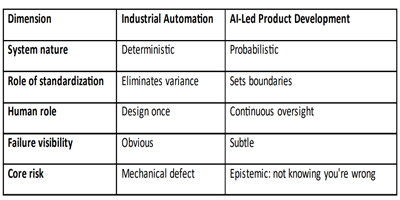 There's one more place the analogy breaks that rarely comes up in leadership discussions: industrial automation doesn't change on its own. The system you standardized around this year is the same system next year. Process improvement happens outside the system through Lean, Six Sigma, and deliberate redesign.
AI systems adapt. Models get fine-tuned. Prompts evolve. Feedback loops shift behavior. The output distribution for a given input today may be meaningfully different six months from now, without any visible process change triggering that shift.
This makes AI governance a continuous practice, not a onetime standardization effort. The instinct imported from industrial automation thinking “define it well once, then monitor for deviation” doesn't hold. There's no stable baseline to deviate from.
A More Useful Mental Model
The industrial automation analogy positions AI as automation with better inputs. A more accurate framing is:
AI is augmented decision-making under uncertainty, and uncertainty doesn't get engineered away.
The shift in the last row is the one that matters most. Mechanical risk is manageable with the right process design. Epistemic risk requires a different capability entirely: the organizational habit of asking "how do we know this output is right?" as a standard step, not an exception.
What This Means If You're Building AI-Assisted Workflows Right Now
Clear inputs are necessary. But they're not sufficient. Beyond input quality, AI success requires:
• Distinguishing exploration from execution: Ambiguity is a defect in industrial automation and sometimes the entire point in early product development. Ideation, discovery, hypothesis generation—these phases need AI workflows that invite range, not pipelines that compress it. Treating them like execution stages produces outputs that look consistent and miss the point.
• Building evaluation into the process, not onto it: If the only quality check is human review of final outputs, you're catching failures late and learning nothing about why they happened. Evaluation needs to be embedded, not appended.
• Accepting that human accountability doesn't reduce over time: The industrial automation model implies humans step back as automation matures. In AI-assisted product development, the decisions AI informs tend to become more consequential as adoption scales. Which means human judgment doesn't recede; it shifts to higher-stakes moments.
Industrial automation is optimized for certainty. It succeeded by eliminating the conditions where it could be wrong.
AI product development operates in exactly those conditions, and succeeds by getting better at knowing when it might be.
Leaders who import the industrial automation model wholesale will over-invest in input standardization and underinvest in the harder capability: building organizations that can tell the difference between an AI output that's right and one that just looks like it.
The articles from these contributors are based on their personal expertise and viewpoints, and do not necessarily reflect the opinions of their employers or affiliated organizations.
EDITOR'S Choice

Fortune Brands Innovations [NYSE: FBIN]
By Juan Guerrero, Director, IT Audit & Data Analytics
The IT Audit Evolution: From Compliance to Strategic Intelligence
Broad River Retail
Wes Dudley, Senior Vice President, Customer Experience
Customer Experience in the Age of Amplified Complexity
Fortune Brands Innovations [NYSE: FBIN]
Scott Barnes, Sr. Director of Enterprise Cyber Security (CISO)
The X-Factor in Cybersecurity: AI and Automation at Work

LHarris Technologies [NYSE: LHX]
Brian Allred, Director of Business Intelligence and Analytics
The Shift from Rigid Dashboards to Conversational Analytics
Ivar's Restaurants
Patrick Yearout, Director of Innovation, Recruitment & Training
From Hiring to Development: Nurturing Teams that CareLatest Issues