-
Technology
-
Industry
-
Solutions
-
- ASSET MANAGEMENT
- CUSTOMER EXPERIENCE MANAGEMENT
- CYBER SECURITY
- DATA CENTER
- DOCUMENT MANAGEMENT
- ELECTRONIC DATA INTERCHANGE
- ENTERPRISE DATA MANAGEMENT
- ENTERPRISE RESOURCE PLANNING
- ENTERPRISE RISK MANAGEMENT
- ENTERPRISE-GRADE WEB DATA SOLUTIONS
- FACILITY MANAGEMENT
- FIELD SERVICE
- IDENTITY AND ACCESS MANAGEMENT
- INFRASTRUCTURE
- IT SERVICE MANAGEMENT
- MANAGED IT SERVICES
- PAYMENT AND CARD
- PROJECT MANAGEMENT
- SOFTWARE TESTING
- STORAGE
- VIDEO SOLUTIONS
- WORKFLOW
-
-
Platforms
-
Functions
- Leadership Perspectives
- Innovation Insights
- Research
- Magazines
- News
- CXO Awards


Contributory Virtus Investment Partners on the invitation from our Editorial

Slotozilla
Why User Trust Beats User Acquisition in 2026
Why Digital Businesses Prioritize User Trust in 2026
In 2026, digital growth is no longer only about bringing in more users. Acquisition still matters, but companies are paying more attention to retention, privacy, reputation and the experience people have after they sign up. A user who does not trust a brand will leave quickly, ignore future offers or warn others, so trust has become part of the growth strategy itself.
https://pixabay.com/photos/trust-arrangement-shaking-hands-3031679/
Why User Trust Became a Competitive Advantage
Trust can be strongly linked to purchases, overall engagement, and loyalty. A formula for purchase intentions is r = 0.67, p < 0.001. Another important formula is brand loyalty, with β = 0.58 and p < 0.001. Trust also affects customer engagement, which can fuel potential profit.
Modern users judge brands through several signals at once, including privacy, security, clear pricing, customer support and honest communication. Overall, it must provide security, communicate transparently, and maintain unique relationships.
The Problems With “Growth at Any Cost” Strategies
Aggressive growth-driven strategies are a common mistake some businesses make even today. Just some of the main issues this can cause include:
• Reputational damage.
• Regulatory risk.
• Ad fatigue.
• Misaligned expectations.
The mismatch between what business owners think and how customers feel is never on the same page. For example, 79% of the brand leaders claim that customers trust that brand. However, only 52% of those same customers reported that this is the case.
Things don't get any better if we look at how many consumers are concerned about their data. Over 57% think brands are selling their data, and most of them are right. 62% of users are worried that their personal details may be exposed in a data breach.
How Digital Businesses Build User Trust in 2026
Before a user signs up, price is rarely the only question. People also look for deposit size, withdrawal rules, fees, limits and anything that could make the service more expensive than it first looks. The low-deposit casino pages on Slotozilla show how clear information about small-entry gambling options can reduce confusion before a player chooses an operator. Users react the same way in subscription apps, delivery services and SaaS products. A SaaS product loses trust quickly when users notice extra fees or awkward cancellation rules too late.
https://pixabay.com/photos/game-ball-coordination-trust-2882474/
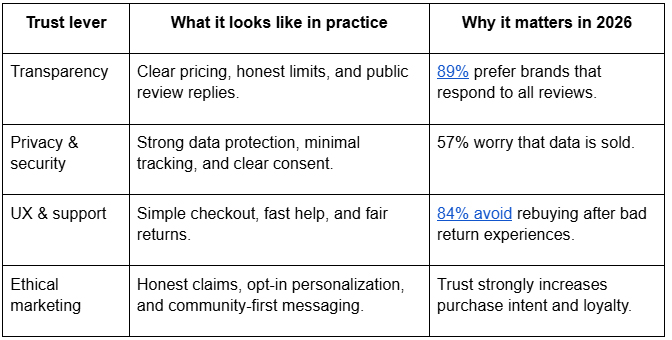
People in 2026 are interested in two-way relationships that are honest and consistent. Many brands have been using a few trust levers to build and maintain that same trust. The following table shows the main methods used nowadays.
As you can see, fake claims, overpromoted, and annoying ads don't work anymore. Many of the brands that have used these tricks are now exposed, and they have lost the customer’s trust.
Transparency and Honest Communication
Users want to see the real price, delivery terms, cancellation rules, return conditions and limits of the product before they commit. Public review replies also matter because they show how a brand behaves when something goes wrong. If most positive and negative reviews are responded to, it's likely that around 89% of users will work with that business. In general, over 91% of users will check the online reviews before making a decision.
Better Privacy and Data Protection
Over 62% of people believe that their data is not secure and may be exposed in a data breach. About 57% of online users believe companies are selling their personal information. Spam emails, unwanted calls and major breach stories make users more cautious, even when they cannot see exactly how their data moved between companies.
The best thing they can do is to invest in security and clear data practices. In addition, they should share this information with consumers. As a matter of fact, security, privacy, and data quality, paired with AI and overall reputation, are among the main factors affecting consumer trust in 2026.

User Experience and Customer Support
Good UX builds trust when users can complete key actions without confusion. In e-commerce, that may mean clear delivery and return steps. In SaaS, it may mean easy cancellation and transparent billing. In gambling, finance or subscriptions, it may mean visible limits, account controls and fast support.
Users are also looking for brands that deliver their goods to the doorstep. If delivery is unavailable, most consumers will just leave and buy elsewhere. This is another proof that UX, paired with needed features, is essential for building and maintaining trust with users.
Additionally, live chat customer support is more than just needed. Over 41% of online users prefer live chat to email or phone. This allows them to get assistance in minutes and resolve the issue. It also proves that the brand cares about them.
Ethical Marketing and Community Building
Ethical marketing refers to offering ads that are honest and don't overpromise just to sell. Ethical marketing means the ad does not promise more than the product can deliver. It also means users can tell when content is sponsored, when personalization is being used and what they are agreeing to before they click. These are known to have short-term effects and generally affect the trust of users negatively.
 How Trust Influences Modern Digital Consumer Behavior
Brands that are not honest about the prices, features, usability, and the overall data usage are the first to lose consumers. People want and need brands that are honest and provide actual claims of their services or products.
If we add the aforementioned protection of the data, we can see that users tend to pick brands that are honest and reliable. At the same time, lower prices cannot repair trust if the product page, support or data practices feel misleading. If trust between the brand and the user is achieved and maintained for some time, it's more likely to stay present for ages. This translates into real, beneficial user retention.
Conclusion
Sustainable digital growth in 2026 depends less on chasing every possible sign-up and more on keeping users after the first interaction. Brands that explain prices clearly, protect data, answer problems quickly and avoid misleading claims have a better chance of turning new users into long-term customers. Acquisition still matters, but trust decides whether growth lasts.
The articles from these contributors are based on their personal expertise and viewpoints, and do not necessarily reflect the opinions of their employers or affiliated organizations.
EDITOR'S Choice

Fortune Brands Innovations [NYSE: FBIN]
By Juan Guerrero, Director, IT Audit & Data Analytics
The IT Audit Evolution: From Compliance to Strategic Intelligence
Broad River Retail
Wes Dudley, Senior Vice President, Customer Experience
Customer Experience in the Age of Amplified Complexity
Fortune Brands Innovations [NYSE: FBIN]
Scott Barnes, Sr. Director of Enterprise Cyber Security (CISO)
The X-Factor in Cybersecurity: AI and Automation at Work

LHarris Technologies [NYSE: LHX]
Brian Allred, Director of Business Intelligence and Analytics
The Shift from Rigid Dashboards to Conversational Analytics
Ivar's Restaurants
Patrick Yearout, Director of Innovation, Recruitment & Training
From Hiring to Development: Nurturing Teams that Care


