-
Technology
-
Industry
-
Solutions
-
- ASSET MANAGEMENT
- CUSTOMER EXPERIENCE MANAGEMENT
- CYBER SECURITY
- DATA CENTER
- DOCUMENT MANAGEMENT
- ELECTRONIC DATA INTERCHANGE
- ENTERPRISE DATA MANAGEMENT
- ENTERPRISE RESOURCE PLANNING
- ENTERPRISE RISK MANAGEMENT
- ENTERPRISE-GRADE WEB DATA SOLUTIONS
- FACILITY MANAGEMENT
- FIELD SERVICE
- IDENTITY AND ACCESS MANAGEMENT
- INFRASTRUCTURE
- IT SERVICE MANAGEMENT
- MANAGED IT SERVICES
- PAYMENT AND CARD
- PROJECT MANAGEMENT
- SOFTWARE TESTING
- STORAGE
- VIDEO SOLUTIONS
- WORKFLOW
-
-
Platforms
-
Functions
- Leadership Perspectives
- Innovation Insights
- Research
- Magazines
- News
- CXO Awards


Enterprises that have spent years running their businesses on SaaS are discovering new limitations as they bring AI into their operations. Critical data and automations remain scattered across platforms such as SAP, Oracle and NetSuite. Conventional integration tools are designed primarily to move information between them. That connectivity does not give an AI agent the business context needed to understand the broader process it is participating in or how to orchestrate work across the systems. LittleHorse provides a powerful action layer that allows enterprises to codify and orchestrate business processes across the SaaS applications they already use. Its Business-as-Code platform allows organizations to define how work should move across applications, AI agents and people, along with the context they need to participate in those processes. Rather than relying on the insufficient automation capabilities in individual platforms, enterprises can define how their own processes should operate across those systems. That control gives enterprises a way to move beyond the limitations imposed by their SaaS platforms. Companies that historically bought software can begin creating capabilities specific to the way they operate, without replacing their SaaS investments or maintaining a massive engineering organization. They can codify business logic around their own requirements, observe how processes perform and refine those capabilities as their needs evolve. "For years, enterprises adapted their business processes to fit the software they bought. Business-as-code reverses that relationship by allowing software to adapt to the business," says Colt McNealy, founder and managing member. Beyond Integration Toward Enterprise Orchestration Business-as-Code emerged from McNealy's experience building enterprise software for the real estate industry. The platform he worked on grew to more than 150 microservices alongside external SaaS applications such as Salesforce and Rippling. Individual workflows could involve several dozen microservices, making it difficult to track a process or understand what went wrong when something failed. Retries, circuit breakers, dead-letter queues and timeouts added further complexity. That experience led McNealy to develop the first part of the LittleHorse platform around reliable workflow execution across microservices and external integrations. "Agents make the decision, and then the deterministic process is orchestrated by the system." The same challenge appears for enterprises built around SaaS platforms. They may connect Salesforce to NetSuite or synchronize information between applications, yet those connections primarily govern data exchange, leaving the business process itself without a mechanism to manage its progression.
Digital Magazine
Top Cloud Optimization & Sustainability Platform 2026
As organizations invest more heavily in AI, cloud environments are becoming increasingly complex, placing greater demands on infrastructure and digital resources. This has made efficient resource utilization a strategic priority, with organizations seeking to eliminate digital waste and maximize the value of their existing cloud environments. OptiCloud is an AI-powered platform that enables organizations to do exactly that. Through what it calls digital sanitation and recycling the continuous identification and optimization of unnecessary digital resources the platform helps organizations uncover hidden inefficiencies across cloud and AI environments. Using organization-specific AI models and AI agents, it automatically executes approved remediation actions under human oversight, reducing cloud costs while improving resource utilization. Using read-only access, the platform securely connects to an organization's cloud environment, builds organization-specific models and analyzes massive volumes of operational data to uncover optimization opportunities while measuring cloud energy, water and emissions, as well as the energy and water associated with digital waste, in line with the latest ITU sustainability standards.

Top Identity Solutions For Humans And AI Agents 2026

Online identity once involved a comparatively simple decision of determining whether the person attempting to open an account or access a service was genuine. AI agents introduce a second question. When software claims to represent that person, how can a business verify both the relationship and the authority delegated to it? For more than a decade, Vouched has helped businesses solve human identity verification through remote identity verification. Today, it is extending that experience to help organizations establish trust in AI agents acting on behalf of people. “We help detect identity theft and fraud in scenarios from banking to healthcare, ensuring secure access while keeping verification simple and compliant for legitimate users,” says Peter Horadan, CEO. Building One Platform for Every Trusted Identity Horadan sees digital identity evolving in three forms that include physical IDs, government-issued digital credentials and AI agents acting on behalf of users. Vouched is expanding its identity capabilities to support all three, enabling organizations to adopt new credential types and AI-enabled interactions without replacing existing verification processes or deploying separate trust systems. Government-issued digital driver's licenses are already gaining traction, with California issuing approximately two million credentials and New York about one million. Organizations can begin accepting these digital credentials without redesigning onboarding journeys, allowing them to prepare for broader adoption while maintaining familiar verification experiences.
Top AI-Powered Strategic Data Solutions 2026
AI and ML applications have become increasingly accessible, allowing organizations to build production solutions on the same underlying technologies. Yet when models themselves are no longer the primary differentiator, the quality and relevance of input data become critical to creating accurate, reliable, and task-specific AI outcomes. Recognizing this reality, Numantic Solutions draws on its role as a full-stack data consultancy to engineer curated datasets that help production AI applications achieve stronger performance and meaningful differentiation in the market. The company approaches input data as an engineering discipline rather than a preliminary step in AI development. Combining automated data pipelines with subject-matter expertise helps organizations build, curate, and enrich the datasets behind customer-facing chatbots, recommendation engines, and automated decision-making systems. This approach gives organizations a structured way to turn existing information into task-specific data foundations for production AI applications, without relying solely on greater data volume. “We focus on improving input data because it offers one of the highest returns on investment for AI solutions, helping organizations leverage their unique subject-matter expertise to create better outputs,” says Stephen Godfrey, CEO.

Computer Systems Manufacturing Company Of The Year 2026

Unlike large Tier-1 manufacturers focused on mass-volume commodity PCs, Polywell Computers occupy a distinctly different space—one shaped by specialization, flexibility, and precision engineering. It operates in a niche where unique technical requirements meet agile production capabilities, enabling it to serve customers whose needs extend beyond off-the-shelf solutions, while the rest of the computing industry focuses on scaling and standardization. As Sam Chu, Founder and CEO, explains, “Our strength lies in serving customers who need specific functionality, reliability, environmental control, product supply lifecycle management, and rapid turnaround. These customers often operate projects too specialized for off-the-shelf products yet too small or too flexible for large-scale OEM programs.” This approach reflects Polywell’s broader philosophy of building systems around real operational demands rather than generic configurations. By closely understanding each client’s constraints—whether related to environment, connectivity, form factor, or lifecycle stability—the company delivers computing solutions that are both practical and purpose-built. In doing so, Polywell maintains its relevance in a rapidly evolving technological landscape defined by increasing complexity and customization. Evolution through Four Decades Founded in 1987, Polywell Computers has established itself as a stalwart in the specialized computing landscape, serving businesses, government agencies, and OEMs that require professional-grade solutions beyond the standard off-the-shelf PC. The evolution of Polywell Computers mirrors the broader trends in the computing industry. In its early years, the company catered primarily to individual users and general-purpose office computing. As market demands shifted toward industrial, embedded, and commercial applications, Polywell pivoted to develop systems that could withstand 24x7 operations, wide temperature ranges, and long product lifecycles. The company now specializes in professional desktops, mini-PCs, workstations, servers, and infrastructure solutions that blend high performance with dependable availability.
Top 10 Directors of Data Analytics 2026

Andrew Dennis plays a central role in advancing the data capabilities that support investment decision-making at Aperture Investors. As Director of Data and Analytics, he leads the development of technology, applications and intelligent workflows that help both front-office investment professionals and business teams make better use of information while streamlining workflows across the firm. Bringing together data expertise, software development and business insight, Dennis has helped establish the digital foundation that enables information to move efficiently across the organization while creating lasting business value. The Foundation Behind Smarter Innovation Throughout my career, one lesson has remained constant. Before you focus on innovation, you have to build a foundation that allows it to last. When I joined Aperture Investors a little over three years ago, we were just beginning that journey. We had talented investment professionals and clear ambitions for growth. What we didn't yet have was the data infrastructure to support those ambitions at scale. That made our priority clear. We focused first on building the systems that would support everything that followed, not chasing the latest technologies. New technology creates opportunity, but progress still depends on getting the fundamentals right. The Beginning of Something Bigger The first project that truly changed our trajectory came from a practical business need. Our risk team’s reporting still relied on certain manual processes. Producing portfolio risk reports could therefore take longer than it needed to. At that point, I was the only developer working on the initiative. I built an automated workflow that extracted portfolio data, integrated it with our external risk analytics provider and stored the results in what became our first centralized database. It became much more than an automation project. Creating that system required establishing the firm’s security master and organizing information in a way that could support future development. Once that foundation existed, it triggered a wave of new requests because teams could see more clearly what was possible. Risk reporting became timely and consistent. More importantly, data began moving across the firm in a more structured way.

Christian Moreno, Director, Data & Analytics at Encore, believes the next evolution of enterprise analytics will be defined not by how much data organizations collect or how sophisticated their platforms become, but by how effectively they turn trusted information into better decisions. That philosophy shapes Moreno’s leadership of Enterprise D&A at Encore, where architecture, governance, analytics and AI are interconnected capabilities designed around business outcomes. His approach is grounded in three principles: start with the decision, govern meaning as rigorously as data, and create the conditions for people and technology to turn information into action. Creating the Conditions for Better Decisions Moreno has seen organizations invest heavily in technology while still asking: Which numbers can we trust? The technology was often capable. The organizational conditions were not. Ownership was unclear. Business definitions differed. Teams reconciled competing metrics instead of helping the business decide what to do next. Modern data leadership must extend beyond infrastructure. It requires clear ownership, preserved business meaning, trusted information and analytics connected to decisions that matter. At Encore, business domains remain accountable for the meaning and outcomes of their data, while Enterprise D&A provides the architecture, governance and standards to scale trusted information. The goal is not dependence on the data team, but an organization more capable because of it. Start With the Decision Moreno’s teams begin analytics initiatives with a different question: What decision are we trying to improve? They work backward. Who makes it? What information is required? Which definitions must be consistent? What action should become possible? Only then does the conversation turn to pipelines, semantic models, analytics or AI. That mindset shaped Encore’s predictive revenue work. The hardest challenge was not the model, but aligning stakeholders around what should be predicted, which decisions the insight would influence and when the business should trust the signal enough to act. For Moreno, that is the difference between producing an analytical output and building a decision capability.
CXO INSIGHTS

Leading IT with Insight and Impact
Rodrigo Ovalles, Senior Director of IT

Progressive IT Leadership: Building Technology That Works for the Business
Ashley Crane, IT Director

Don’t Let The Biscuits Burn While You’re Watchin’ The Gravy: A Southern Gentleman’s Guide To
Scott Barnes, Sr. Director, Enterprise Cyber Security (CISO)

Callzilla: Industry-Leading Contact Center Quality Management
Neal Topf, President

Securing Trust: A Practical Look at Access Control, Authentication, And Identity In Modern Banking
Michael Lawson, Vice President, Security & Loss Prevention Officer, BSA Officer


IN FOCUS
Modern Business Automation: Advancing Intelligent Workflow Coordination
Organizations are increasingly operating within environments where speed, coordination, and intelligent decision-making influence competitiveness as much as traditional operational efficiency. Business processes now span multiple applications, departments, data sources, and communication channels, creating a need for systems capable of managing complexity without increasing administrative burden. As enterprises seek greater agility, automation is evolving beyond task execution and moving toward intelligent orchestration that connects workflows, data, and decision-making across the organization.
Enhancing Efficiency in Computer Systems Manufacturing
In the modern industrial environment, computer systems manufacturing has become a foundational element supporting digital operations across enterprises and institutions. The increasing reliance on computing infrastructure has led to a growing demand for efficient production systems that can deliver reliability, scalability and consistency. Manufacturers are operating in a landscape where technological requirements evolve rapidly, and operational precision has become essential for maintaining competitiveness. Organizations are focusing on strengthening production frameworks, improving coordination across functions and enhancing long-term adaptability. This sector combines engineering discipline, structured workflows and coordinated planning to produce systems that meet performance expectations while supporting expanding global demand for computing solutions. The importance of efficiency is not limited to output alone but extends to cost management, resource utilization and lifecycle sustainability across manufacturing operations.
EDITORIAL
Building the Foundations for Intelligent Enterprise Transformation
AI, automation and connected systems are changing how businesses operate. Organizations are looking for technology that not only adds new capabilities but also improves efficiency, decision-making and scalability. In this edition of CIOReview, we highlight companies and leaders helping enterprises navigate this shift.
Continue Reading
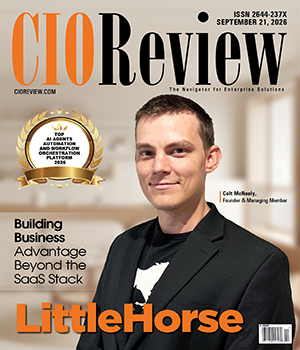
LittleHorse, recognized as the Top AI Agents Automation and Workflow Orchestration Platform 2026, helps enterprises manage complex business processes across SaaS applications, AI agents and teams. Its Business-asCode approach allows organizations to define and adapt workflows around the way they operate, while keeping automation structured, transparent and easier to manage.
Polywell Computers, recognized as the Computer Systems Manufacturing Company of the Year 2026, delivers specialized computing solutions for organizations with requirements beyond standard hardware. Its customized systems, lifecycle support and expertise in edge computing and AI workloads help customers address complex technology needs.
Vouched, recognized as the Top Identity Solutions for Humans and AI Agents 2026, is advancing digital identity verification by helping organizations establish trust across people, digital credentials and AI agents acting on behalf of users.
Numantic Solutions, recognized as the Top AI-Powered Strategic Data Solutions 2026, helps organizations build stronger AI foundations through data engineering, automated pipelines and domain expertise.
OptiCloud, recognized as the Top Cloud Optimization & Sustainability Platform 2026, helps organizations identify inefficiencies across cloud and AI environments. Its platform combines AI capabilities with human expertise to uncover optimization opportunities and improve resource utilization.
The edition also features Andrew Dennis, Director of Data and Analytics at Aperture Investors, recognized among the Top 10 Directors of Data Analytics 2026, and Christian Moreno, Director, Data & Analytics at Encore, recognized among the Top Directors of Data Analytics 2026. Their perspectives explore how trusted data, analytics and strong decision-making frameworks are helping organizations create greater business value.
The issue also includes Carlos Martin Soriano, Director of IT, Applications & Business Intelligence at RectorSeal, whose Leadership Perspective examines AI’s role in M&A due diligence and systems integration.
Together, these companies and leaders show how technology is becoming a strategic advantage for modern enterprises. We invite you to explore the edition and the ideas shaping a more intelligent and adaptable future.
